OSAsleep
In cooperation with
TNO, Dutch Sleep Apnea Association (ApneuVereniging) and Zaans Medisch Centrum
Improving monitoring of treatment response in obstructive sleep apnoea through continuous multimodal data collection and patient-centred digital measures that capture real-world therapy effectiveness in daily life.
The challenge
OSA is a chronic condition in which repeated breathing disruptions fragment sleep, leaving many people with non-restorative sleep, daytime sleepiness, fatigue, and cognitive difficulties, alongside increased long-term health risks. With close to one billion adults affected worldwide and prevalence rising, the need for effective monitoring and follow-up is growing.
For years, the clinical “gold standard” has been the AHI, but a single AHI value cannot fully reflect how patients feel and function, and the condition varies widely among individuals.
Positive airway pressure (PAP) therapy can generate detailed device readouts, yet they often still fall short of answering the practical question that patients and clinicians have: is treatment improving day-to-day health? For non-PAP therapies, such as mandibular advancement devices, hypoglossal nerve stimulation or positional therapy, objective monitoring is very limited or absent, so therapy adjustments and outcome assessment rely heavily on symptoms and trial-and-error based on subjective experience.
The study
TNO is conducting a single-centre, observational mixed-methods feasibility study in patients starting continuous positive airway pressure (CPAP) or mandibular advancement device (MAD) therapy. This innovative study design places patients at the heart of the research process, recognising that meaningful digital measures must be both scientifically rigorous and relevant to those who use them in daily life.
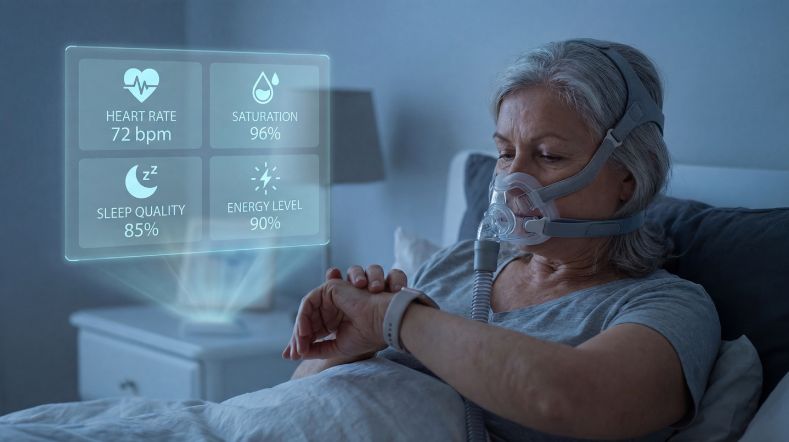
Continuous physiological data are collected using medical-grade nearable and wearable devices, providing objective measurements of a range of health metrics including sleep, AHI, snoring, cardiac , and physical activity. These data are complemented by daily ecological momentary assessments that capture real-time patient experiences in their natural environment. Quality-of-life patient-reported outcome measures (PROMs) assess broader wellbeing impacts, completing a comprehensive picture of treatment response that extends beyond purely physiological metrics.
A distinctive feature of this study is the active involvement of patients as part of the study team, ensuring that the research addresses their priorities and concerns from the outset. Feedback on personal health data reports is included as a primary endpoint, recognising that digital measures must be meaningful and actionable for patients themselves, not merely data points for clinicians. This co-creation approach helps ensure the resulting tools are adopted and valued in real-world settings.
Looking to the future
TNO is setting up a European pre-competitive public–private consortium that unites clinicians, industry partners, patient organizations, and scientific advisors around a shared challenge: moving the field towards the development of validated, patient-centered digital outcome measures that extend beyond AHI and enable structured, real-world assessment of treatment effectiveness.
Future work will focus on expanding the study to multiple centres, validating predictive algorithms to identify patients at risk of treatment failure, and exploring how personalised feedback can enhance treatment adherence. Collaboration with device manufacturers, healthcare providers, and patient organisations will be essential to ensure widespread adoption and a sustained impact on patient outcomes.
Digital monitoring solutions
Interested in digital monitoring solutions for sleep disorders or participating in validation studies? Contact us to explore collaboration opportunities.
Contact us
-

Annika van Rosmalen
Functie:Business Developer-
Standplaats:Leiden - Sylviusweg
-
Email:Email Annika
-
LinkedIn:Annika on LinkedIn
-
-

Kristel Kamstra
Functie:Scientist IntegratorMy expertise is in designing, conducting, and coordinating clinical (validation) studies across various healthcare domains. I have experience with remote patient monitoring, using various wearables, connecting partners, and all operational aspects of valid clinical study execution. Contact me for clinical study design and coordination.
-
Standplaats:Leiden - Sylviusweg
-
Email:Email Kristel
-
-

Nina Haring
Functie:Scientific Consultant Digital Biomarkers‘Trustworthy digital biomarkers are not designed for patients, but with them — from the first question to real-world use. Contact me for patient-centric digital biomarker development, combining patient engagement with real-world validation studies to generate reliable insights for healthcare decision-making and evidence generation.’
-
Standplaats:Leiden - Sylviusweg
-
Email:Email Nina
-
Get inspired
Beyond the breath count: patients want meaningful digital metrics in sleep apnoea monitoring
DIMPLAD: Empowering early recognition of Alzheimer’s with user-centered digital solutions
IBDigital Project Starts at ECCO Conference in Berlin

How can AI help reduce pressure on our healthcare system?

Health applications