TNO to design adaptive secondary mirror for Keck Observatory
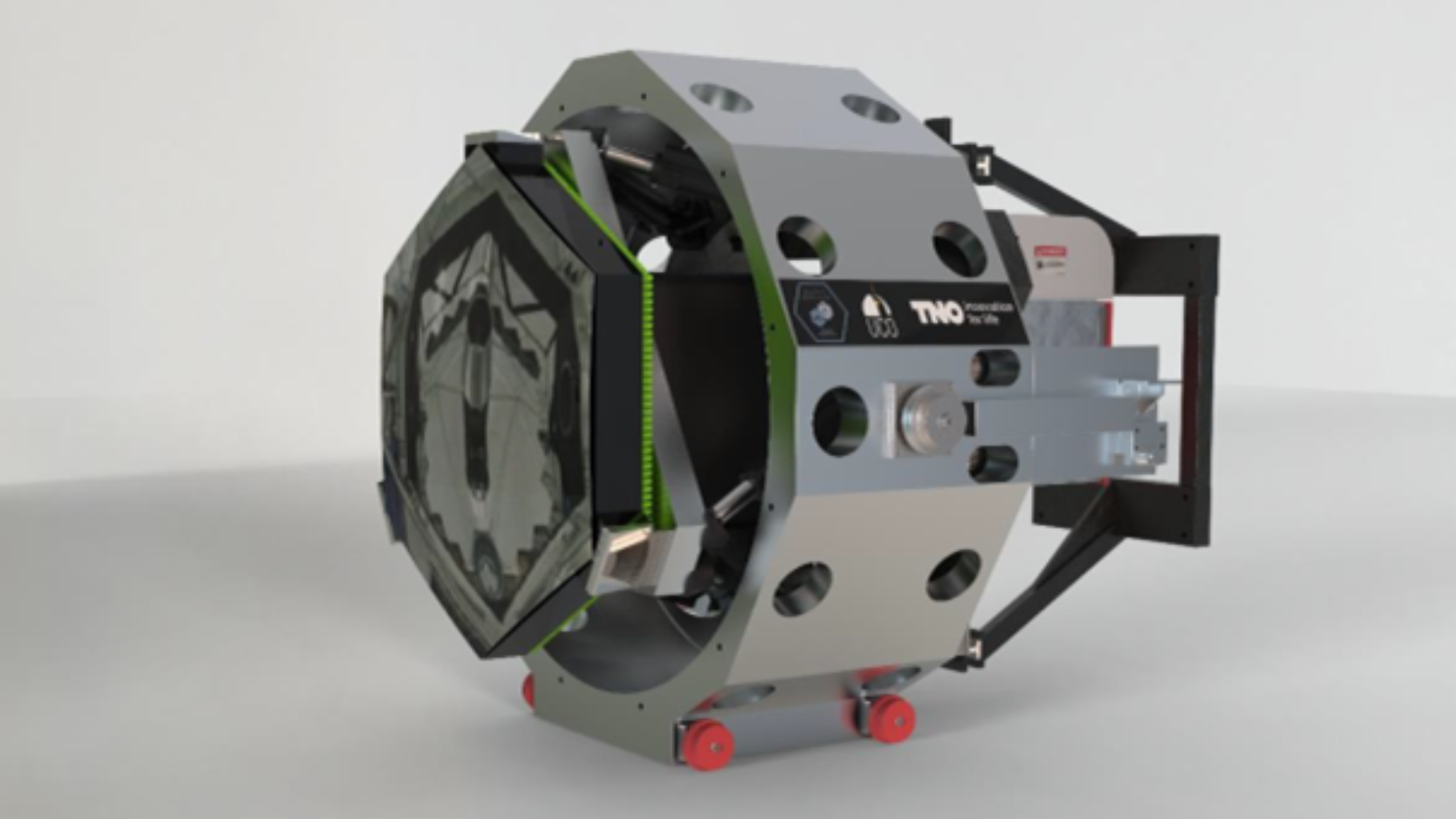
TNO has signed its first contract with the W. M. Keck Observatory to initiate the design of Keck’s Adaptive Secondary Mirror (ASM). This mirror will use TNO’s patented Hybrid Variable Reluctance (HVR) technology to improve the view of the Keck Observatory on Maunakea, Hawaii, 4,145 meters above sea level. The project is a collaboration with the Keck community, including the Keck Observatory, the University of California, Caltech, NASA, and the University of Hawaiʻi.
New step in astronomical research
For more than three decades, astronomers using Keck Observatory have vastly expanded our understanding of the universe through astonishing discoveries about our solar system, exoplanets, supermassive black holes, and more. The two, 10-meter optical and infrared telescopes feature a suite of advanced instruments including imagers, multi-object spectrographs, high-resolution spectrographs, integral-field spectrographs, and world-leading laser guide star adaptive optics systems.
‘Adding an adaptive secondary mirror using TNO’s innovative actuator design to Keck Observatory will greatly enhance the science we can do on Maunakea with every one of our existing and future Keck I instruments.’
More detailed observations
The telescope’s view will improve significantly with TNO’s high-density ASM. The captured images will rival those of the Hubble and James Webb space telescopes. By correcting atmospheric distortions, an Adaptive Secondary Mirror for the Keck telescope enables higher-resolution images and more sensitive observations, especially when infrared and eventually visible light are involved. This allows for more detailed studies of distant galaxies, black holes, exoplanet atmospheres, and the solar system. It also increases the observatory’s efficiency by reducing the need to wait for optimal conditions.
‘Adding an adaptive secondary mirror using TNO’s innovative actuator design to Keck Observatory will greatly enhance the science we can do on Maunakea with every one of our existing and future Keck I instruments,’ explained Antonin Bouchez, Head of Adaptive Optics Development at Keck Observatory. ‘Thanks to this partnership with TNO, this adaptive secondary mirror will play a key role in keeping Keck Observatory contributing to humanity’s understanding of the universe for decades to come.’
About TNO
The Netherlands Organization for Applied Scientific Research (TNO) has many years of experience in developing innovative technologies for leading astronomical observatories. TNO has worked on delay lines, precision support for mirrors, and laser launch telescopes for the European VLT and ELT telescopes in the Southern Hemisphere. They collaborate with industrial partners such as VDL and Demcon and knowledge institutions such as NOVA.
About the W. M. Keck Observatory
The W. M. Keck Observatory telescopes are among the most scientifically productive on Earth. The two 10-meter optical/infrared telescopes atop Maunakea on the Island of Hawaiʻi feature a suite of advanced instruments including imagers, multi-object spectrographs, high-resolution spectrographs, integral-field spectrometers, and world-leading laser guide star adaptive optics systems. Some of the data presented herein were obtained at Keck Observatory, which is a private 501(c) 3 non-profit organization operated as a scientific partnership among the California Institute of Technology, the University of California, and the National Aeronautics and Space Administration. The Observatory was made possible by the generous financial support of the W. M. Keck Foundation. The authors wish to recognize and acknowledge the very significant cultural role and reverence that the summit of Maunakea has always had within the Native Hawaiian community. We are most fortunate to have the opportunity to conduct observations from this mountain. For more information, visit the website.
Header picture: Twin telescopes Keck I and Keck 2 with their ‘eyes’ open. Credit: W. M. Keck Observatory/Ethan Tweedie.
Contact us
-

Matthew Maniscalco
Functie:Senior Business Developer-
Standplaats:Delft - Stieltjesweg
-
Email:Email Matthew
-
LinkedIn:Matthew on LinkedIn
-
Get inspired
Sentinel-5: ultra-precise satellite data for a healthier future
Optics
Time setter story: Max van Strien

TNO technology selected for Secondary Mirror of W. M. Keck Observatory

Time setter story: Benjamin Brenny