HyFINE: Pioneering sustainable routes for specialty and fine chemicals
The chemical industry is facing a major challenge: reducing its dependence on fossil feedstocks while meeting ambitious climate targets. Specialty and fine chemicals – essential for pharmaceuticals, advanced functional materials like coatings, plastics, fragrances, flavouring agents and battery materials – are currently produced through fossil-based processes. These methods contribute significantly to CO₂ emissions and make supply chains vulnerable to global fossil market fluctuations.
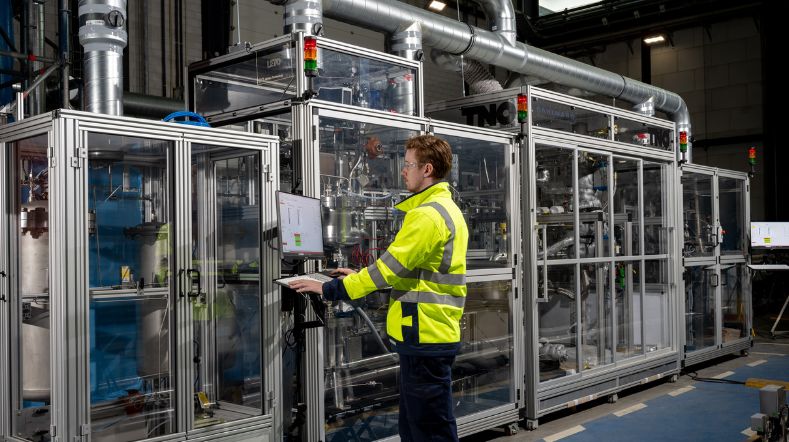
In the HyFINE project coordinated by TNO, the partners will address this challenge by developing new, fossil-free production routes based on green electrons and residual streams such as biomass and waste.
This innovation is crucial for creating a resilient, competitive and climate-neutral chemical sector in the specialties and fine chemical domain
Research into fossil-free chemistry underway
The Dutch research programme HyFINE is developing entirely new, sustainable processes for producing specialty will be chemicals. These include key building blocks for coatings, paints, polymers, cosmetics and advanced materials for electronics.
The programme focuses on replacing fossil feedstocks with green hydrogen, renewable electricity and residual streams such as biomass and waste.
Innovation for future-proof chemical processes
HyFINE runs for five years. More than one hundred researchers, engineers and specialists are working together to create technologies that will make the chemical industry circular and climate-neutral.
This includes new catalysts, innovative reactors advanced experimental methods and digital tools such as Machine Learning models to accelerate research. The programme will deliver over fifteen tangible technological results ready for further industrial development.
'HyFINE enables breakthrough technologies that replace fossil feedstocks with green hydrogen, renewable electricity and circular resources. This research is essential to make the chemical industry climate-neutral and competitive in a global market.'
Urgency and opportunities
The transition to sustainable chemistry is vital to meet Dutch and European climate targets. New processes based on green hydrogen and green electrons will significantly reduce CO₂ emissions and decrease dependence on fossil imports.
At the same time, new opportunities arise for industry, agriculture and start-ups: from converting waste streams into valuable chemicals to developing electrochemical and photochemical technology businesses.
Who should take note
HyFINE is particularly relevant for key stakeholders:
- Chemical manufacturers seeking fossil-free production routes
- Energy and hydrogen companies exploring integration with chemical processes
- Agricultural and biomass processors looking for new value chains
- Start-ups and technology developers in electrochemistry, photochemistry and AI-driven process design
- Policy makers and investors focused on accelerating the green transition
Collaborative innovation to replace fossil feedstocks with sustainable alternatives
HyFINE is powered by a strong public-private partnership with 15 Universities, Universities of Applied Sciences and Research and Technology Organisations, alongside 20 companies – from innovative start-ups to global multinationals. This collaboration ensures that scientific breakthroughs can be translated into scalable industrial solutions.
GroenvermogenNL consortium with funding from the National Growth Funds.
TNO focuses on scaling-up fossil-free technologies from lab to industry
Accelerating the market introduction of technologies that are climate-neutral, resilient and economically competitive is central to TNO’s contribution to HyFINE. By combining expertise in electrochemistry, catalysis and process design TNO develops robust and scalable processes that enable these fossil-free production routes.
This approach not only supports the industry and society in reducing CO₂ emissions but also strengthens economic resilience by creating competitive, future-proof processes.
As overall coordinator of HyFINE, TNO fosters collaboration and knowledge sharing, ensuring smooth progress throughout the four-year programme and paving the way for scalable, real-world implementation.
Contact us
-

Monalisa Goswami
Functie:Senior Business DeveloperMonalisa Goswami is a dedicated Senior Business Developer at TNO, specializing in the Power-2-Chemicals programme.
-
Standplaats:Rijswijk - Kesslerpark
-
Email:Email Monalisa
-
Get inspired
Fewer microplastics and higher yields in plastic recycling
Circular economy

Report: Drop-in solutions as an accelerator of biobased chemistry
New routes for sorting and composite separation
From lab to market: TNO steps up sustainable plastic recycling with dissolution