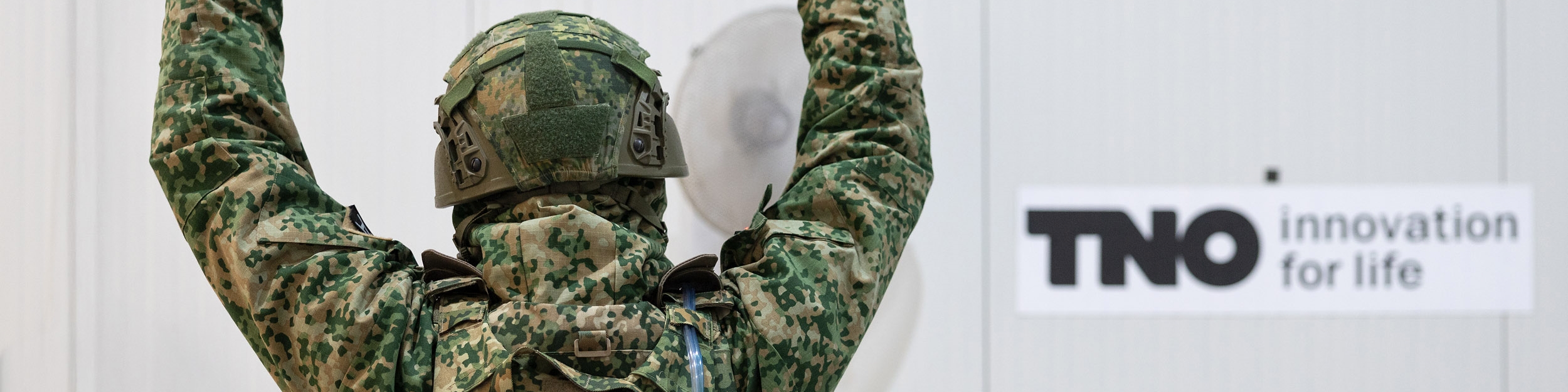
From CBRN laboratory to battlefield: International field trials with gas masks
Worldwide, the demand for advanced equipment that provides protection against chemical and biological weapons is growing. Despite international treaties prohibiting the development, production and use of such weapons, incidents involving their deployment continue to occur.
TNO’s Defence, Safety & Security (DSS) Unit supports the Netherlands Ministry of Defence with a broad technological foundation for protection against chemical, biological, radiological and nuclear (CBRN) weapons. This includes detection and warning systems, as well as decontamination and evacuation protocols. One of DSS’s recent projects focused on testing the combination of protective suits and gas masks under realistic operational conditions.
Esmée, project manager within the Protection, Munitions & Weapons division, explains the design and execution of these tests. In addition, Paul, head of the Protection and Contamination Countermeasures Group at Canada’s Defence Research and Development Centre, outlines the objectives of the Canadian delegation’s research and the methods they employed.
Research objectives and design
'When Defence began renewing its entire CBRN equipment a few years ago, TNO played a research and advisory role in selecting the new protective suits and gas masks,' Esmée begins. 'TNO has advanced facilities that allow us to handle biological and chemical substances safely, such as a High Tox Lab, an Aerosol Test Chamber and a Breeze Tunnel.'
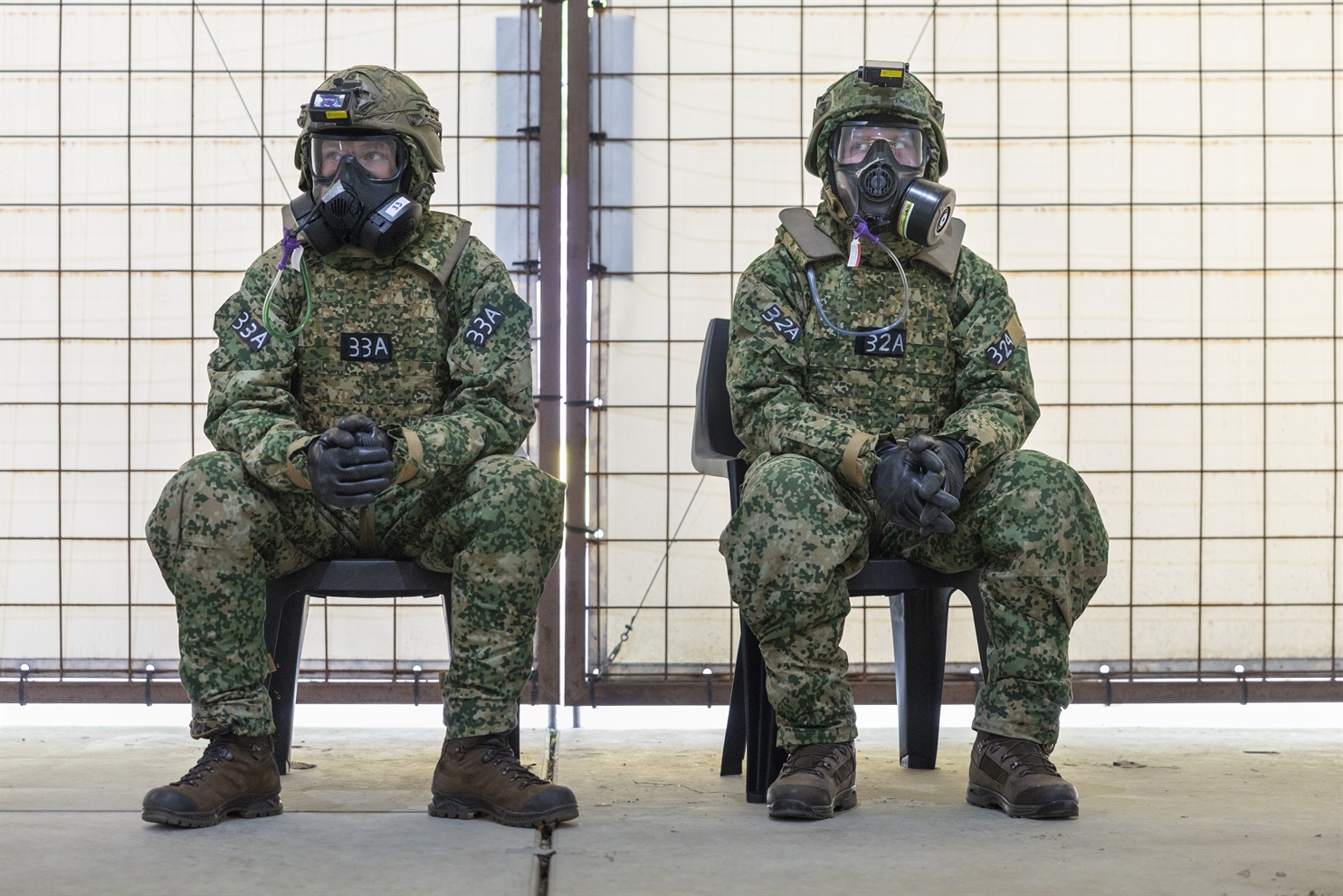
In addition to earlier individual laboratory tests, the full equipment including masks has now been tested as a combined system under realistic conditions. The aim of this field test was not to remeasure the level of protection, but to examine how the combination of suits, helmets, ballistic vests, gloves, and boots works together with the gas mask during physical activities. For example, are there weak points where components meet, or patterns that suggest existing usage protocols need adjustment?'
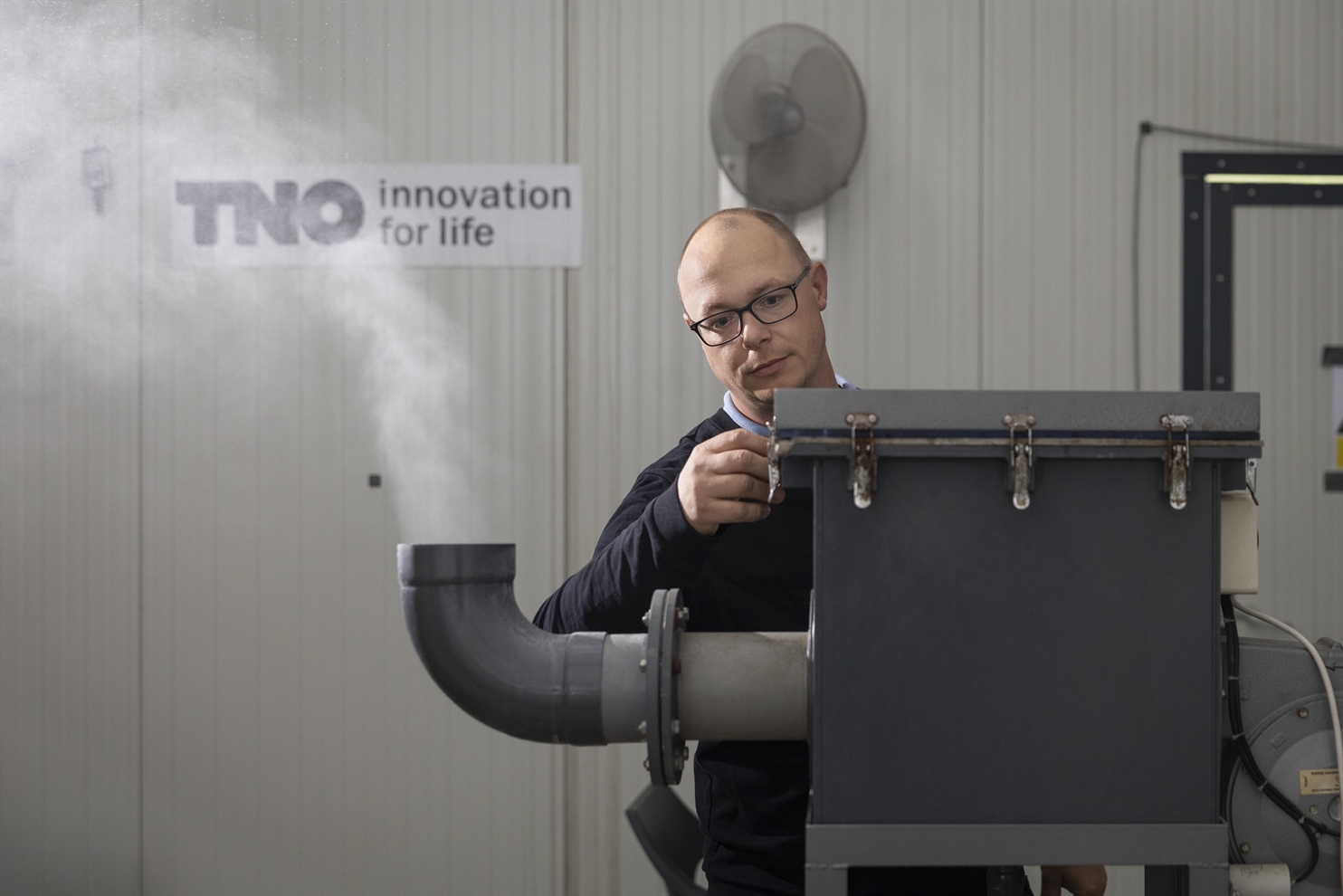
Salt particles for semi-natural measurements
'The Breeze Tunnel is an extremely suitable test facility for this type of research,' Esmée continues. “This unique wind tunnel enables exposure to test substances and is equipped with advanced sensor technologies. Its size allows us to simulate various real-life scenarios in which protective suits and gas masks can be tested.
For these tests, nanoscale salt particles (aerosols) were dispersed in the air under controlled conditions. These particles represent the size range of chemical and biological agents where the system is least effective. This way, we can safely perform particle measurements under semi-natural conditions.
Together with researchers from our Canadian partner, we defined a series of setups and activities representative of battlefield situations soldiers may encounter, such as running, climbing stairs, digging, jumping, shooting and dragging objects.'
'TNO has advanced facilities that allow us to handle biological and chemical substances safely, such as a High Tox Lab, an Aerosol Test Chamber and a Breeze Tunnel.'
Collaboration with Canada: focus on skin and respiratory protection
Paul, one of the Canadian scientists present, explains: 'While our Dutch colleagues mainly focused on the interface between gas masks and suits, our emphasis was on skin protection. We wanted to test the extent to which aerosols could penetrate the protective gear and reach the skin during physical exertion. This large-scale field trial in the Breeze Tunnel allowed us to combine our separate objectives into a joint study.'
During the field test, soldiers fully equipped with suits, masks, gloves, and boots performed various activities. Sensors were attached to different parts of their bodies. As they ran, jumped and overcame obstacles, the sensors recorded how many aerosols penetrated the protective gear and where on the body the risk was greatest. Helmet-mounted cameras enabled us to link aerosol counts directly to footage of each soldier’s physical movements.
Regarding the Dutch focus, Esmée adds: 'For the respiratory study, we used a new portable instrument called OmniCount, developed by TSI, a leading manufacturer of particle measurement devices. This device was mounted on the back and directly connected to the soldier’s mask, allowing us to measure aerosol concentrations inside and outside the mask in real time. Values were recorded every second, showing precisely if and during which activity the protection became less effective.'
'While our Dutch colleagues mainly focused on the connection of the gas masks to the suits, our attention was on skin protection.'
Valuable insights and areas for improvement
'The analyses we’ve conducted so far already provide highly valuable insights,' says Paul. 'For both Dutch and Canadian researchers. We see that certain movements or strenuous activities increase the risk of aerosols penetrating the protective gear. Touching the mask during a task or adopting certain postures can slightly shift the mask, potentially causing brief leaks that could be fatal in an operational military context. Thanks to the new wearable measurement equipment, we were able to determine this precisely for the first time.
The initial results are encouraging. The equipment offers good protection, but some areas for improvement emerged. That’s exactly why such realistic field tests are essential. In the lab, you can’t always see how gear behaves during physical exertion or in combination with other components.'
'The tests have been successful,' Esmée concludes. “They demonstrated that the combination of protective suits and gas masks works, and with additional insights, their use can be further optimised. Once all research data has been analysed, optimisations may involve adjusting usage protocols for CBRN situations, recommending mask sizing, changing how other gear is worn, or modifying certain actions.'
Future of CBRN research and international cooperation
'In addition to valuable data, the field test in the Breeze Tunnel also delivered a new testing methodology,' Esmée concludes. 'For the first time, we were able to measure in real time how respiratory and skin protection perform under realistic field conditions. These tests focused on individual equipment, but in future we aim to study complete operational systems, such as tanks or tents, in this controlled environment. TNO sees this as an opportunity to strengthen the Dutch armed forces and contribute to a safer operational environment for military personnel and emergency services worldwide.'
Paul adds: 'Both Dutch and Canadian Defence benefit from the collaboration between TNO and Canada’s Defence Research and Development Centre (DRDC). We expect to continue this partnership and knowledge exchange in the future, possibly involving our Swedish partners who attended as observers. The exact form is still unclear, but our ultimate goal is certain: to provide scientifically proven protection and ensure that soldiers and first responders receive the best possible gear so they can work confidently in hazardous conditions. We want them to return safely, whatever happens.'
Contact us
-

Frans van Gemerden
Functie:Director Protection, Munitions & Weapons-
Standplaats:Den Haag - Ypenburg
-
Email:Email Frans
-
Get inspired
State of Dutch Tech 2026: The Netherlands must dare to scale at a global level

ACROSS: Can adaptive camouflage help make soldiers invisible to enemy detection?
Time setter story: Mirjam de Bruin-Hoegée about chemical weapons
Time setter story: Anthia Solaki about human-machine teaming
ProQares rejoins TNO and strengthens testing capacity for CBRN protection