New routes for sorting and composite separation
Plastic waste streams are becoming more complex, and current sorting and recycling technologies can no longer keep up. These challenges are too large and too interconnected for any single company to solve. Therefore, the R&D Hub for Plastic Waste Processing of the Global Impact Coalition (GIC),led by TNO, brings partners together to research new, realistic technological routes. So that the sector can move towards more effective,scalable and future-proof recycling that strengthens Europe’s resource autonomy and earning capacity.
Advancing plastic recycling together
Since 2023, the R&D Hub has focused on core challenges shared across the plastics value chain that are addressed in three projects. In this article we focus on the first two:
- Recognising complex plastics that are currently missed in sorting.
- Separating thermoplastic composites into reusable components.
- Enhanced solvolysis for thermoset composite recycling.
Both projects 1 and 2 are critical for reducing waste, improving recyclate quality, and preparing the industry for upcoming legislation and societal pressure.
Industrial partners provide real-world samples, operational insights and market knowledge. TNO contributes scientific depth, modelling, testing capabilities and neutrality. This combination allows for open technical dialogues that are uncommon in a competitive industry.
'The programme allows us to openly discuss challenges with companies we normally see as competitors,' says Jaap den Doelder (DOW). 'That transparency accelerates learning and helps us focus on what is realistically achievable.'
'The programme allows us to openly discuss challenges with companies we normally see as competitors.'
Sensing for Sorting: identifying materials the sector currently loses
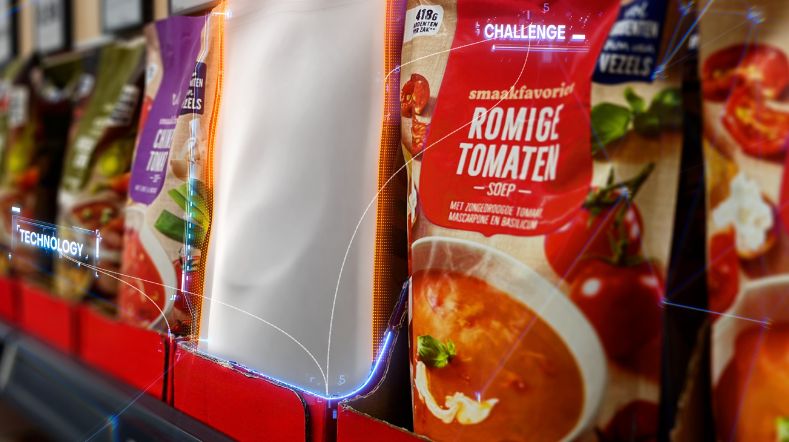
High-quality recycling starts with correct identification. Yet multilayer packaging, thin films and dark plastics remain difficult to recognise with today’s commercial sorting systems. These missed recognitions reduce sorting efficiency, reduce recyclate quality and limit the circular value.
The Sensing for Sorting project investigates how new sensing concepts and machine-learning models could improve future sorting lines. TNO evaluated a broad set of sensing technologies: some commercially available, others derived from sectors such as food, security or medical imaging, assessing their ability to detect complex materials.
Machine learning plays a key role, trained on over 400 partner-provided samples to interpret subtle signals and patterns.
'Machine learning helps us extract meaning from complex signals that traditional systems cannot interpret,' explains Véronique Barthelemy (TNO). 'It allows us to recognise material differences that are not visible to the human eye and that could make a real difference in future sorting lines.'
Industry partners recognise the urgency. 'The requirements on waste streams in recycling are evolving faster than sorting technology, especially with multilayer packaging,' says Bernhard von Vacano (BASF). 'Research like this helps us understand what could be possible in the next generation of identification systems, and what it will take to get there.'
While results remain exploratory, the findings identify promising routes that could help improve recognition accuracy, limit mis-sorting, reduce costs and strengthen Europe’s strategic autonomy in recycled materials.

'Research like this helps us understand what could be possible in the next generation of identification systems, and what it will take to get there.'
Thermoplastic Composite Separation: unlocking value from difficult materials
Thermoplastic composites are increasingly used in automotive, electronics and durable goods because of their strength and stability. But at end of life, their combined structure of polymers and fillers makes them difficult to recycle.
The Thermoplastic Composite Separation project explores technologies that can help separate these materials into valuable components. TNO assessed melt-filtration concepts capable of removing fillers at both millimetre and micrometre scale, and explored how external forces, including microwaves, superheated steam and CO₂, can support delamination before filtration.
'The challenge is not only to separate components, but to do so under conditions industry can realistically apply,' says Jeroen van Aart (TNO). 'That is why we look for routes that can be integrated into existing processing lines rather than require completely new infrastructure.' He emphasises that composite behaviour varies significantly. 'There is no single solution for all composites. What we are developing is a set of technological routes that companies can adapt to their own materials.'
Partners appreciate this grounded approach. 'If a solution cannot scale, it will not have impact,' says Den Doelder. 'The strength of this programme is that results are promising, but communicated realistically and carefully.'
These insights support future improvements in composite recycling, helping industry capture value currently lost in incineration, directly contributing to earning capacity and sustainability goals.
'Machine learning helps us extract meaning from complex signals that traditional systems cannot interpret.'
Neutral collaboration builds trust and progress
Across both projects, partners highlight the importance of honest, pre-competitive collaboration. The R&D Hub structure, combined with TNO’s independent role, allows organisations to share samples, data and lessons without competitive pressure.
'TNO’s neutrality creates a safe space for technical discussion,' says Von Vacano. 'It enables an openness that is rare in our industry across players and extremely useful when tackling shared challenges.'
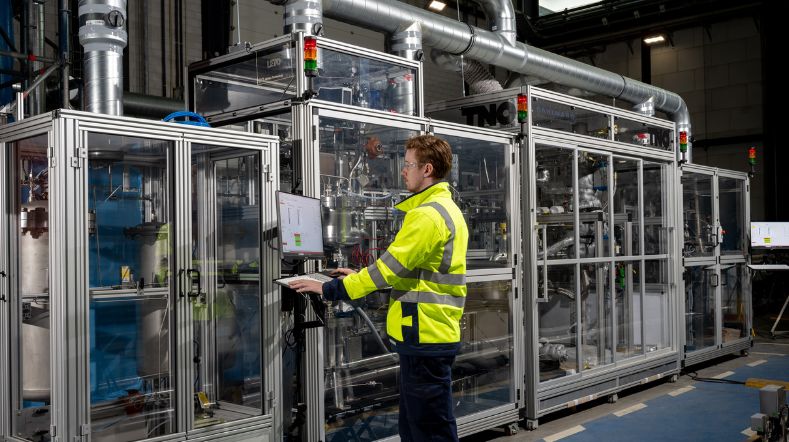
Research is carried out at TNO’s Polymer Solutions facilities in Eindhoven, where expertise in sensing, extrusion, material characterisation and machine learning is brought together. These TNO facilities enable rapid prototyping, controlled testing and realistic evaluation of potential solutions.
Towards more effective and scalable recycling
The insights from both research lines identify new technological directions that can strengthen Europe’s recycling infrastructure, reduce material losses and support a more circular plastics system. While further development is required before industrial implementation, the work delivers a shared foundation the sector can build upon.
If your organisation is interested in exploring how these sensing or separation routes could support your recycling roadmap, or if you want to learn more about pre-competitive collaborative research opportunities, we warmly invite you to get in touch. Together, we can take the next steps towards more effective and scalable plastic recycling.

'We look for routes that can be integrated into existing processing lines rather than require completely new infrastructure.'
Contact us
-

Hella Koops
Functie:Senior Consultant Circular Plastics and Industrial TransformationHella focusses on sustainable innovations and developing circular value chains in the plastics domain and chemical industry. With a strong background in engineering, technology scale-up and systems thinking, she is involved a.o. in the development of new plastics recycling technologies and scenario projections of the circular plastics- and materials transition.
-
Standplaats:Utrecht - Princetonlaan
-
Email:Email Hella
-
-

Peter Versloot
Functie:Senior Business Developer Circulaire PlasticsPeter Versloot brings technology and markets together to create sustainable solutions. As a Business Developer at TNO, he focuses on the plastics sector, with expertise in Microplastics and Circular Plastics Modelling.
-
Standplaats:Eindhoven - High Tech Campus 25
-
Email:Email Peter
-
LinkedIn:Peter on LinkedIn
-
Get inspired
Fewer microplastics and higher yields in plastic recycling
CRM materials and processes

From lab to market: TNO steps up sustainable plastic recycling with dissolution
Webinar: Biobased plastics in a sustainable future
Progress in circular packaging for soups and sauces