
Time setter story: Maaike de Boer about hybrid AI
This is the time when innovation is crucial. To make our world safer, lives healthier and combat climate change. ChatGPT, Copilot, Gemini, Midjourney… AI has become hugely popular in no time. But how much can we really trust these tools? TNO employees make their mark on our time. In this series, we share stories of our time setters. Senior data scientist and nominee for the Young Excellent Researcher Award 2025, Maaike de Boer has been researching trustworthy and transparent AI at TNO for years.
Hybrid AI
'I research how we can use AI in a trustworthy way. I do this through hybrid AI. The famous psychologist Daniel Kahneman argues that humans have two ways of thinking: fast, intuitive thinking and slow, deliberate thinking. Our brains work best when both are combined. And that’s exactly what hybrid AI does: it combines fast and slow thinking.'
'The fast thinking is data-driven, and for that I mainly use language models. The slow thinking is knowledge-driven, and for that I use or develop ‘knowledge graphs’. These help computers add meaning to data using structured, up-to-date knowledge, enabling smarter searches and making connections. When you combine data-driven and knowledge-driven models, you get far more trustworthy and intelligent outcomes than with non-hybrid AI.'
Disease or system failures?
'With hybrid AI, we can achieve spectacular things. Think of improving disease diagnosis (together with doctors), enhancing decision-making in high-stakes domains, or predicting system failures. One area where hybrid AI is already making an impact is the labour market. It’s tight and changing rapidly. Diplomas and CVs are no longer the best way to find the right candidate; it’s increasingly about skills. I’ve built a model that matches skills, helping job seekers and employers connect more effectively in the future.'
Making significant difference
'I’m proud of the difference I can make. AI is currently dominated by Big Tech, which still focuses almost exclusively on data-driven AI - the fast thinking. Whereas I’ve been working on hybrid AI for 12 years. I’m also proud that there’s now an entire team working on my research. And that I’m part of a unique collective: the Hybrid Intelligence Centre, a collaboration between seven universities.'
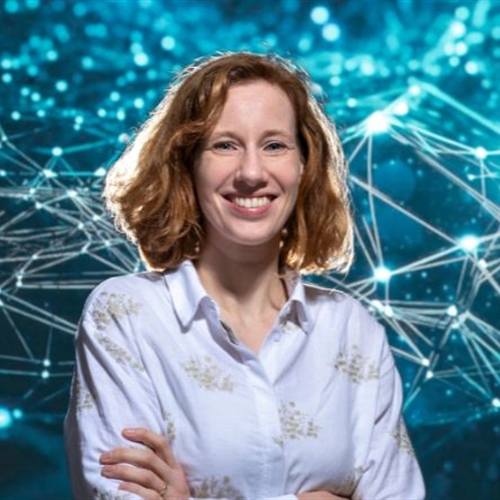
'The challenge is to make people realise they shouldn’t rely solely on data-driven AI, but also need knowledge-driven AI.'
Knowledge-driven AI
'Getting people to understand that they shouldn’t just use data-driven AI, but also invest in knowledge-driven AI. Right now, the world is captivated by generative, data-driven AI. Everyone wants to jump on the bandwagon quickly. In that rush, there’s sometimes too little attention for the shortcomings of current models. They simply make statistical predictions but cannot truly understand. As a result, they sometimes give wrong answers, produce inconsistent results, or fail to explain the basis of their answers. Hybrid AI can reason based on knowledge rather than just data, making it far more robust and reliable.'
Collaborating
'The great thing about my work is that I get to collaborate with so many people. On the one hand, I work with peers: professors and other AI experts. On the other hand, I work in multidisciplinary teams with TNO colleagues from different units. I learn a lot about their domains and how AI can help—whether it’s the labour market, healthcare, or Dutch law. All these collaborations are not only enjoyable but also highly educational.'
Hybrid AI is the future
'My message to everyone who wants to invest in AI: go for it! But don’t rush, cutting corners and ending up reinvesting in a few years. Take a breath, don’t get swept up in the hype, and focus on hybrid AI. That’s the future.'
Time to innovate in AI. Become a time setter too
Get inspired
Appl.AI Splash: Challenges unlocked
Balancing skepticism and blind trust: critical thinking as the key to responsible and effective use of GenAI
From reactive to proactive: How organisations gain control over GenAI governance

How TNO is leading the drive towards sovereign, responsible Dutch AI
TNO’s vision for responsible AI that works