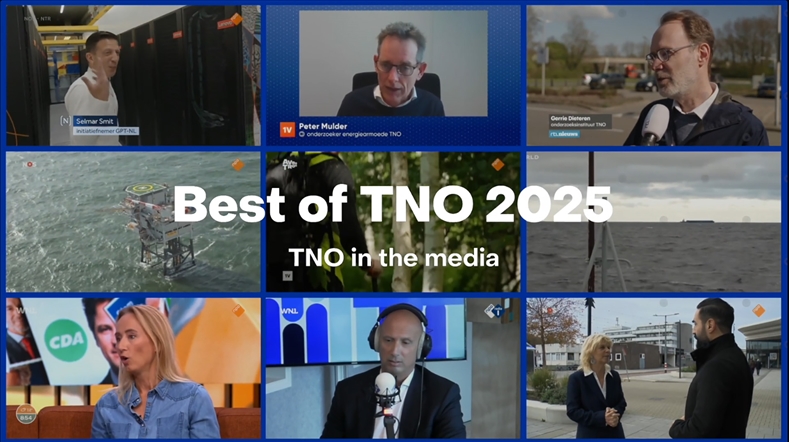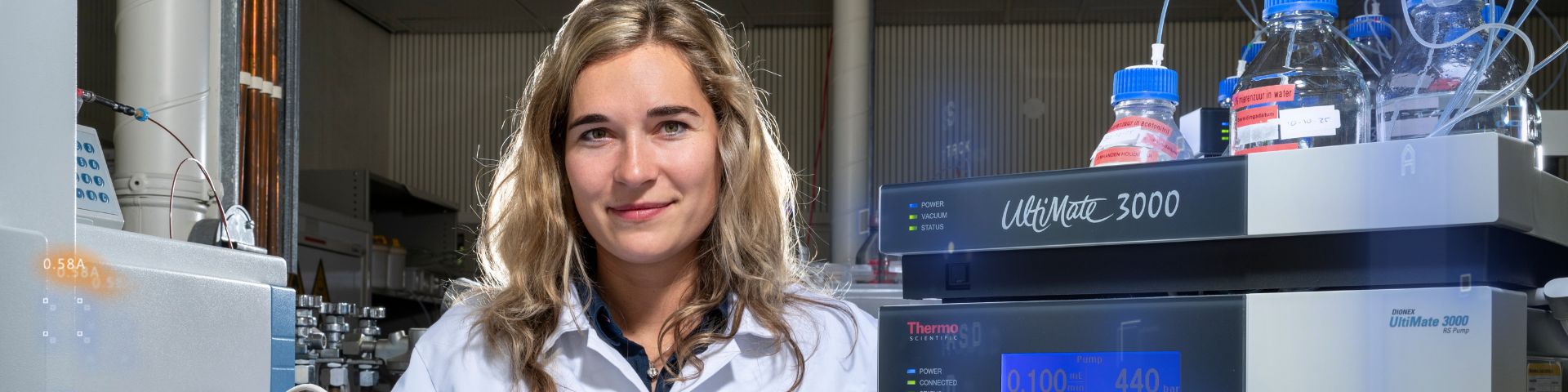
Time setter story: Mirjam de Bruin-Hoegée about chemical weapons
This is the time when innovation is crucial. To make our world safer, lives healthier and combat climate change. Chemical warfare agents have been deployed more than 9,000 times in Ukraine, according to the AIVD and MIVD earlier this year. Yet proving what exactly happened afterwards is often difficult. TNO employees make their mark on our time. In this series, we share stories of our time setters. Forensic researcher and winner of the Young Excellent Researcher Award 2025, Mirjam de Bruin-Hoegée developed new methods to trace chemical weapons - months after their use. Already a global impact.
Origin chemical weapons
'I’m investigating whether the origin of chemical weapons can be determined using forensic methods. For explosives or drugs, we’re already much further along, but for chemical weapons, that knowledge is still lacking. I mainly focus on situations where you don’t find a full grenade, but only tiny traces. For example, when people have been poisoned and all you have is some blood. Or when you can only enter a war zone later and all that’s left are plants or chunks of concrete. I find it fascinating to figure out what can still be deduced from that.'
Best medical care immediately after exposure
'Sadly, chemical attacks still occur regularly. That’s why I felt this needed to be proven more effectively. Not only to identify who was behind it afterwards, but also to provide the best medical care and protective equipment immediately after exposure. The unique aspect of this research is that we found stable biological indicators in both blood and plants. These can point to chemical exposure even months later.'
'These insights can already be applied worldwide. TNO is one of nearly 30 laboratories that can be called upon by the Organisation for the Prohibition of Chemical Weapons in The Hague to conduct investigations after an attack. Our plant-based method has now been included in a handbook of guidelines for this type of research, enabling other labs to use it too.'
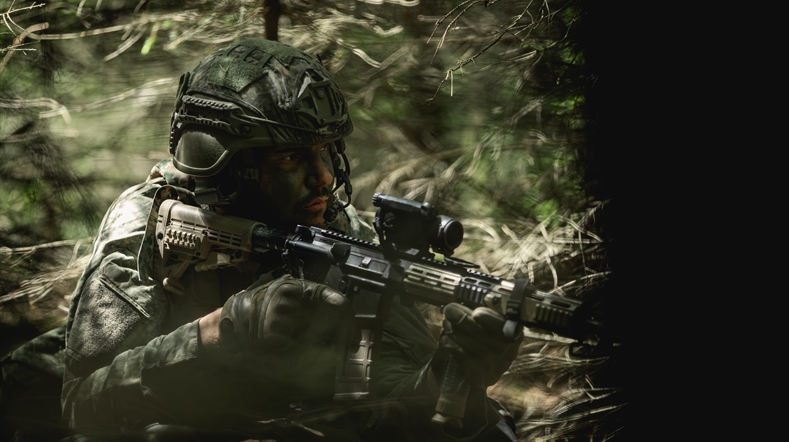
'Looking ahead, I want to take the techniques I developed for the lab into the field. So that soldiers can immediately test: have I been exposed? For nerve agents, TNO has already conducted research in this area. But for substances like chloropicrin, we still know very little. Ideally, soldiers will soon receive an automatic alert from a sensor if they’ve been exposed—just like someone with diabetes gets a notification when their blood sugar is low.'
International collaboration
'That we were able to build truly new methods with a very diverse group of people. Colleagues within TNO, the Netherlands Forensic Institute and international partners all brought unique perspectives to the research. As a result, many different aspects were incorporated into the experiments. There was quite a bit of scepticism about whether such tiny amounts of markers could be measured in blood, but with a few enthusiastic colleagues, we went for it anyway.'
'The international collaboration was also remarkable. I spent three months in the United States researching the traceability of materials used to disperse chemical substances—such as drones or improvised explosive devices.'
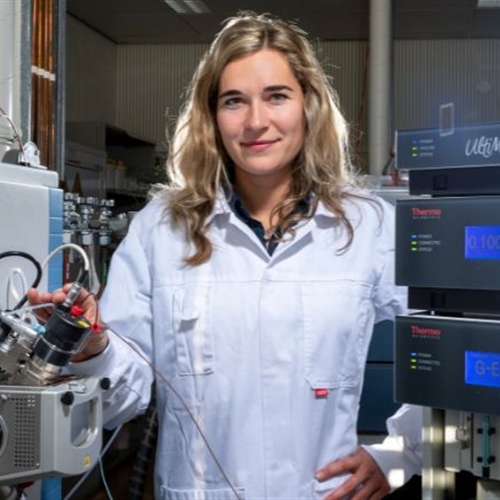
'Ideally, soldiers will soon receive an alert when exposed, just like someone with diabetes gets a warning when their blood sugar is low.'
Realistic research
'One of the biggest challenges was how to research this realistically. You can’t, of course, test toxic substances on real people. So we did a lot of in-vitro research using blood from, for example, Sanquin, and simulated exposure in the lab. With plants, we could replicate scenarios: we placed a live plant in a glass chamber and exposed it to chemical warfare agents under controlled conditions. Then we examined the proteins in plants, which resemble those in human blood.'
Collaborating
'We work closely with TNO Health & Work in Leiden and High Tech Industry in Eindhoven. Also with colleagues in Utrecht, particularly the Environmental Modelling, Sensing & Analysis department, as they often characterise fine dust and perform lab analyses similar to ours. And we collaborate across all divisions of the Defence, Safety & Security (DSS) unit. In fact, there are quite a few different departments I work with - and given the topic, there could be even more.'
Preventively contributing to a safer world
'I think it’s wonderful to contribute to a safer world—and ideally, to do so preventively. Because better detection hopefully discourages the use of chemical weapons.'
'These are also the things that motivate me in my work as a reservist with the armed forces and as a volunteer with the Red Cross, where I give guest lectures on international humanitarian law. In the military, I see many practical challenges. For example, if a soldier puts on a gas mask, the filter can obstruct aiming a weapon. Then you have to choose between protection against gas or bullets. I find those kinds of challenges very interesting.'
Time to innovate in safety. Become a time setter
Get inspired
State of Dutch Tech 2026: The Netherlands must dare to scale at a global level
ACROSS: Can adaptive camouflage help make soldiers invisible to enemy detection?
Time setter story: Anthia Solaki about human-machine teaming
ProQares rejoins TNO and strengthens testing capacity for CBRN protection

TNO in the media 2025