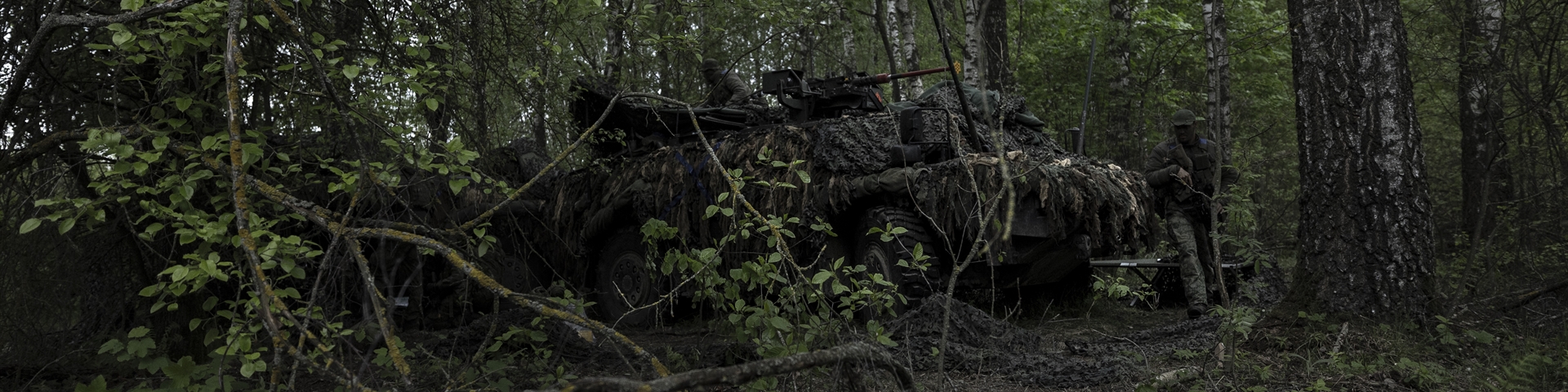
ACROSS: Can adaptive camouflage help make soldiers invisible to enemy detection?
Thanks to TNO’s support, the Dutch Ministry of Defence is becoming a global leader when it comes to rapid advances in military detection technology. At the same time, TNO is also working on the exact opposite: preventing detection. In the European Defence Fund’s ACROSS (Adaptive Camouflage foR sOldierS and vehicleS) project, TNO is working with 17 European partners to produce adaptive, multi-spectral camouflage materials that make soldiers and equipment virtually invisible to enemy detection.
Maarten is a researcher from the Human Performance department at TNO’s Defence, Safety & Security unit. Giampiero is a principal scientist at TNO’s Optics department. Here, the two discuss the state-of-the-art techniques being developed in this project.
The tactical importance of camouflage
‘Having the right camouflage on the front line can make a huge difference. If our soldiers are able to detect and locate an enemy while remaining undetected themselves, that gives them a tactical advantage,’ Maarten explains. ‘However, this is becoming more and more difficult. Not too long ago, we could send a sniper or a spotter out in a “ghillie suit” (camouflaged clothing that uses natural-looking materials such as leaves to make a soldier blend in almost entirely with their surroundings), but we can’t get away with that anymore.’
‘It’s increasingly difficult now to operate without detection not just because of satellites, which have become more advanced, but also because of drones, which are relatively simple and inexpensive to make,’ he continues. ‘Small, manoeuvrable drones equipped with one or more detection systems can reach all kinds of areas and situations without putting anyone in immediate danger, pass on intel and even spot a well-camouflaged soldier. That’s why we at TNO are constantly working on new techniques to counter detection, so that our soldiers are able to remain invisible for longer.’
Visibility vs invisibility
‘To be invisible, you first need to know how enemies can make you visible,’ Giampiero explains. ‘In addition to acoustic systems, there are roughly three types of detection systems that use specific electromagnetic waves to detect soldiers, vehicles, and other equipment. One of the most commonly used systems is radar, which transmits an electromagnetic wave in the form of a narrow beam. An object is detected when that beam bounces off it.
As well as radar, there are infrared sensors ‒ the most common being heat cameras, often referred to as thermal infrared. These sensors can detect anything that emits heat (i.e. infrared radiation), such as people, vehicles, and machines. Finally, there are optical detection systems that use light to produce highly accurate images from a long distance to detect military bases or activities.’
Manipulating electromagnetic waves
‘Electromagnetic waves are all around us,’ Giampiero continues. ‘Look around you: we can see light, which has wavelengths measured in nanometres (roughly from 380 to 780 nanometres, with one nanometre being one billionth of a metre).
When you listen to an FM radio station, the sound is brought to you by electromagnetic waves transmitted by the radio station. These can travel up to hundreds of kilometres before being picked up by your radio antenna. The systems in your radio then convert them into audible sound waves.
But when you wear sunglasses, bright sunlight is filtered into softer light, making it more difficult to distinguish between certain colours. And if your radio antenna doesn’t receive the wave correctly, all you may hear is static. By changing how the electromagnetic waves are dispersed or reflected, what’s being transmitted can be perceived differently: its signature can be changed.’
Multi-spectral measurement and response
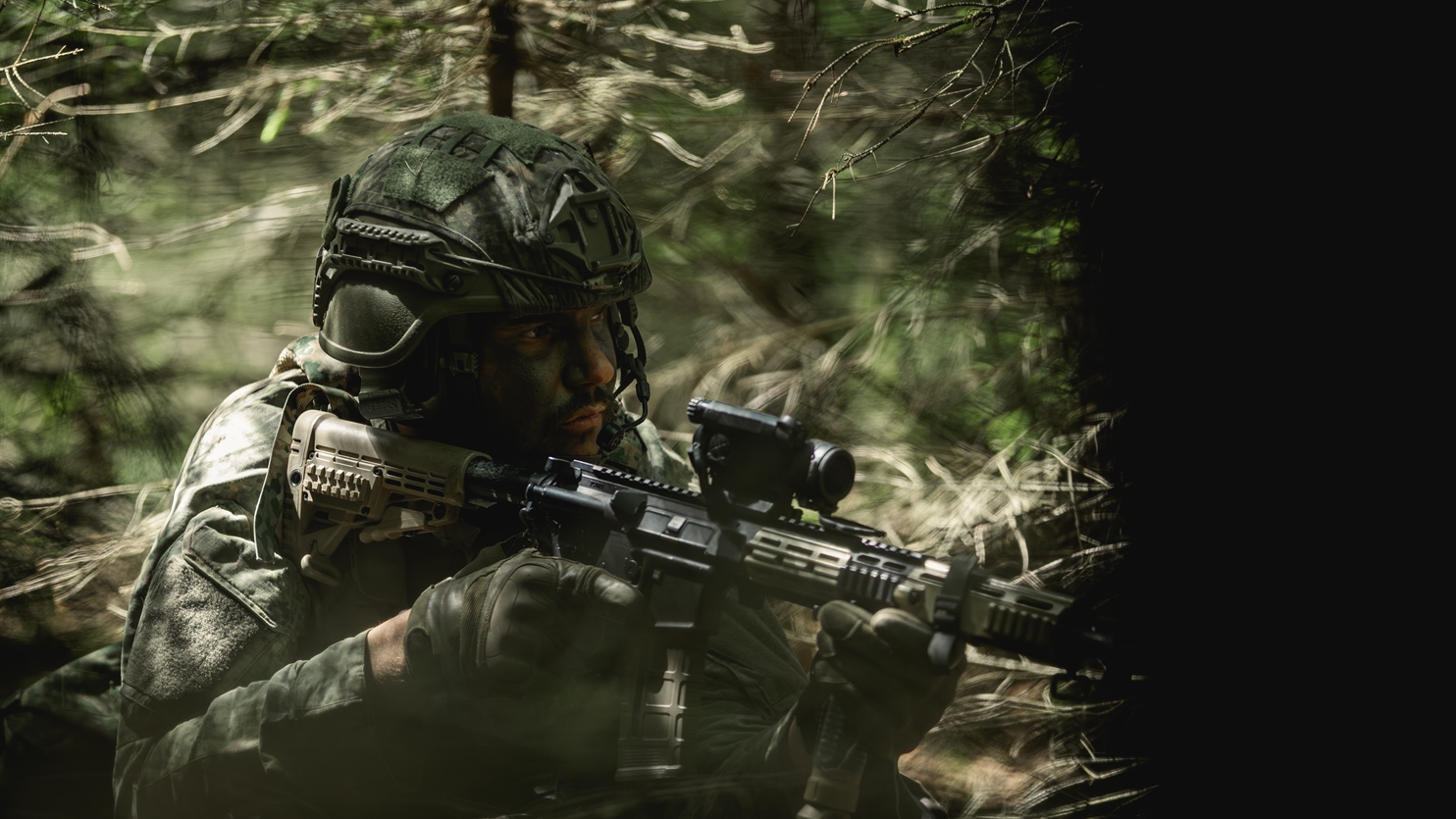
‘Camouflage is all about reducing or changing an object’s signature, so that detection systems are unable to perceive the object as it really is,’ Giampiero explains. ‘If soldiers were to walk through the forest wearing orange overalls, their colour, shape, and manner of movement (i.e. their signature) would make them clearly recognisable as soldiers. But if they wear camouflage suits in colours that blend in perfectly with the forest environment, they’re hardly noticeable. Our technology does the same thing, but automatically and across all relevant areas of the electromagnetic spectrum.
By harnessing this technology, we can develop camouflage systems that use sensors to perceive the environment around an object on multiple spectral ranges – not only at the optical level, but also in the ranges of radar and infrared waves. With the data thus obtained, the camouflage system is able to respond multi-spectrally, automatically adapting to the environmental conditions in real time. Ideally, the camouflaged object will adopt the same signature as its surroundings, essentially making it undetectable.’
The future of adaptive camouflage: metasurfaces
Giampiero continues explaining his specialist approach. ‘One promising approach to achieving this adaptive camouflage is by using metasurfaces and metamaterials. Metasurfaces are ultra-thin, artificial surfaces that can manipulate electromagnetic waves in a controlled way. We attach a metasurface to an object so that when electromagnetic waves hit that metasurface, they can be dispersed or reflected in a different way to reduce the object’s signature.
In practice, this means we’re able to manipulate electromagnetic waves to “trick” enemy detection systems. The systems will detect a different radar echo intensity, colour, shape, or temperature. If these are exactly the same characteristics as those of the object’s environment, the system won’t detect anything, and we’ll have achieved what we set out to do.’
Metasurfaces in more detail
Metasurfaces are ultra-thin surfaces that can manipulate electromagnetic waves – such as light, radio waves, or microwaves – in a controlled and often unusual way. They consist of a grid of sub-wavelength structures, known as meta-atoms, which are much smaller than the wavelength of the incoming signal. By adjusting the shape, size, arrangement, and material type of these meta-atoms, it is possible to determine precisely how the metasurface behaves in relation to incoming radiation.
Unlike traditional materials that manipulate electromagnetic waves through their thickness and refractive index, a metasurface works by abruptly varying the characteristic parameters of the wave, such as amplitude, phase, and polarisation. This allows an inbound electromagnetic wave to be controlled using thin surfaces that can be even smaller than the operating wavelength. This makes it possible to adjust an inbound electromagnetic wave’s properties, such as direction, polarisation, frequency, and amplitude, in real time and at a sub-wavelength level.
The innovation behind metasurfaces is partly inspired by nature, taking an example from the feathers of such species as peacocks and hummingbirds. The colours we see on their feathers are not the result of pigment, but are caused by the microscopic structures on the feathers. These structures manipulate light through interference, diffraction, and disruption of light waves. This means that the colours change depending on the angle they are viewed from, for example from dark to bright blue and turquoise to light and dark green. Metasurfaces are capable of mimicking and refining this effect in different parts of the electromagnetic spectrum.
Metasurfaces have a variety of uses:
- Optics and photonics: for developing very thin and easily integrated optical components – such as flat lenses (meta lenses), filters, and polarisers – to replace traditional, bulkier components.
- Communication and detection: for improving wireless signals by controlling how radio waves are reflected in urban environments, using passive, intelligent reflective surfaces.
- Imaging: for more complex forms of smart imaging in medical scanners or drones, for example by simultaneously using different parameters such as frequency and polarisation in very compact cameras/sensors.
Challenges of metasurfaces in practice
‘The next phase in developing metasurfaces for camouflage is the testing phase,’ adds Maarten, drawing on his expertise. ‘Demo models of vehicles or suits with these technologies integrated into them are being developed precisely for this purpose. During testing, we’ll be looking not only at the ability to avoid detection, but also at practical aspects: is the suit too heavy? Does it overheat the person who’s wearing it? Are batteries required? And if so, can they be used in the field?
Another challenge we’ve come across with this technology is preserving that adaptive camouflage while the soldier or vehicle is moving, as their surroundings are constantly changing. To achieve this, the sensors need to measure and process data and then send the correct response to the material – all at lightning speed. This is technically feasible when moving slowly, but becomes more complicated at higher speeds.
It’s also still difficult to form metasurfaces in practice, because modelling and characterising their complex structures is extremely complicated. That’s why we’re still using relatively simple shapes, such as flat or slightly curved surfaces, as these are easier to optimise and model.’
What does the future hold?
Giampiero concludes: ‘It’s clear that our military personnel are finding it increasingly difficult to operate unnoticed. The ACROSS project offers us the opportunity to deploy European armed forces more safely. The next few years will be crucial: if we manage to produce metasurface technology effectively, affordably, and in a way that is scalable, it will change invisibility and protection on the battlefield fundamentally. It’s a mission that’s fraught with challenges, but also has enormous strategic potential. After all, being invisible allows you to set the parameters of battle.’
Adaptive Camouflage foR sOldierS and vehicleS (ACROSS) project
The ACROSS project aims to push the undergoing technological effort addressing adaptive camouflage for protection of land systems.
ACROSS will develop solutions in two specific areas of protection systems: soldier and platform systems, addressing all the objectives and requirements of the call. The project will develop multispectral, adaptive camouflage solutions that are able to adapt to the various scenarios mentioned above.
Research will focus on a combination of innovative and current technologies using disruptive materials to achieve protection in the multiple spectral ranges. Moreover, ACROSS will develop adaptive camouflage techniques and devices that are able to adapt their signatures to the background, to the surveillance sensors (mainly when active), different weather and daytime conditions and threat level hence reducing the ranges of detection, tracking, recognition and identification increasing the survivability of soldiers and platforms.
ACROSS timeline
Start date: 1 December 2023. End date: 31 May 2027
EU BUDGET €14,578,102.97
PARTNERS: 19 partners | 9 EU countries
Contact us
-

Tjarda Krabbendam-Hersman
Functie:Director Human & Organisational EffectivenessTjarda is Division Director of Human and Organisational Effectiveness at TNO Defense and Security. Her portfolios include resilience, readiness, and combat preparedness. She works with her colleagues on knowledge and innovation for military and societal preparedness. Since 2023, Tjarda has been part of the management team of TNO Defense and Security. Prior to that, she was Program Manager for National Security and Cyber Security.
-
Standplaats:Den Haag - Oude Waalsdorperweg
-
Email:Email Tjarda
-
Get inspired
State of Dutch Tech 2026: The Netherlands must dare to scale at a global level

Time setter story: Mirjam de Bruin-Hoegée about chemical weapons
Time setter story: Anthia Solaki about human-machine teaming
ProQares rejoins TNO and strengthens testing capacity for CBRN protection

TNO in the media 2025