


Exploratory Research Programmes: Incubator for promising innovations
Major societal challenges require fast and smart innovation. Through the Exploratory Research Programme (ERP), TNO builds on scientific breakthroughs and creates lasting value for society and the economy.
How we do this
Our ERPs are multi‑year research programmes in which new, high‑risk and promising research is explored. TNO already has a strong position in these topics and makes a difference by combining knowledge from various disciplines.
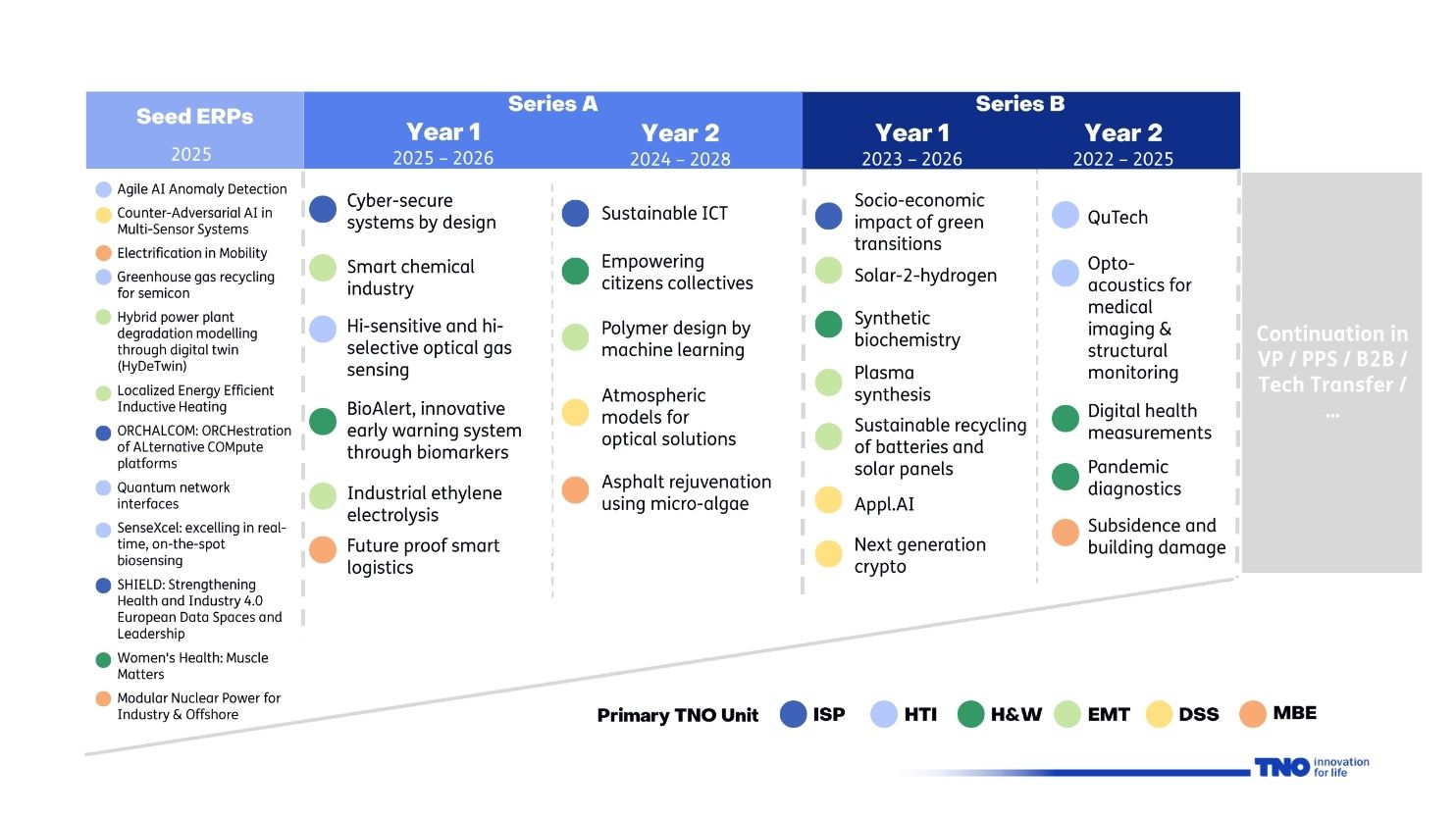
The programmes pass through three phases, each with increasing maturity, proving scientific strength as well as societal and economic relevance.
- Seed Phase:
In this one‑year start‑up phase, the idea is evaluated for technical feasibility and potential impact, and potential partners are explored. Roughly half of the Seed ERPs progress to Series A. - Series A:
In this two‑year phase, the scientific and technological foundation is developed. Work is done on applications, partnerships and demonstrators. The five projects with the highest impact potential and strongest results are selected for Series B. - Series B:
During this additional two‑year phase, the focus is on scaling up, validation with partners and connecting to follow‑up funding.
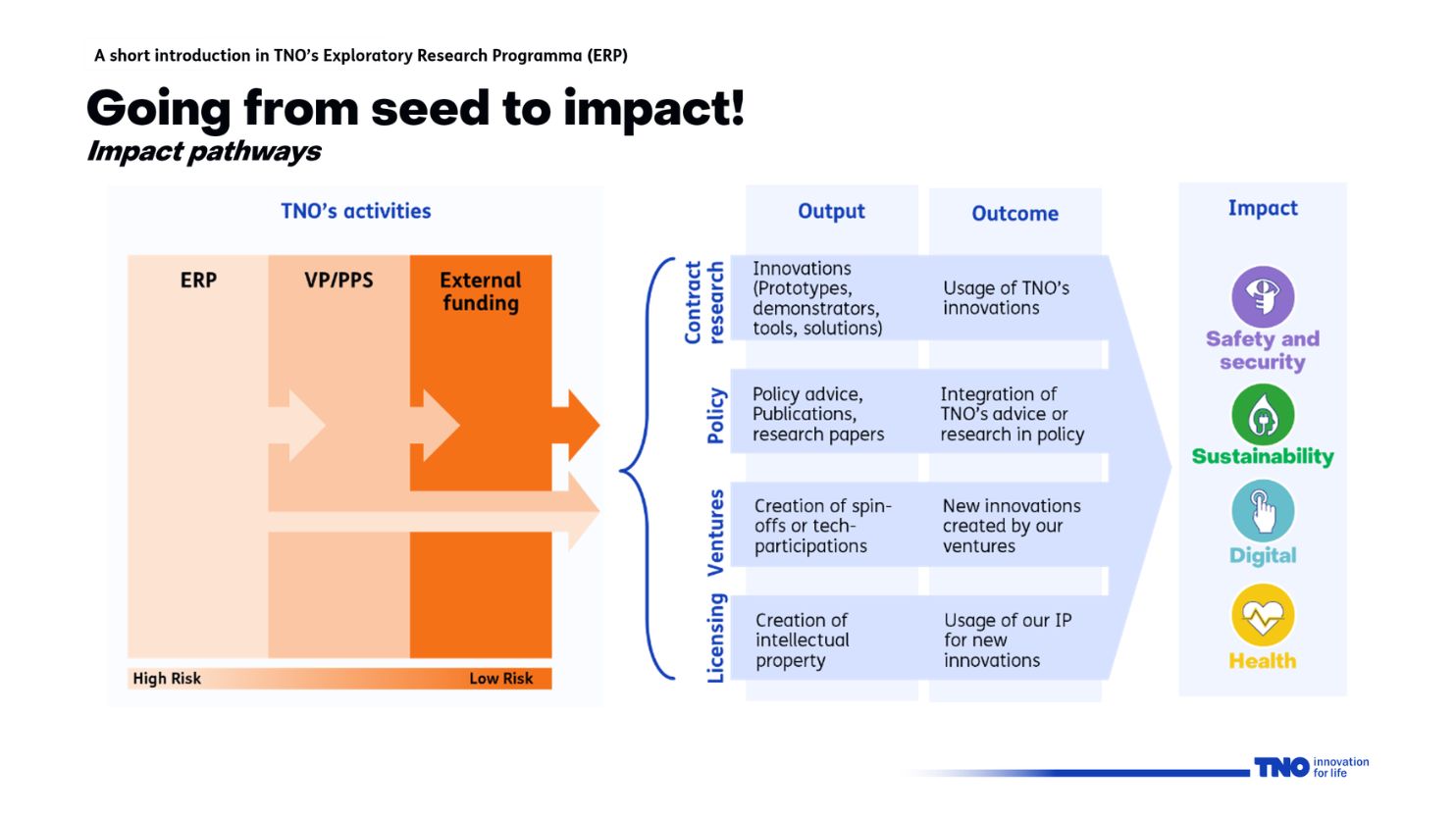
The infographic “Going from seed to impact! Impact pathways” shows the different steps through which ERP projects develop from an initial idea into concrete innovations, policy advice and intellectual property.
On the left-hand side of the image, three blocks are shown next to each other. The first block is called ERP, the second VP or PPS, and the third External Funding. These three blocks represent a transition from high risk at the start to low risk at the end. Large arrows run through all three blocks from left to right, illustrating how research evolves into subsequent phases.
To the right of the arrows are two columns. The first column is titled Output. This column lists four types of results: innovations such as prototypes and demonstrators; policy advice and publications; the creation of new spin-off companies; and the generation of intellectual property such as patents.
Next to this column is the second column, titled Outcome, which describes what happens afterwards. Innovations are taken into use, advice is integrated into policy, spin‑offs develop new innovations, and intellectual property is applied in new developments.
On the far right of the image is a row of four themes in which TNO aims to make impact. These themes are: safety and security, sustainability, digitalisation and health.
Contribute to new innovations
Impactful innovation cannot be achieved alone. Our excellent researchers within ERPs work closely with companies, governments and other knowledge institutions.
ERP research eventually continues in demand‑driven programmes, collaborations, start‑ups or one‑to‑one cooperation with clients.
If you see a match with an ERP topic or have ideas for new applications, we’d be happy to talk. Contact: Joëlle van den Broek
A selection of ongoing programmes
-
Empowering citizen collectives
Co‑creation with society is essential for accelerating societal transitions. Yet the contribution of citizen initiatives often remains underutilised. We are developing innovative methods for citizen engagement to support collaboration, research and innovation.

-
Polymer design by machine learning
A climate‑neutral and circular industry by 2050 requires faster design processes for new bio‑based polymers. To achieve this, we have launched a programme that uses machine learning to accelerate the design of bio‑based polymers.
-
Women’s Health: Muscle Matters
Muscle strength, recovery and load-bearing capacity in women differ from those in men, with a direct impact on health and performance. We map these differences and design solutions to reduce the health gap. In doing so, we contribute to healthy ageing, lower healthcare costs and a stronger societal position for women.

Curious about all our Exploratory Research Programmes?
View the ERP plans for 2026 (pdf) and read about the ERP plans for 2025 (pdf). View the ERP Annual Report 2025 (pdf).
- Women’s Health: Muscle Matters
This project aims to reduce the health gap between men and women by improving women’s muscle health, performance and work capacity. - Greenhouse Gas Recycling for Semicon
Developing breakthrough technology to capture, recycle and reuse powerful greenhouse gases from the semiconductor industry. - Electrification in Mobility – Large‑scale Agent‑Based Simulation
Creating a high‑speed simulation platform for smart and affordable planning of charging infrastructure and power grids in a fully electric mobility system. - System‑level Platform for Adversarial Robustness Testing and Analysis
Developing a digital twin that identifies vulnerabilities in autonomous systems—such as self‑driving vehicles—to make them safer and more reliable. - Orchestrating Alternative Compute Platforms
Creating an intelligent middleware layer that automatically distributes computational tasks over advanced computing technologies, without requiring specialist IT knowledge. - Agile AI Anomaly Detection
Developing AI methods capable of detecting anomalies in complex systems with minimal labelled data—for faster, cheaper and more accurate inspection, defence and medical screening. - Hybrid Power Plant Digital Twin for Resilient Health‑Aware Operation & Maintenance
Building a digital twin of hybrid power plants to enable smarter planning of maintenance and operations, increasing efficiency and reliability. - Industrial Ethylene Electrosynthesis
Converting CO₂ into ethylene using electrochemistry, helping the chemical industry become greener and less dependent on fossil feedstocks. - BioAlert – Innovative Early Warning System Through Biomarkers
Developing a biomarker platform that can detect lung and liver diseases early, even before symptoms appear. - Future‑proof Smart Logistics
Designing intelligent, shared planning tools to make logistics networks more sustainable, efficient and resilient. - Cyber‑secure Systems by Design
Embedding cybersecurity into products from the earliest design stage to build robust and future‑proof cyber‑physical systems. - Smart Chemical Industry
Developing a toolbox that enables chemical processes to adapt to fluctuating sustainable electricity, supporting a green transition in industry. - Highly Sensitive Optical Gas Sensing
Developing extremely sensitive instruments for airborne detection of gases such as ammonia, enabling fair and accurate emissions monitoring. - Asphalt Rejuvenation Using Micro‑Algae
Creating a bio‑based rejuvenator derived from micro‑algae to improve asphalt recycling and reduce environmental impact. - Atmospheric Models for Optical Solutions
Improving atmospheric models to make optical communication systems, laser‑based technologies and Earth observation more reliable. - Empowering Citizen Collectives
Developing methods and tools to strengthen citizen initiatives and improve collaboration between residents, government and industry. - Polymer Design by Machine Learning
Building an AI engine to accelerate the design of safe, circular and climate‑friendly polymers. - Sustainable ICT
Providing insight into the environmental impact of digital technologies, supporting policymakers and ICT companies in reducing emissions. - Appl.AI
Developing reliable and explainable AI for autonomous systems and decision‑making. - Next‑Generation Crypto
Advancing privacy‑preserving and quantum‑safe cryptography for secure, real‑time sharing and analysis of sensitive data. - Plasma Synthesis
Developing plasma technology to convert methane into valuable chemicals such as ethylene using electricity. - Socio‑economic Impact of Green Transitions
Building simulation models that show how the energy and mobility transitions impact different households, enabling fairer policy decisions. - Solar‑to‑Hydrogen
Designing and testing devices that convert water into green hydrogen directly using sunlight. - Sustainable Recycling of Batteries and Solar Panels
Creating new recycling technologies to preserve valuable materials in a circular system and reduce import dependency. - Synthetic Biochemistry
Building highly efficient biochemical production lines for medicines and bio‑based materials, enabling faster and cleaner manufacturing.
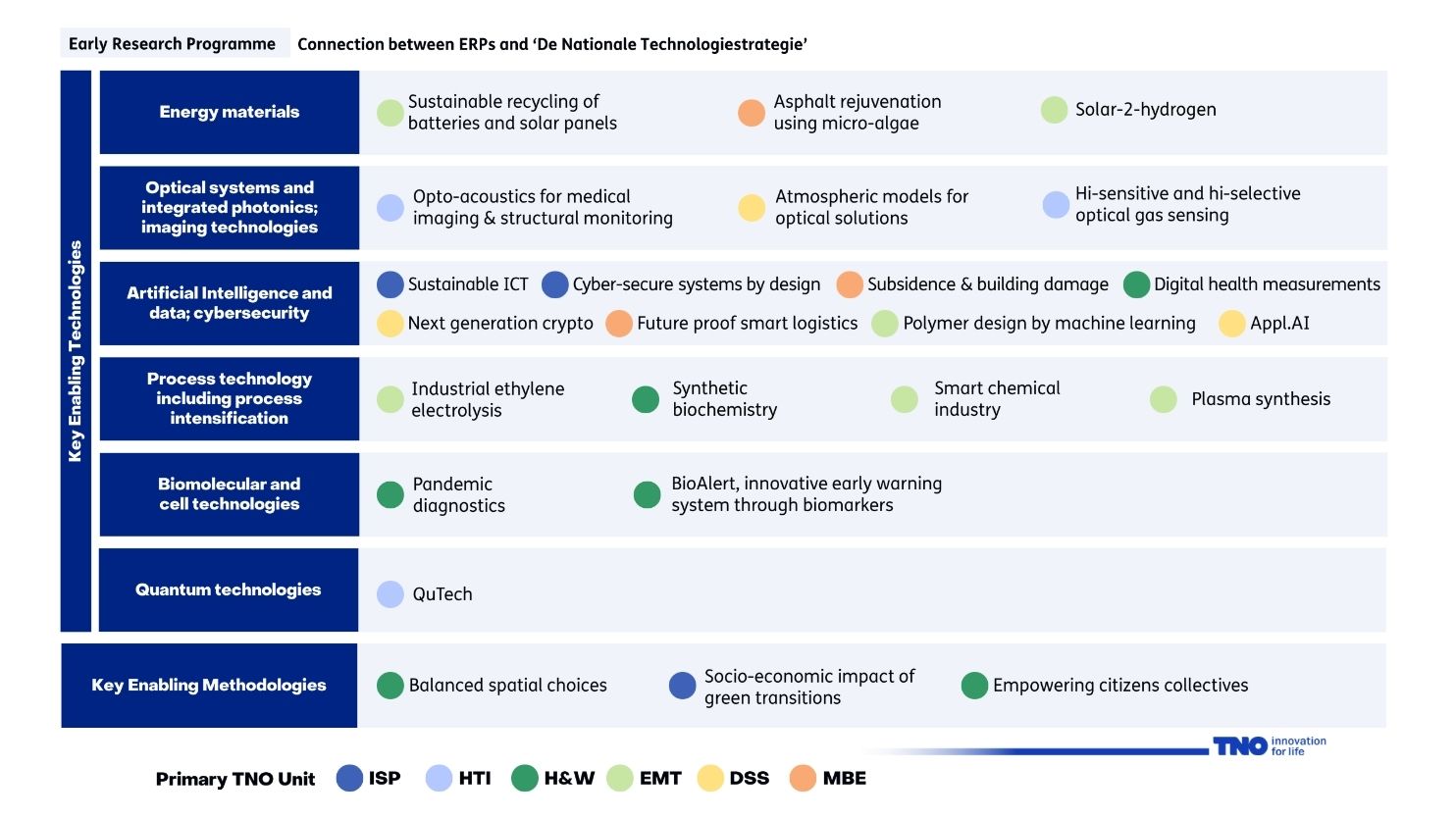
This figure illustrates how the projects within TNO’s Exploratory Research Programmes are connected to the six key technology domains of the National Technology Strategy.
In the left‑hand column, the technology domains are listed: energy materials; optical systems and integrated photonics; artificial intelligence, data and cybersecurity; process technology; biomolecular and cell technologies; and semiconductor technologies.
To the right of each domain is a row of ERP projects associated with it, such as sustainable recycling of batteries, atmospheric optical detection models, AI security, synthetic biochemistry, biomarker diagnostics and greenhouse‑gas recycling. At the bottom is an additional category of supporting methodologies, with projects focusing on socio‑economic impacts and citizen collectives.
Each project name has a coloured dot indicating which TNO unit is responsible for it.
A selection of our completed ERPs

ExpoSense: Real‑time measurement of fine particulate matter
On construction sites, workers are exposed to substances released during activities such as milling, sawing and drilling. How much, and which harmful substances, are they exposed to? Using new sensor technologies and a new data‑interpretation method, we mapped this accurately.

WISE Policy Making: Steering towards broad societal well‑being
Policy‑makers currently lack sufficient tools to base decisions on the well‑being of society. In this research programme, TNO develops methods and instruments that provide insight into how policy choices affect societal well‑being. This enables more accurate steering towards increasing broad prosperity in the Netherlands.
Contact us
-

Joëlle van den Broek
Functie:Director Science and Technology-
Standplaats:Eindhoven - High Tech Campus 25
-
Email:Email Joëlle
-