TNO Well Technology Centre
We are an open innovation facility. Whether on an hourly basis or via dedicated projects you can access state-of-the-art equipment to conduct research and bridge the technology readiness gap.
De-risking technology readiness and strengthening industry
High well construction costs often represent a major barrier to investments in new subsurface energy systems. At the same time, energy access, security and affordability have become a growing concern around the world.
By leveraging our solid network, collaborating with large industry partners, academia, start-ups, small and medium enterprises, we develop solutions that can reduce costs and improve efficiency in different sectors of the value chain.
Connect with our team of scientists and experts in well technology, subsurface and digital solutions. This helps to de-risk field trials and accelerate market roll-out towards a more just and equitable energy future.
Examples of what we do include:
- Testing new well technologies across the well lifecycle (from drilling to decommissioning or repurposing) using our full-scale drilling rig and test wells.
- Exploring geothermal heat production and storage in the local subsurface using our instrumented (geothermal) wells.
- Conducting in depth testing of drilling and completion tools, sealing materials and solutions, fluids in a porous media environment.
Discover the TNO Well Technology Centre
Walk through the TNO Well Technology Centre in the virtual tour and see the facilities.
Large-scale experimental capabilities
Our facilities bring together large-scale testing setups, precision measurement tools, and adaptable experimental spaces. This combination enables us to investigate, validate, and demonstrate well drilling, completions, integrity, stimulation, and thermal energy storage technologies in conditions that closely resemble real-life scenarios.
We conduct everything from comprehensive downhole simulations to precise bench-scale experiments, offering extensive opportunities for minimising risks and cost of large-scale testing and field trials. This work builds on up to date knowledge of all kinds of (inter)national projects and the Dutch subsurface, including expertise from the Geological Survey of the Netherlands. Discover our latest technological breakthroughs in the virtual tour, and view a summary below.
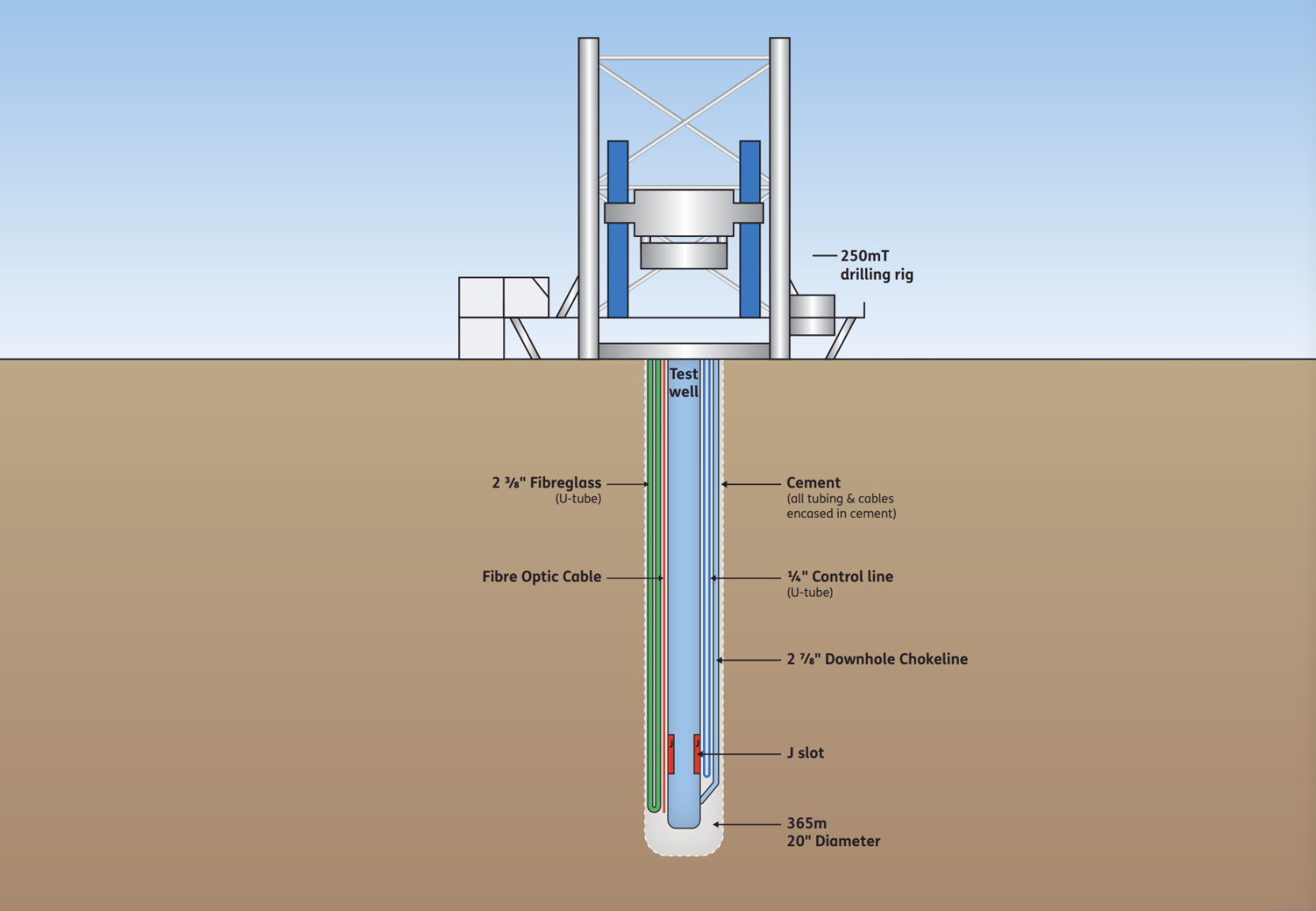
The basis of our offer is a Herrenknecht B003 semi‑automatic drilling rig is mounted on a skid frame and stands above two test wells, a ~400‑metre, a ~200 m deep well.
The deeper well has a 22‑inch casing with annulus isolation and fiber optic monitoring cables and can be completed with different work-strings up to 18 inches. The 200m with a 9 5/8 (alternating steel and composite) casing is also equipped with a DAS/DTS fiber optic monitoring cable.
The rig is equipped with hydraulic pistons that can apply up- and downward forces to simulate conditions found in deep and extended reach wells. It is connected to a fluid circulation system with three mud pumps and a ring line.
This set‑up allows full‑scale testing of well technology under controlled and repeatable conditions. Experiments include testing plugs, casings, and downhole tools in general. Ongoing and planned research covers new drilling technologies, storage concepts, casing integrity, well abandonment, well intervention, sealing, monitoring and logging. The facility is also used for training and can function as a field lab for smart sensing and augmented‑reality applications in industrial environments.
Mud system
Three electrically driven mud pumps with combined capacity 3600l/min and rated to 690bar. Mud flow serves the drilling rig and 50T drilling machine and can also be diverted to support other non-drilling tests.
Full mud circulation system with pumps and high pressure (10k psi / 690 bar) ring lines, 3 high capacity mud pumps jointly delivering ~ 3000 l /min @ max pump pressure, 3 x 10m3 mud tanks and 2 x 5m3 return tanks.
WECO connections which facilitate coupling of modular flowloops to create a test environment; variety of orifices to create back pressure.
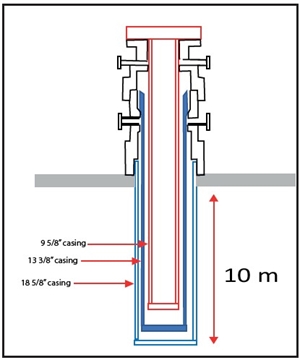
The centre also has a shallow indoor well of about 12 metres deep. This depth is enough to install a full casing section, making it a useful test location before moving to the larger rig or field trials.
A wellhead can be fitted on top of the well to allow pressure testing. Overhead cranes in the hall support safe and efficient installation of casings or tools.
The shallow well is often used for testing of logging and well intervention tools as well as for cement and plug experiments. It provides a controlled space for quick and practical testing of well components and procedures.
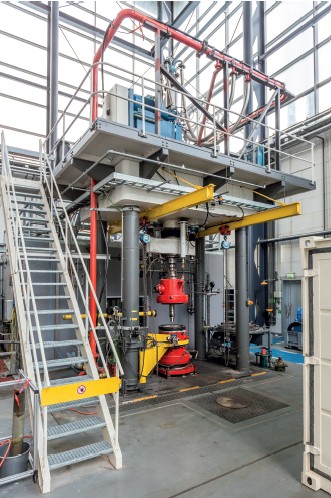
The 50‑tonne drilling simulator is designed for experiments under realistic and dedicated pressure conditions. It can test different drill bits and other drilling technologies on rock samples placed inside a pressure vessel.
Sensor systems and shaker optimisation can be evaluated, and the set‑up can be adjusted for testing alternative flow techniques. Planned projects include assessing steering technologies for horizontal and multilateral wells, which are becoming increasingly important for geothermal applications. An example project that we have supported is DEPLOI.
The facility includes a 50‑tonne compression‑stroke drilling machine connected to a full mud circulation system with pumps, a ring line and a shaker. It allows drilling tests at downhole‑level pressure, up to 250 bar, with variable rotational speed and weight‑on‑bit.
Rock samples, either natural rock or reproducible artificial samples such as cement, can be placed in the pressure vessel. Real rock provides close similarity to field conditions, while artificial samples are easier to reproduce for follow‑up experiments.
This set‑up allows controlled and repeatable testing of drilling systems, supporting research into performance, efficiency and tool behaviour under subsurface conditions.
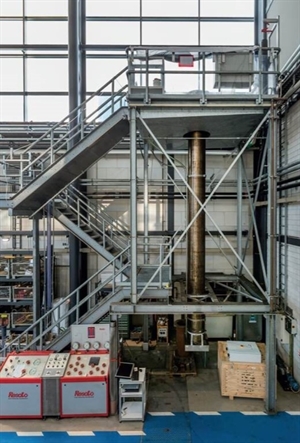
We use a high‑pressure vessel, six metres tall, for burst and collapse tests.
The vessel has been used to test the strength of a full composite casing section, in collaboration with Huisman. Sensors were added to measure deformation just before the casing failed.
This work supports the development of corrosion‑resistant composite well designs with embedded sensors. Such designs aim to provide continuous data on geothermal production and well integrity. The project creates opportunities for companies working in sensing technology, data processing, composite materials and related services.
The pump has a maximum pressure of 1230 bar and a flow rate of 2,5L/min. The pressure vessel has a volume of 600L and a temperature of 185 degrees Celsius. Test and operating pressure are 1500 and 1000 bar respectively.
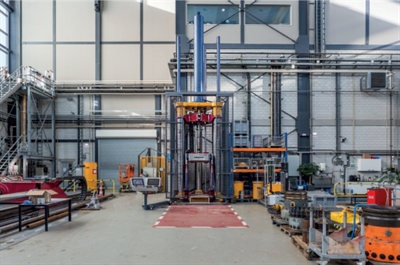
These presses are used for experiments that require high mechanical forces. They can simulate formation loads, placement forces and hydraulic pressure. By adding heaters, downhole temperature conditions can also be recreated.
Both presses have a straightforward set‑up that allows controlled loading of tools and materials, such as casing sections. The 400‑tonne press can handle larger samples. Samples are moved automatically to ensure safe, hands‑off installation. Tests can also include fluids, such as drilling mud.
Their simple operation makes the presses suitable for quick preparation tests as well as more detailed mechanical studies.
The presses can handle 4x6 cubic metres and have a diameter of 0 to 18”. It comes with a sample length 2,5 metres maximum. The pressure sensors are monitored with camera’s.
At TNO we use large flow loops to study how fluids move during drilling and production. This helps improve flow efficiency and reduce the energy needed for pumping in geothermal and district heating systems. We also support the DRAGLOW project, which investigates environmentally friendly additives that can reduce drag in pipelines.
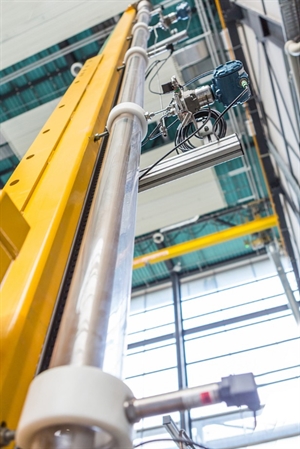
Cuttings Flow Loop is used to study how rock cuttings move during drilling. Cuttings must be carried out of the well to prevent blockage. A transparent pipe allows us to observe how cuttings travel in different positions, horizontal, vertical or angled. A rotating drill string can be added to mimic field conditions. Understanding cuttings transport is important because poor removal can damage tools and reduce drilling performance.
The ESP Flow Loop is used in Geothermal wells which work with Electrical Submersible Pumps (ESPs) to lift hot water to the surface. We can build a dedicated test set‑up to study how these pumps perform. This research supports the reliable operation of geothermal systems.
Flow loop for monitoring behaviour of fines and solids in water (e.g. of water-based drilling fluids, slurries or water-based completion fluids).
- Transparent monitoring tube on rotatable frame (horizontal, vertical, at angle).
- Fines / solids injection vessel max 70l capacity.
- Flow line fitted with shaker
- Max flow rate 600l/min at max pressure of 10bar and 85˚C
Application area’s:
- Experiments to investigate flow and particle transport during drilling.
- Investigate behaviour of fines or other particles and their impact on erosion in the well.
- Testing of sensors, flow optimisation techniques and (new) zonal isolation materials.
- Testing of scaling behaviour and prevention.
For businesses
At the TNO Well Technology Centre, research is being conducted into innovative energy solutions just below the Earth's surface and more sustainable ways to access it.
Partnering with TNO gives you access to this unique facility, expertise, and a strong network. Whether you need to test a technology, develop a prototype or carry out a risk analysis: we are here to help.
You can find even more information about Innovate subsurface technologies on our webpage. Get in touch and accelerate your innovation.
Contact us
-

James O'Connor
Functie:Senior Business DeveloperMy focus is on developing projects in well technology to improve access and utilization of the subsurface. I have spent many years promoting and developing drilling technology in the energy sector and I am excited to leverage this experience to make an impact with TNO in this important area of subsurface utilization.
-
Standplaats:Rijswijk- Lange Kleiweg
-
Email:Email James
-
-

Fabio Rosas
Functie:Senior Business Developer Well TechnologyIn my career, I have been driven by a passion for fostering innovation and enabling collaboration across industries to support a sustainable energy future.
At TNO, I am committed to connecting research and industry to spark innovation in the energy sector. My focus is on creating fertile ground for new ideas and advancing technologies that prioritize sustainable resources, all with the goal of driving progress toward more sustainable societies.
With a steadfast dedication to collaboration and progress, I work to align strategic objectives and inspire transformative solutions for the ever-evolving energy market.
-
Standplaats:Utrecht - Princetonlaan
-
Email:Email Fabio
-
Get inspired
TNO–SodM–NIOZ: ‘Methane emissions in the North Sea often linked to shallow natural gas’

Heat
Geothermal energy: sustainable heat from the subsurface
Heat system integration: aligning all the pieces
Friendship Sports Centre becomes a testing ground for sustainable energy