Li-ion battery recycling in the Netherlands: Big ambitions, small volumes
To help secure critical raw materials, TNO assessed the opportunities and challenges for battery recycling in the Netherlands. While the Netherlands performs strongly in collection, logistics and pre-treatment, large-scale material recovery is still absent. Demand for recycled materials, feedstock availability, regulations, permitting, and energy infrastructure limit further scale-up. More sustainable and cost-efficient recycling technologies can address certain challenges. However, a broader system change will be required to make domestic battery recycling a success.
Strengths and weaknesses
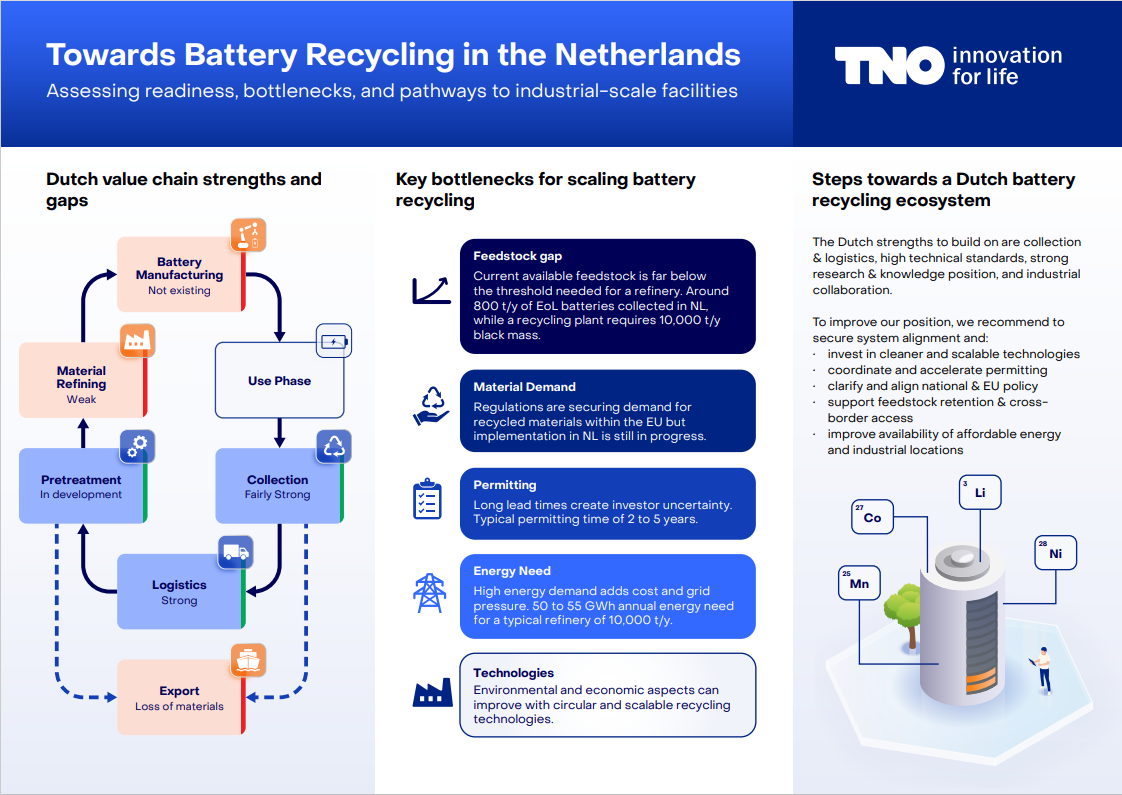
The Netherlands performs strongly in the early stages of the Li-ion battery recycling value chain: collection, logistics, and pre-treatment of batteries. However, it lacks capacity in actual material recovery. There are no operational large-scale facilities for refining ‘black mass’, meaning that valuable materials are exported and processed abroad.
Much of the economic and strategic value of battery CRMs like lithium, cobalt, and nickel is lost to other countries. As a result, valuable critical raw materials and economic value leave the Netherlands, limiting both domestic value creation and strategic autonomy.
Feedstock gap
Industrial-scale battery recycling requires significantly larger feedstock volumes than are currently available in the Netherlands. An industrial-scale black mass refining facility requires approximately 10,000 tonnes of black mass input per year, while the Netherlands collected only about 430 tonnes of electric vehicle batteries in 2025 through ARN (Auto Recycling Nederland). Additionally, Stichting OPEN which is responsible for collection of other battery streams, reported collection of around 400 tonnes of e-bike batteries in 2024.
This gap between required and available volumes makes investment in domestic recycling infrastructure difficult. In practice, such investments are only feasible when access to additional feedstock can be secured, for example through off-take agreements with gigafactories for production scrap.
At the same time, domestic demand for recycled materials remains limited due to the absence of battery manufacturing facilities. To make investments viable, it is therefore important to strengthen connections with European markets, for example through off-take agreements and strategic partnerships.
Permitting and energy challenges
Additional challenges include high energy costs, grid congestion, and complex permitting procedures. Recycling is considered as energy intensive industry, while access to the electricity grid is increasingly constrained. Permitting processes are lengthy, typically taking two to five years, creating uncertainty for investors and slowing down progress.
Importance of system alignment
If the Netherlands wants to capture more value from battery recycling, supply, demand, regulation, energy infrastructure and industrial development need to evolve in a coordinated way. Key priorities include increasing feedstock availability, accelerating permitting processes, and creating stable market conditions. Without these actions, the Netherlands will remain primarily a logistics hub, rather than becoming a significant player in the European circular battery economy.
More information
Read the paper 'Towards Battery Recycling in the Netherlands: Assessing Readiness, Bottlenecks, and Pathways to Industrial-Scale Facilities', an assessment of the Dutch battery recycling ecosystem, value-chain gaps and conditions required for industrial-scale recycling.
Future perspective
TNO supports both technology development and ecosystem design. Whether you are developing recycling technologies, exploring investment opportunities or shaping policy, TNO can help you identify realistic pathways and accelerate implementation.
Contact us
-
Wouter de Wolf
Functie:Business Developer Circular EconomyContact me to partner with TNO on Circular Economy related topics like: Recycling and other R-strategies, Critical Raw Materials and Environmental Impact Assessment (LCA).
-
Standplaats:Utrecht - Princetonlaan
-
Email:Email Wouter
-
LinkedIn:Wouter on LinkedIn
-
-

Emma Folkertsma
Functie:Project manager and team lead Circular ElectronicsWould you like to work together on a sustainable and future-proof raw materials value chain? Feel free to contact me to explore collaboration opportunities in the fields of critical raw materials (CRMs), the circular economy, circular value chains, and battery recycling.
-
Standplaats:Utrecht - Princetonlaan
-
Email:Email Emma
-
Get inspired
Europe's chemical industry can become more sustainable without losing its foundations
Discover your pathway to tomorrow’s energy system today
Faster reinforcement of low-voltage grids requires improved collaboration
A fossil-free 2050 is technically achievable
Temporary Special Economic Zone around Rotterdam can prevent climate delays and GDP losses