Reliable monitoring of battery condition for transparent battery passports
How can we accelerate Europe’s transition to a circular battery economy? The EU Battery Regulation demands that batteries that are used for light transport, industrial and electric vehicles all need a battery passport by 2027. But how can we ensure that the Battery Passport shows reliable data? TNO and NXP developed a way to make a secure and interoperable battery passport, with their project: Secure Battery Passport Demonstrator (SeBaPaD).
Preparing for the Battery Passport
‘Since the European Commission introduced the idea of the Battery Passport as part of the EU Battery Regulation, TNO has been working on the algorithms and system concepts behind it’, says Avedis.
During this time, TNO has contributed to several Battery Passport related initiatives. In the Green Transport Delta – Electrification (GTD-E) project, TNO worked with a broad industrial consortium to establish a solid technical foundation for battery passports, resulting in the 2024 white paper Towards future-proof battery passports.
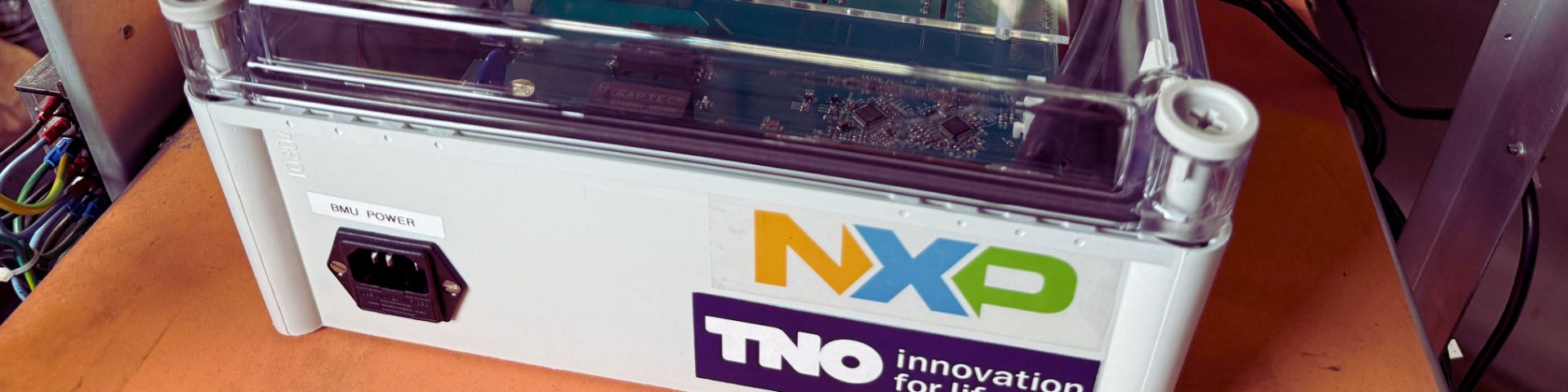
TNO also led the Secure Battery Passport Demonstrator (SeBaPaD), developed together with semiconductor industry leader NXP. NXP provided the Battery Management System (BMS) hardware including secure chipsets, and developed the base software layer of the BMS. TNO developed the SoX battery algorithms, integrated them with a commercial NMC battery module, provided the Battery Passport environment, and performed system testing. An end-user group with industry partners was involved throughout the project to ensure practical relevance.
Determining the actual state of the battery
One of the requirements of the Battery Passport is that it reports on the condition and performance of a battery through a set of so-called State-of-X (SoX) values. SoX is an umbrella term covering the different metrics used to describe the state of a battery.
To meet this requirement, TNO developed a comprehensive SoX framework, referred to as SoX Toolchain. The SoX Toolchain combines all essential data currently needed to operate a battery, with the additional dynamic data required for the Battery Passport. This includes both the core operational metrics, already used in battery systems, and new Battery Passport–related indicators that are not commonly provided by existing Battery Management Systems, such as round-trip efficiency.
‘A challenge with many existing approaches is that SoX values become less reliable as a battery ages’, explains Feye Hoekstra from TNO. ‘There is no standardized way to calculate these values, and many algorithms do not account for long-term degradation.’
According to Hoekstra, a key feature of TNO’s SoX Toolchain is that it evaluates SoX estimation performance for the full lifetime of the battery. ‘This allows users to continuously and reliably monitor battery condition and performance, even as the battery degrades over time.’

‘TNO’s SoX Toolchain enables users to continuously and reliably monitor the condition and performance of batteries, even as the battery degrades over time.’
Highly secure IC’s (chips)
In order to test the SoX algorithms, the software needed to be combined with the BMS hardware. ‘NXP built a BMS reference design with Security IC’s (chips) on it’, says Wenzel Prochazka from NXP. ‘Within the BMS, this is what protects the sensitive data, to make sure that the information, given by the SoX algorithm, cannot be manipulated.’
‘The chipsets have an extremely high safety level. It’s the same type as used for credit cards and passports’, adds Marc Manninger from NXP. This safety level is crucial, for example for battery manufacturers, because they are legally liable for the reliability of the data.
The software layers of a Battery Management System
In addition to hardware components such as sensors and chipsets, a BMS consists of multiple software layers with distinct responsibilities. At the lowest level, the sensing and acquisition layer interfaces directly with the hardware to measure raw signals, including cell voltage, current, and temperature.
Above this, the core BMS software performs essential functions required for safe and reliable battery operation. These include signal processing, safety and protection mechanisms such as overcharge and overtemperature protection, cell balancing, and communication with external systems, such as the Battery Passport.
On top of these foundational layers sits the application layer, where higher-level battery functionality is implemented. This is the layer in which TNO’s SoX algorithms are integrated. The framework builds on the validated and protected data, provided by the lower layers to compute both the essential operational metrics needed to run a battery and the additional dynamic data that are required for the Battery Passport.
‘The climate chamber enables us to test batteries at different temperatures and humidity levels, and to verify that their behaviour remains within the expected limits as they degrade.’
Test facilities at TNO
Once the BMS has been assembled and programmed, it is integrated with a commercial NMC battery module in the SeBaPaD case. TNO has advanced expertise and state-of-the-art laboratory facilities for building battery prototypes and conducting high-precision testing under fully controlled conditions.
These facilities enable detailed electrical characterization of battery cells and validation of battery systems, while ensuring safe operation throughout the test campaigns. In addition, TNO uses climate-controlled test chambers to evaluate battery performance under a wide range of environmental conditions. ‘This allows us to test batteries at different temperatures and humidity levels and verify that their behavior remains within the expected limits’, says Feye.

‘This step is essential to move closer to industrial and mobility applications, where higher-voltage systems are standard.’
Scaling up
‘With the first SeBaPaD project completed and the battery passport demonstrator in place, TNO and NXP are continuing to expand and validate the system’, says Avedis. One of the current focus areas is testing the battery passport setup with an LFP battery module. Compared to other chemistries, LFP batteries are more challenging for SoX calculations because their voltage remains relatively flat over a large part of the charge range.
This makes it harder to determine how full or healthy the battery is based on voltage alone. This, in addition to the dependency on temperature and aging of batteries in general, requires even more advanced algorithms to maintain reliable estimates over time.
In parallel, TNO and NXP have launched SeBaPaD 2, which aims to scale the demonstrator from a 50V battery module to a 500V battery pack. ‘This step is essential to move closer to industrial and mobility applications, where higher-voltage systems are standard’, says Avedis. Operating at this level introduces additional requirements for safety, monitoring, and control, all of which are critical to demonstrating that the battery passport system can function reliably in realistic operating environments.
By scaling up in both battery chemistry and system voltage, TNO is working towards a solution that is directly relevant for industry and suitable for integration into future commercial products. Are you interested in collaborating with TNO on future digital product passport initiatives or BMS challenges? Contact us.
Contact us
-

Feye Hoekstra
Functie:Battery ScientistAt TNO I work on sustainable mobility and built environment by using batteries to replace fossil fuels. My research is aimed at using battery management to enhance battery performance and my expertise lies in battery management algorithms, and battery modelling and testing.
-
Standplaats:Helmond - Automotive Campus
-
Email:Email Feye
-
Get inspired
How far can you travel in an electric car?
Battery technology: 4 developments according to the Battery Lab
TNO accelerates electrification of logistics and construction through a deeper understanding of batteries
Team Polar

Batteries