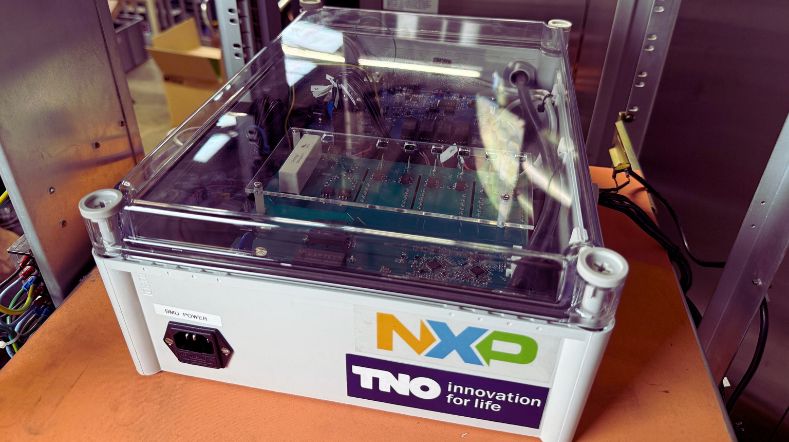
Battery technology: 4 developments according to the Battery Lab
The development of battery technology is progressing at lightning speed. Five years ago, battery-electric trucks were still almost unthinkable. Development is accelerating due to electrification, stricter sustainability requirements, new mobility applications, and increasing demand for energy storage. Experts Erik Hoedemaekers and Jan-Willem Sangers identify four key developments in the battery industry.
What are the four key developments in battery technology?
1. Growing number of battery applications calls for rapid validation and testing
'As batteries have become increasingly better and more affordable over the years, we are seeing entirely new areas of application emerge,' says Jan-Willem. This is evident, for example, in drones. 'In the past, a drone was a children’s toy that could barely fly for more than five minutes,' Jan-Willem explains. 'Nowadays, a drone is a serious agricultural or film-making tool capable of carrying heavy loads and achieving long flight times.'
These new areas of application bring their own challenges. For instance, drones have different safety requirements compared to batteries for electric transport or maritime uses. 'We are moving towards other mobility applications for batteries, which means an ever-growing diversity of products with unique characteristics and requirements must be tested,' Jan-Willem adds.
This growing diversity demands flexibility in the battery lab: new components, battery modules or packs must be tested quickly. That is why TNO is working on prototyping facilities to validate new concepts rapidly. 'This enables us to quickly turn innovations into prototypes and demonstrate whether the desired results are achieved,' Erik explains.

'The voltages at which systems operate, especially in vehicles, but also in stationary systems, are getting higher and higher.'
2. Stricter safety requirements and more realistic gas analysis
In addition to a greater diversity of applications, TNO experts are seeing a shift in the type of testing requests coming in. Erik explains: 'We are receiving more and more questions about safety testing, particularly from the aviation sector. Think of manufacturers of drones and small aircraft. In that sector, safety requirements are typically even stricter than, for example, in the automotive industry.'
This shift has a clear cause: new EU regulations require the industry to test in a different way. For certain applications, battery manufacturers must be able to demonstrate which specific gases are released and in what quantities during a thermal runaway – an uncontrollable chain reaction in which an overheated battery becomes progressively hotter and can eventually rupture or catch fire.
At the Battery Lab, TNO addresses this specific need. 'In our lab, we can safely induce thermal runaway in batteries and perform gas analyses during the process, even for larger systems,' Erik explains. The value lies in the combination: being able to safely test thermal runaway (and its propagation) and immediately carry out a detailed analysis of which gases are released. 'That combination is commercially hardly available,' Erik adds.

'The industry no longer wants to simply look at how a battery behaves, but also understand why it behaves that way.'
3. More powerful battery systems with higher voltages
'The voltages at which systems operate – especially in vehicles, but also in stationary systems – are getting higher and higher,' observes Jan-Willem from the testing requests coming in. Batteries with higher voltages are more efficient; they require lower currents for the same power output.
Many car manufacturers, for example, are making the transition from 400 volts to 800 volts and already offer electric vehicles (EVs) with 800-volt battery systems. For heavy-duty vehicles, batteries can even exceed 800 volts. This development imposes new demands on testing facilities; test equipment must be capable of handling higher voltages.
TNO is anticipating this by expanding the Battery Lab’s testing capacity to 'significantly above 1,000 volts,' as the expectation is that batteries will only become more powerful. 'We need to try to stay ahead of the market so that we can continue testing the available systems,' Jan-Willem emphasises.
TNO has extensive experience with thermal runaway research in open environments. This offers the advantage that larger batteries and realistic heat and smoke plumes can be studied. A disadvantage is that repeatability and complete gas capture are difficult to guarantee, especially for quantitative toxicity analyses.
Therefore, in addition to the open facilities (bunkers at TNO Ypenburg), we are working on a controlled pressure vessel setup with an internal volume of approximately 500 liters. This is intended for trials with a battery size of up to around 1 kWh. Conditions are adjustable, for example, an inerted nitrogen atmosphere or temperature conditioning.
Runaways can be initiated via overcharging, external heating, or mechanical penetration. We continuously measure mass loss, determine the total gas volume, and perform online gas analysis via FTIR, supplemented with GC/MS for offline characterisation. Depending on the test objective, we additionally evaluate particulate matter, flammability, and toxicity. In this way, we combine representative thermal loading with reproducible gas data for normative thresholds and design assumptions.
Thermal runaway tests reveal a recurring pattern. Even before visible venting, the stress curve deviates and the temperature rises at an increasing rate. Around the moment the safety vent opens or, in the case of pouch cells, the foil bag tears, a short-lived, localised temperature drop often occurs. This apparent ‘breathing’ takes place just before a large, irreversible temperature peak.
Rise rates of well over one hundred degrees per second are not uncommon, depending on the chemistry and configuration. After the peak, a sharp drop follows as soon as the casing fails and hot gases escape. This type of data supports early detection criteria and helps to realistically dimension provisions against thermal and pressure consequences. Furthermore, the reproducibility enables reliable comparison between cell chemistries and configurations.
Many car brands, for example, are making the transition from 400 volts to 800 volts and already offer electric vehicles (EVs) with 800-volt battery systems. For heavy-duty vehicles, batteries can even exceed 800 volts. This development places new demands on test facilities; test equipment must be able to handle higher voltages. Electric vehicles with an 800-volt battery can charge faster and drive more efficiently. The battery can be charged from 10% to 80% in 15 to 20 minutes.
Battery Lab
Discover how Battery Lab drives progress in battery technology and supports partners in accelerating electrification.
4. Shift towards a deeper understanding of chemical processes
Finally, the experts at TNO’s Battery Lab are seeing a fundamental shift in how batteries are tested. 'The industry no longer wants to simply look at how a battery behaves, but also understand why it behaves that way, what is happening chemically inside the battery,' says Erik.
'The problem with traditional testing is that you have to test every new battery from scratch. That takes a lot of time,' Erik explains. 'If you understand what happens at component level, you can make predictions much faster.' This can be done using physical models that describe the electrochemical process. Instead of merely observing from the outside, the focus is on what is really happening to the electrodes and other components inside the battery.
TNO is therefore investing in equipment to dismantle batteries and analyse the individual parts. Erik: 'By understanding how electrodes and other components react, we can create models that deliver reliable lifetime predictions much more quickly.'
Responding to market needs
Gas analysis, higher voltages, prototyping, component analysis – four different developments with one thing in common: they show how important it is to keep pace with a rapidly changing industry. From new safety requirements to unexpected areas of application.
'We try to stay as close as possible to the research questions that arise,' says Jan-Willem. But what those questions will be tomorrow is not always predictable in such a fast-moving industry. That is why TNO also looks to the market itself for direction. 'Input on market needs is very welcome,' Erik emphasises. TNO’s Battery Lab is keen to work with (new) partners to explore what is possible and ensure future investments align as closely as possible with market demands.
Biggest challenges in battery industry
- We are moving towards other mobility applications for batteries, which means that an ever-increasing diversity of products with their own characteristics and requirements must be tested.
- There are increasing requests for safety testing, particularly from the aerospace sector. Think of manufacturers of drones and small aircraft. In that sector, safety requirements are typically even stricter than, for example, in the automotive industry.
- The voltages at which systems operate in vehicles, as well as in stationary systems, are becoming increasingly higher.
- There is a shift in how batteries are tested. The industry no longer wants to look solely at how a battery behaves, but also wants to understand why it behaves that way, and what is happening chemically inside the battery.
Contact us
-

Jan-Willem Sangers
Functie:Business Development ManagerIn my role as a business developer Sustainable Vehicles, I work on establishing and facilitating collaborations in the field of sustainable mobility. These collaborations range from small-scale industrial research to large-scale international public-private partnerships in areas such as heavy-duty transport, shipping, non/off road mobile machinery, and even aviation applications.
-
Standplaats:Helmond - Automotive Campus
-
Email:Email Jan-Willem
-
LinkedIn:Jan-Willem on LinkedIn
-
Get inspired
Forces combined: how TNO supports LionVolt to accelerate next-generation battery technology

How Arriva and TNO are shaping the next phase of electric bus transport
From lab to ice sheet: how TNO accelerates battery innovation with Team Polar
Sailing with an engine that emits only water? Mitsubishi and TNO prove it’s possible
Reliable monitoring of battery condition for transparent battery passports