Sailing with an engine that emits only water? Mitsubishi and TNO prove it’s possible
Our maritime sector is undergoing its biggest transition since combustion engines replaced manual labour. Mitsubishi and TNO are demonstrating that zero-emission inland shipping is within reach, with the world’s first CO₂-free hydrogen engine that is safe, powerful, and capable of competing with diesel. A major step towards clean transport and European energy independence.
Proven technology, clean fuel
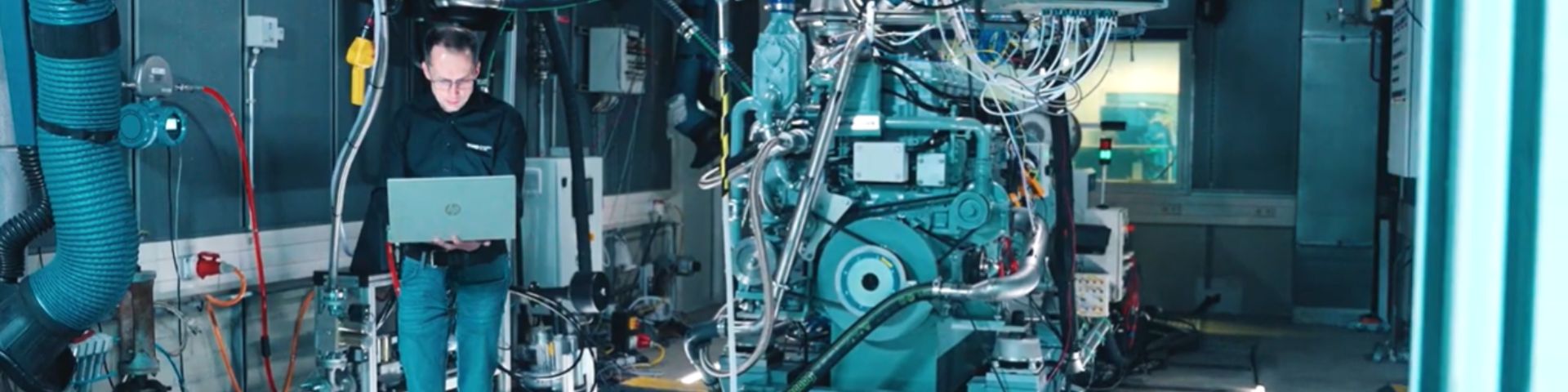
Since 2022, Mitsubishi and TNO have been working together on the first CO₂-free hydrogen engine for inland shipping. Rather than developing an entirely new system, they are building on engine technology that has been proven for over a century. Using an existing Mitsubishi SR-series diesel engine as a foundation, the partners have adapted it to run on hydrogen.

'TNO is the only organisation in the Netherlands, and one of the few in Europe, with large-scale hydrogen infrastructure. It allows industrial engines of up to 1.4 MW to be tested on alternative fuels.'
Hydrogen in, water out
Ronald Boensma explains that the hydrogen engine operates much like a conventional gas engine, using spark ignition. The compression ratio is slightly lower, and the pistons and cylinder heads have been modified. The key difference from a diesel engine is that hydrogen goes in and only water comes out of the exhaust. The mono-fuel prototype already complies with the strict EU Stage V emissions standards. It currently delivers 374 kW of power, with a target of 500 kW.
TNO as a strategic innovation partner
Boensma emphasises that TNO’s expertise and facilities are essential to the engine’s development. ‘TNO is the only organisation in the Netherlands, and one of the few in Europe, with large-scale hydrogen infrastructure. It allows industrial engines of up to 1.4 MW to be tested on alternative fuels.’
From TNO, Business Developer Jack Bloem is closely involved in the entire process:
‘We started with lab tests using a single-cylinder engine—identifying which components work, what performance we can achieve, and which combustion concept is most effective. Together with Mitsubishi, we then developed the current six-cylinder engine and calibrated it in a test cell.’
Hydrogen becomes competitive
The hydrogen engine has already obtained a basic approval certificate from a classification society. It will now undergo a durability test of 5,000 operating hours to ensure it continues to perform optimally and reliably. Provided the results are positive and type approval is granted, the engine could become available for inland shipping applications.
According to Jack Bloem of TNO, hydrogen is expected to become competitive with diesel over time (around 2030): 'Hydrogen prices are expected to range between €4 and €8 per kilogram. Thanks to SWIM (Subsidy Scheme for Hydrogen in Mobility), more refuelling locations along major rivers are being developed. In addition, hydrogen engines offer greater flexibility in terms of access to waterways, ports and protected Natura 2000 areas.'
Why electrification alone is not enough
Bloem stresses that hydrogen engines are essential alongside electrification:
‘The continuous availability of electricity will not be sufficient in the near term to power European transport. Batteries are heavy, have limited storage capacity, and rely on raw materials such as lithium from China. Hydrogen, on the other hand, can be generated entirely from renewable electricity, using surplus energy during peak production. It can then store that energy for times when electricity supply is limited.’
Hybrid inland shipping is the future
The Netherlands accounts for half of Europe’s inland shipping fleet. Dutch container vessels transport between 30 and 500 containers as far as Germany and Switzerland. Reducing emissions in inland shipping therefore has a significant impact, especially as other sectors decarbonise rapidly and shipping must remain competitive with road transport.
Moreover, inland vessel engines typically need replacing every 15 to 20 years, an ideal moment to transition to hybrid propulsion. By combining multiple smaller hydrogen engines with battery packs, engine performance can be optimally adjusted to actual demand, resulting in minimal fuel consumption.

'Hydrogen can be generated entirely from renewable electricity, using surplus energy during peak production. It can then store that energy for times when electricity supply is limited.'
From subsidy project to driver of innovation
The development of the hydrogen engine began during the COVID-19 crisis under the R&D Mobility Sectors (RDM) subsidy scheme. One of the eight resulting innovation projects was the Green Transportation Delta hydrogen project (GTD-H). Mitsubishi’s prototype is one of its outcomes. Two others include a hydrogen engine for trucks and a mobile hydrogen generator set, for example for festivals. This project is a clear demonstration that targeted incentives and collaboration can deliver real breakthroughs.
Now is the time to accelerate
Hydrogen represents a strategic direction for the Netherlands and its maritime sector. Alongside electrification, it provides the acceleration needed for the energy transition. Incentive schemes are expected to make hydrogen widely available and affordable by 2030, while subsidies are already in place for inland vessel owners aiming to reduce emissions. The logical next step is to act now and gain momentum.
Develop and certify with TNO
TNO and Mitsubishi are calling on various stakeholders to take action. Inland vessel owners can benefit from subsidies, such as the second tender of the Maritime Masterplan, to take initial steps towards hybrid propulsion using hydrogen engines. Engine developers and manufacturers looking to decarbonise can also take advantage of innovation funding and TNO’s facilities to test and optimise new concepts and fuels.
TNO also supports the testing required to obtain mandatory emissions certificates. As the technical service provider for the Dutch Vehicle Authority (RDW), TNO conducts emission testing for marine engines in line with regulations. All the more reason to get in touch with Jack Bloem today.
Contact us
-

Jack Bloem
Functie:Business DeveloperIn my role as a business developer, I work on establishing collaborations between TNO, governmental bodies, and industrial partners with the aim of developing combustion engines for renewable fuels such as hydrogen, methanol, and ammonia. These engines can be applied in the heavy-duty transport sector, as well as in inland shipping, coastal shipping, agriculture, and construction.
-
Standplaats:Helmond - Automotive Campus
-
Email:Email Jack
-
LinkedIn:Jack on LinkedIn
-
Get inspired
Five tips for driving plug-in hybrid more efficiently

Forces combined: how TNO supports LionVolt to accelerate next-generation battery technology

How Arriva and TNO are shaping the next phase of electric bus transport
From lab to ice sheet: how TNO accelerates battery innovation with Team Polar
Reliable monitoring of battery condition for transparent battery passports