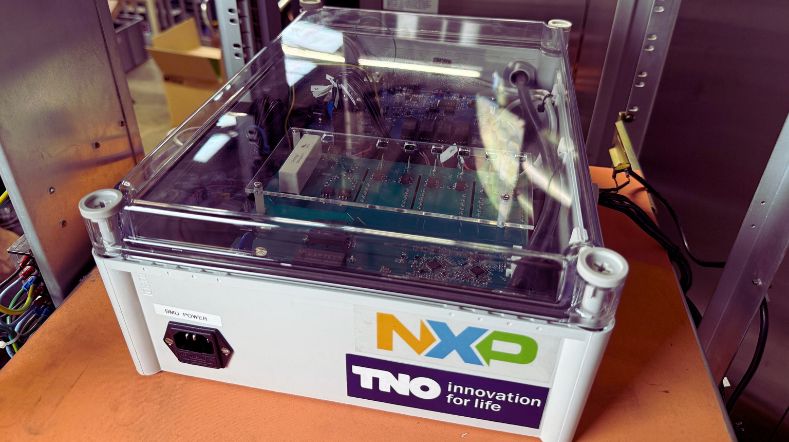
From lab to ice sheet: how TNO accelerates battery innovation with Team Polar
The energy transition relies increasingly on batteries in a wide range of applications; the mobility sector is leading the way, from light vehicles to heavy transport. But there is no such thing as a single perfect battery. Every application places its own demands on energy density, power output, thermal behaviour, safety, and lifespan. And that is precisely why TNO is contributing its expertise to Team Polar’s student project to make research in Antarctica more sustainable, affordable, and efficient.
Team Polar: Antarctica as the ultimate stress test for battery innovation
Team Polar, consisting of students from TU Eindhoven, is developing a self-driving vehicle to make research in Antarctica more sustainable, affordable, and efficient. TNO supports the team by sharing facilities and providing expert guidance.
The autonomous vehicle must be able to run on sustainable energy: solar panels and batteries. Both play a crucial role, but each has limitations. It is about finding the right balance.
Why is Antarctica relevant for batteries? Because Antarctica amplifies the preconditions we increasingly encounter in electrification: cold, limited energy input, autonomy, and reliability. In that environment, any overly optimistic assumption “fails” mercilessly, making it a perfect testing ground to learn what is truly needed.
Generating and storing energy in a world of -40°C
Team Polar’s first vehicle had to withstand rough terrain, drive autonomously, and generate and store its own energy, using, among other things, solar panels that repel ice and snow. Crucially, the system also requires batteries that are heated so that the rover can cover sufficient distances in the icy landscape, even when there is little or no sunlight.
This touches upon a core issue in battery practice: at low temperatures, power, charge acceptance, and usable capacity decrease, while internal resistance and risks regarding plating or adverse reactions actually increase. Team Polar addresses this not with “a better cell,” but with systems thinking: energy management, thermal management, and operational strategy.
Gentoo: 1,000 km in Antarctica
Team Polar’s second vehicle is Gentoo, named after an Antarctic penguin species. The autonomous vehicle weighs 300 kilograms, carries six square meters of solar panels, and is designed to operate autonomously 24/7 at temperatures of -40 degrees. Moreover, it will cover 1,000 kilometers across Antarctica. That figure is significant for battery systems: it implies not only sufficient energy but, above all, predictability.
In remote areas, “marginal degradation” quickly becomes “mission failure.” The combination of solar energy, storage, and thermal management makes the energy balance dynamic. Consequently, it requires battery management that anticipates conditions, not just a standard driving cycle. Both technologies were first tested in the Netherlands and subsequently put to the test in Sweden.

'As TNO, we’re not just standing on the sidelines. Our team of experts is helping Team Polar turn their wildest engineering dreams into reality.'
TNO as ‘enabler’: expertise and infrastructure
TNO explicitly supports Team Polar with knowledge regarding autonomous driving, solar panels, and batteries for vehicles. At least as important: the team can make use of TNO facilities such as climate chambers with extreme temperatures reaching far below zero.
This is where the bridge between TNO’s battery management portfolio and practice becomes visible: a rover that must function autonomously in extreme cold requires State of Control (SoX), Lifecycle Insight (RUL), and thermally controlled operation, precisely the building blocks TNO is working on.
Learnings for the battery sector
The value of Team Polar for the battery sector does not lie in the fact that everyone will build a polar rover tomorrow. It lies in the tightening of requirements that are also emerging in heavy-duty mobility, off-grid applications, and autonomous machines: less predictable load profiles, stricter availability requirements, and greater reliance on software optimisation.
TNO’s approach, physics-based modeling, SoX/RUL, integration into Battery Management Systems, and validation via PoC—shows how to manage that complexity without relying solely on “the next cell chemistry.” At the same time, Team Polar demonstrates why this is necessary: when energy input is limited (sun), the environment is extreme (cold), and failure is not an option, battery management becomes not a nice-to-have but a strategic core competency.

'In our lab, we can put batteries into thermal runaway in a safe environment and perform gas analyses during this process, even for larger systems.'
TNO’s battery expertise: from production to lifespan and recycling
Experts at TNO focus on various aspects of battery technology:
TNO is working on alternative raw materials and production processes for even better batteries, hydrogen electrolysers, solar panels, and wind turbines.
It is of strategic importance that Europe, and also the Netherlands, can produce their own batteries. TNO, together with Holst Centre and partners, contributes to the production of the battery.
By intelligently designing management, cooling, and monitoring, you shift degradation and safety margins from a cost item to a design variable. Our state-of-the-art Battery Lab offers fully climate-controlled test rooms, whether for battery packs or complete electric vehicles, with temperature control from –40 °C to +150 °C and humidity control.
What happens to used batteries, such as those from laptops or electric cars? LFP (Lithium Iron Phosphate) batteries are increasingly used in electric cars due to their safety, longer lifespan, and lower cost. However, recycling these batteries is a challenge because of the relatively cheap raw materials. TNO is conducting research into this.
Contact us
-

Jan-Willem Sangers
Functie:Business Development ManagerIn my role as a business developer Sustainable Vehicles, I work on establishing and facilitating collaborations in the field of sustainable mobility. These collaborations range from small-scale industrial research to large-scale international public-private partnerships in areas such as heavy-duty transport, shipping, non/off road mobile machinery, and even aviation applications.
-
Standplaats:Helmond - Automotive Campus
-
Email:Email Jan-Willem
-
LinkedIn:Jan-Willem on LinkedIn
-
Get inspired
Five tips for driving plug-in hybrid more efficiently
Forces combined: how TNO supports LionVolt to accelerate next-generation battery technology

How Arriva and TNO are shaping the next phase of electric bus transport
Sailing with an engine that emits only water? Mitsubishi and TNO prove it’s possible
Reliable monitoring of battery condition for transparent battery passports