Scaling high-value recycling for wind turbine blades
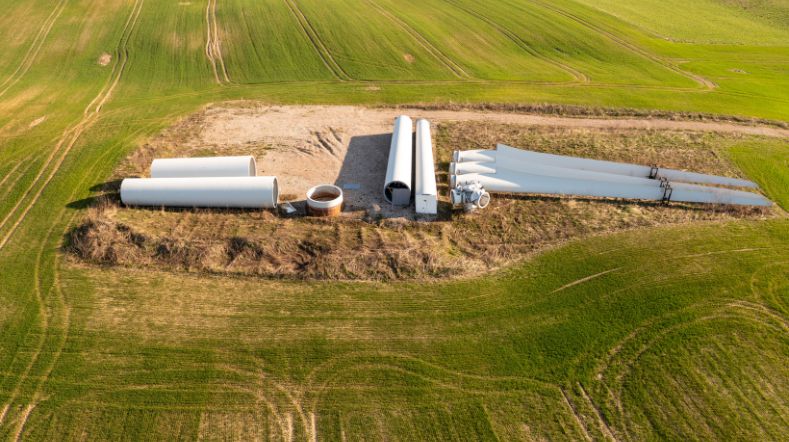
Wind turbine blades are increasingly reaching end of life, yet viable high-value recycling options remain limited. CIRCLE4WIN demonstrates how thermolysis can reclaim reusable glass fibres and has now taken key steps towards industrial-scale circular solutions.
Offshore wind is scaling rapidly, but its circularity challenge is becoming more visible with every passing year. The first generation of offshore wind farms is now approaching decommissioning, and the share of turbines requiring recycling is expected to increase steadily.
Modern turbine designs tend to be more tightly optimised for their intended service life, whilst offshore machines at end of life face a different reality altogether. Exposed to higher structural loads and harsher environmental conditions than onshore equivalents, they are generally not suitable for reuse, making recycling the only responsible route forward.
At the same time, the regulatory context is shifting. The EU has introduced a landfill ban for composite blades, meaning recycling is no longer optional. In the Netherlands and across Europe, tender criteria are increasingly requiring wind park owners to demonstrate a clear end-of-life strategy before projects are awarded. The pressure to have a credible, high-value solution is no longer theoretical.
The most commonly used recycling routes today, mechanical processing and co-processing in cement production, fall short compared to what is needed to make it circular. Mechanical recycling does not sufficiently separate fibres from resin to enable high-value reuse. Cement co-processing recovers material in the broadest sense, but does not reclaim it for new production cycles. Neither route reduces dependence on virgin raw materials at the level the sector requires.
Turning composite waste into reusable material
Within the CIRCLE4WIN project, TNO and its partners are developing an integrated recycling pathway based on thermolysis. Among the available separation technologies, thermolysis currently has the greatest short-term potential for application and scale-up alongside complementary routes such as dissolution-based plastic recycling, which can selectively separate polymers for high-quality reuse. The technology is already being used in other industrial contexts and offers a direct pathway to separate fibres from resin effectively.
The process consists of two steps applied to pre-processed blade material. Feedstock is derived from advanced pre-processing, including smart cutting solutions validated in an earlier phase of the project.
TNO has optimised key process parameters including input particle size, temperature, residence time and oxidation severity to deliver carbon-free reclaimed glass fibre (rGF) that meets the quality requirements for reuse in new glass fibre production and applications such as thermoplastic composites.
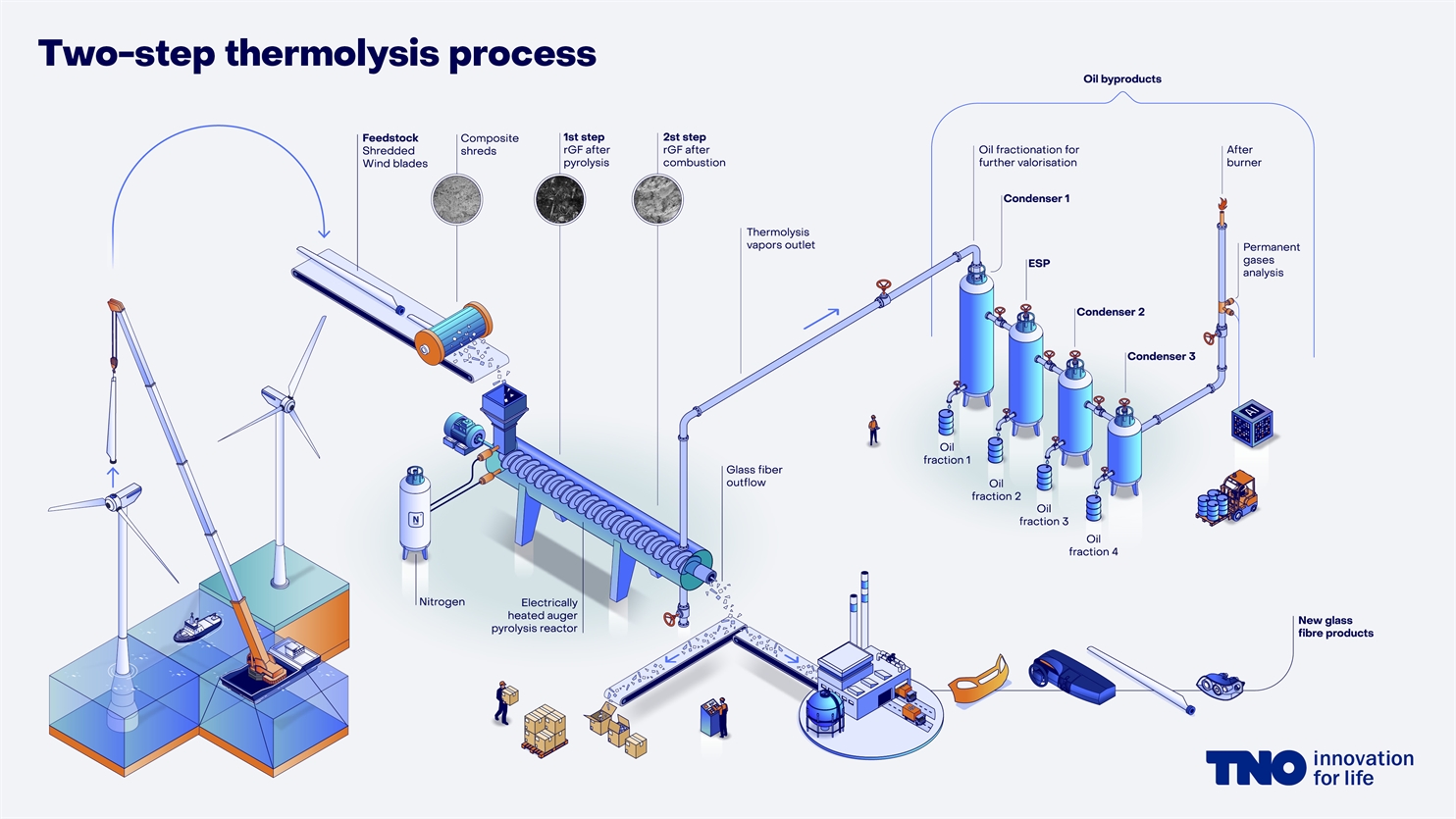
To ensure robustness, multiple batches of blade material from different origins were processed, deliberately addressing the heterogeneity of real-life end-of-life blade streams. Practical insights from these campaigns, including the early identification of contaminants such as metal wiring, copper, PVC core material and stones, have directly informed upstream pre-processing and shredding strategies across the consortium.
To date, approximately 60 kg of reclaimed glass fibre has been produced from two different wind turbine blade sources and extensively characterised. No red flags have been identified. Testing is now continuing with additional blade sources, and further characterisation of process outputs is underway to de-risk scale-up.
From pilot to industrial design
The project has now generated a comprehensive dataset covering mass and energy balances across all major input and output streams, including reclaimed glass fibre, circular liquid carbon products, residual char and process gases. This provides a solid technical foundation for scaling towards industrial deployment.
Reclaimed fibres are being tested for reintroduction into glass production in collaboration with Sibelco, which is processing the recovered material into Furnace Ready Cullet. Early results indicate that this material can serve as a direct input for new glass fibre products containing recycled content, a significant step towards closing the material loop.
The learnings from pilot operations are already feeding into the technical design of a demonstration-scale plant with a capacity of approximately 10,000 tonnes per year. To put this in perspective: such a facility would be capable of processing all wind turbine blades from the Prinses Amalia windpark with 60 wind turbines, one of the first Dutch offshore wind farms to be decommissioned, in approximately one month.
Building a value chain that can scale
A key strength of CIRCLE4WIN lies in its full value chain approach. The consortium spans every critical step: blade manufacturing (Suzlon), end-of-life management (IX Decom), pre-processing (D&E), thermolysis recycling (Renewi), raw material processing (Sibelco) and glass fibre production (Envalior). This integration is what makes the approach industrially credible rather than a laboratory exercise.
Scaling recycling is not only a technical challenge. It also depends on reaching sufficient volumes. For a recycling business to be commercially viable, an annual throughput of around 40,000 to 50,000 tonnes of composite material is required.
End-of-life wind turbine blades alone cannot yet supply these volumes, which means different composite waste streams will need to be combined. This is achievable, but it requires adequate knowledge and transparency about material composition and quality requirements across the chain. A Digital Product Passport (DPP) can play an important role in capturing and sharing this information.
'For high-value recycling of composite blades, transparency and clarity are essential, both in material composition and in planning and regulatory requirements.'
Why thermolysis stands out
From a circularity perspective, the route that enables glass fibres to be remelted and reused offers the highest recycling value currently available. Where mechanical recycling produces mixed materials with limited end-use options, thermolysis makes it possible to reintroduce fibres into new production cycles. This difference is critical for reducing demand for virgin raw materials and building more resilient, circular material supply chains within Europe's wind energy ecosystem particularly in the context of increasing pressure on the availability of critical raw materials.
Looking ahead: from feasibility to deployment
The current results mark an important milestone, but significant work lies ahead. The project will continue to:
- Finalise design requirements and detailed cost estimates for large-scale thermolysis installations
- Complete lifecycle assessments for real-world scenarios
- Produce additional rGF batches for end-product performance testing with additional blade sources
The broader system conditions must also evolve in parallel. Policy frameworks, tender requirements and value chain coordination, including instruments such as the Digital Product Passport, will all be essential for enabling large-scale adoption.
By connecting technological validation with industrial implementation, CIRCLE4WIN helps reduce uncertainty for investors and accelerates the transition towards circular wind energy systems. The sector has introduced the regulatory conditions. The value chain is taking shape. What CIRCLE4WIN is now building is the technical and economic evidence base to make large-scale adoption real.
Interested in collaboration or exploring circular solutions for wind turbine blades?
Get in touch with our experts to discuss applications, partnerships and scale-up opportunities.
Contact us
-
Harald van der Mijle Meijer
Functie:R&D portfolio managerIr Harald van der Mijle Meijer is a materials engineer and has been working in offshore wind research since 2007. Harald has a passion for wind, sea and sustainability and applies this for the strategy and implementation of the development of innovations in wind energy together with the industry. At TNO he has carried out several national and international projects on a wide range of topics. In addition to being a consultant, he is R&D portfolio manager on the research line 'Offshore Wind Farms'.
-
Standplaats:Petten - Westerduinweg
-
Email:Email Harald
-
Get inspired
Smart radar protects bats at Eemshaven wind farm
Biodiversity
TNO and Jungle AI collaborate to detect cyberattack on wind turbine and improve detection capabilities
Improving wind turbine maintenance with the sensor installation robot
First study on public perception of wind turbine circularity