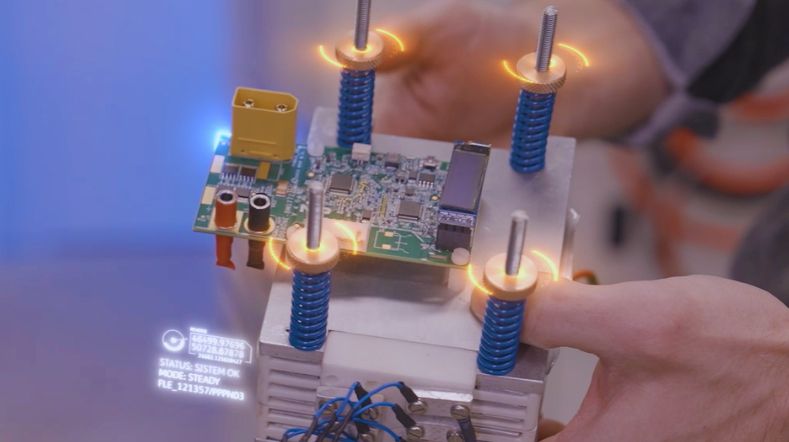
SeBaPaD 2: Secure Battery Passport Demonstrator 2
Status project
January 2026 – October 2026
In cooperation with
NXP Semiconductors
Batteries are becoming increasingly important for energy, mobility and electronics. SeBaPaD 2 builds on the first Secure Battery Passport project and scales the secure battery passport from module level to high‑voltage battery packs. Together with NXP and industrial partners, TNO demonstrates a reliable battery passport for complete battery systems.
SeBaPaD 2
In the first Secure Battery Passport Demonstrator (SeBaPaD) project, a secure and reliable Battery Passport was successfully demonstrated at battery module level. Building on this foundation, SeBaPaD 2 aims to take the next step by extending the concept to a high-voltage battery pack, addressing the additional technical complexity that arises when multiple modules are combined into a complete system.
SeBaPaD 2 focuses on scaling the Battery Management System and Battery Passport concept from module level to pack level, while maintaining reliable battery condition assessment, system safety, and data trustworthiness throughout the battery lifetime.
SeBaPaD 2 addresses the research challenges that arise when scaling a secure Battery Passport and Battery Management System from module level to a high-voltage battery pack.
The project investigates how battery condition and performance assessment, data aggregation, and security concepts can be preserved when multiple modules are combined into a pack operating at approximately 500 V. This requires research into pack-level system architectures, coordination between module-level and pack-level BMS functions, and consistent aggregation of lifecycle data into a single pack-level Battery Passport.
Security is addressed as a system property. By analyzing how increased system complexity affects data integrity and trust, the project explores how secure hardware elements, protected communication, and software-based checks can be combined to maintain trustworthy Battery Passport data at pack level.
System integration and experimental validation are performed at the battery prototyping and testing facilities of TNO in Helmond, enabling controlled testing of high-voltage packs and BMS behaviour under realistic conditions.
SeBaPaD 2 is a collaboration between TNO and NXP, building on a proven partnership established in SeBaPaD 1.
TNO contributes expertise in battery systems engineering, Battery Management System algorithms, system integration, testing, and the Battery Passport cloud infrastructure. NXP provides Battery Management System hardware platforms, embedded software, and security technologies that are essential for high-voltage battery systems.
By combining complementary expertise, the partners aim to deliver a realistic and scalable reference implementation that reflects both research insights and industrial constraints.
Impact
SeBaPaD 2 aims to demonstrate that secure and reliable Battery Passport implementation is feasible not only at module level, but also at high-voltage pack level, where system complexity and safety requirements are significantly higher.
By addressing the technical challenges of scaling in hardware, software, and security, the project supports the development of Battery Passport solutions that remain trustworthy throughout the battery lifetime. This enables better-informed decisions on battery reuse, repurposing, and recycling, contributing to a more circular battery economy.
The outcomes of SeBaPaD 2 are intended to support industry readiness for upcoming Battery Passport obligations. Curious about SeBaPaD 2 or TNO’s expertise on Battery Passport and algorithms? Contact one of our experts.
Collaboration

- The project is funded by Holland High Tech
- Programme: Battery Integration | 2024-2027
- Total budgeted project costs: €141.549,00
Contact us
-

Avedis Dadikozyan
Functie:Medior Scientist IntegratorAs a Medior Scientist Integrator, my work focuses on powertrain electrification through modeling and optimization techniques, with applications in the automotive and maritime industries. Furthermore, my work includes development of battery modeling tools and diagnostic protocols, aimed at improving the efficiency and reliability of electric powertrains for sustainable transport solutions.
-
Standplaats:Helmond - Automotive Campus
-
Email:Email Avedis
-
-

Federico Ribatti
Functie:Project managerIn TNO, I coordinate research projects focused on several technologies applied to sustainable mobility and sustainable storage of energy, both in civil and military domain.
-
Standplaats:Helmond - Automotive Campus
-
Email:Email Federico
-
-

Feye Hoekstra
Functie:Battery ScientistAt TNO I work on sustainable mobility and built environment by using batteries to replace fossil fuels. My research is aimed at using battery management to enhance battery performance and my expertise lies in battery management algorithms, and battery modelling and testing.
-
Standplaats:Helmond - Automotive Campus
-
Email:Email Feye
-
Get inspired
Reliable monitoring of battery condition for transparent battery passports
How far can you travel in an electric car?
National Growth Fund invests in Dutch battery consortium for heavy duty transport
TNO opens test cell for sustainable marine engines
Battery technology: 4 developments according to the Battery Lab