ELOQUENCE: quantifying well leakage risk for a safer energy transition
Status
2026 - 2028
Partners
TNO (Netherlands), SINTEF (Norway), Shell (Netherlands/UK), Eni (Italy), PTTEP (Thailand), RAG (Austria), INPEX (Japan)
Europe’s climate ambitions depend on the subsurface. Carbon capture and storage (CCS) is one of the few available tools for decarbonising hard-to-abate industries, while geothermal energy and hydrogen storage are emerging as pillars of a flexible, low-carbon energy grid. What all of these have in common is that they rely on wells, and on those wells staying sealed during operations and after activities have ceased.
Securing the subsurface for the energy transition
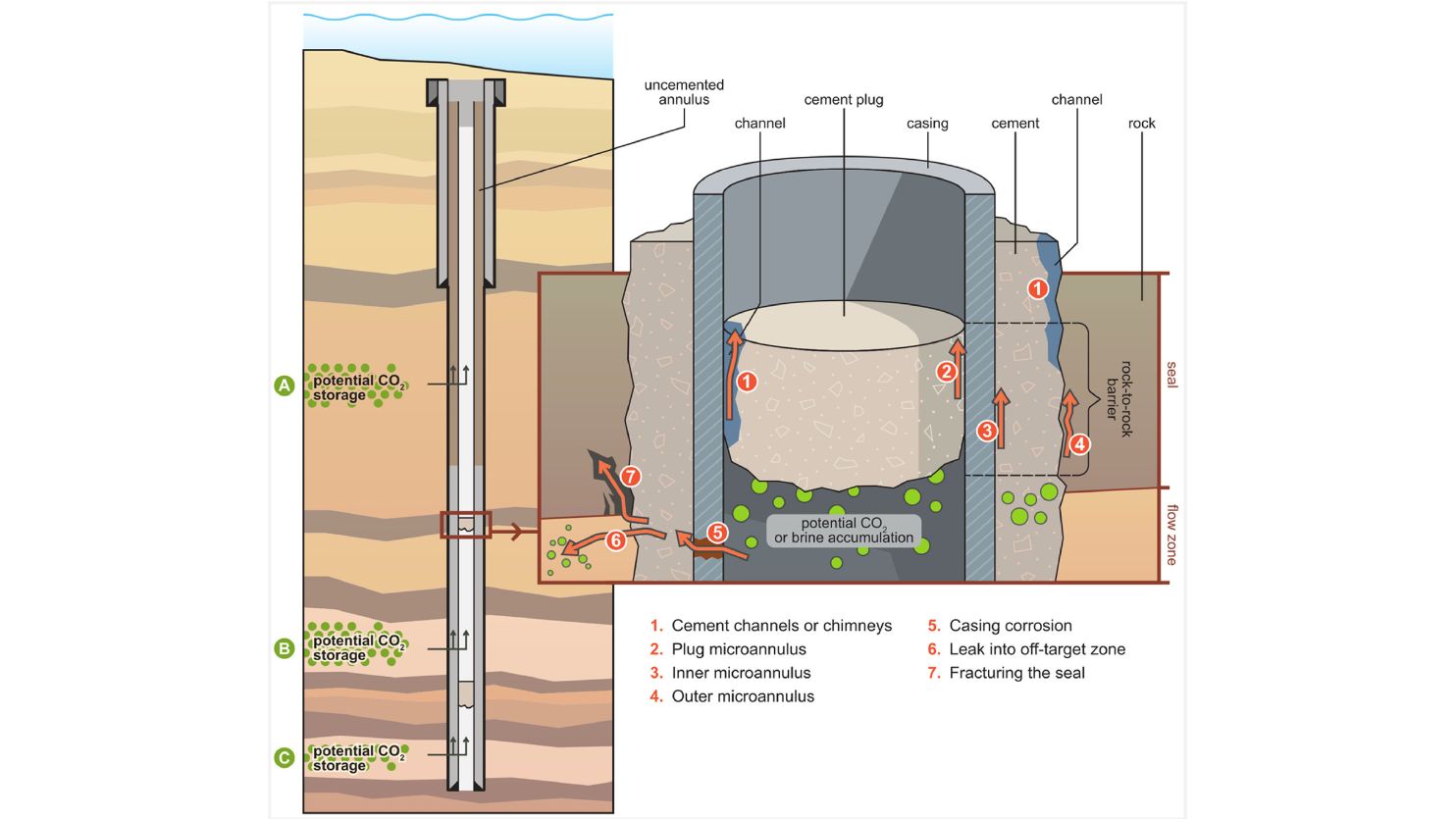
Although this not always is a given. Across Europe and beyond, hundreds of thousands of oil and gas wells have been drilled over the past century. Many are aging, abandoned, or poorly documented. As CO₂ (CCS), water (geothermal), or hydrogen are injected into the subsurface near these legacy wells, they can become unintended escape routes (Figure 1).
Operators, regulators, and investors all need to know: which wells pose a risk, how much and which fluids could leak, and where would it go? Today, no industry-standard tool exists to answer those questions quantitatively. ELOQUENCE is building it.
Building the industry standard for well leakage assessment
ELOQUENCE is a Joint Industry Project (JIP) led by TNO in collaboration with SINTEF and five international industry partners: Shell (Netherlands/UK), Eni (Italy), PTTEP (Thailand), RAG (Austria), and INPEX (Japan). Over 24 months, the consortium is developing a stand-alone predictive software tool that estimates leakage rates and pathways for any well, from modern CCS injection wells to decades-old legacy wells with incomplete records.
The tool works in two integrated steps. First, it analyses the well’s geometry, cement condition, and surrounding geology to map all plausible leakage pathways and predict the size of hairline gaps in the cement (called microannuli) that can form during and after well construction.
Second, it uses those results to calculate how fluids would actually move through the well system over time. This includes flow rates, pressure changes, and the most likely destination of any leaked gas, whether that is a shallow aquifer, an adjacent formation, or the surface.
This modelling work is grounded in new laboratory experiments: cement stress evolution tests under realistic downhole pressure and temperature, novel two-phase flow tests in water-filled hairline gaps (a first-of-its-kind experimental demonstration), and flow tests on realistic wellbore samples.
Building on TNO and SINTEF’s existing well integrity modelling and experimental capabilities, developed through a decade of European, Dutch and Norwegian research, the project will validate the tool against real wells with documented leakage before delivery to partners.
A practical tool for risk management
At project completion, industry partners will receive the leakage calculator, experimental datasets, and a full user manual, giving them a concrete asset for permit applications, well screening, and investment decisions in CCS and well decommissioning.
The tool’s relevance extends beyond CO₂ storage. Fugitive methane emissions from abandoned and active oil and gas wells are increasingly on the regulatory radar: the EU’s new Methane Regulation introduces binding requirements for operators to measure, report, and reduce emissions from inactive wells.
ELOQUENCE’s leakage quantification approach is directly applicable here, offering operators a defensible, physics-based method to assess and demonstrate compliance, rather than relying on conservative assumptions or costly well-by-well measurement campaigns.
Want to shape the future of CCS well integrity?
Industry partners who join ELOQUENCE gain direct access to emerging research results, an active voice in shaping the tool’s development, and a working computer program at project completion. If your organisation is concerned with well integrity and leaks, managing legacy wells or planning CCS storage, we’d welcome a conversation.
Contact us
-

Fabio Rosas
Functie:Senior Business Developer Well TechnologyIn my career, I have been driven by a passion for fostering innovation and enabling collaboration across industries to support a sustainable energy future.
At TNO, I am committed to connecting research and industry to spark innovation in the energy sector. My focus is on creating fertile ground for new ideas and advancing technologies that prioritize sustainable resources, all with the goal of driving progress toward more sustainable societies.
With a steadfast dedication to collaboration and progress, I work to align strategic objectives and inspire transformative solutions for the ever-evolving energy market.
-
Standplaats:Rijswijk - Kesslerpark
-
Email:Email Fabio
-
-

Jens Wollenweber
Functie:Project Manager-
Standplaats:Utrecht - Princetonlaan
-
Email:Email Jens
-
-

Al Moghadam
Functie:Senior Scientist, Geoscience & TechnologyContact me to discuss our tools and methods to evaluate well leakage risk for abandoned oil and gas wells, hydrogen storage, geothermal, and carbon sequestration projects (CCS).
I specialise in modelling well cement and fluid leakage along wells, connecting science with field application and evidence.
-
Standplaats:Utrecht - Princetonlaan
-
Email:Email Al
-
In collaboration with



Get inspired
Hydrogen & CCUS Expert Workshop at the Hamburg Expo
Oil and gas in transition

TNO–SodM–NIOZ: ‘Methane emissions in the North Sea often linked to shallow natural gas’

Heat
Geothermal energy: sustainable heat from the subsurface