

Obesity
Our flagship TNO Ldlr-/-.Leiden model closely reflects the metabolic dysfunction underlying human obesity and its multi-organ complications. When fed energy-dense diets without requiring added cholesterol, these mice develop obesity, insulin resistance, and dyslipidemia, resulting in complications that affect the liver, vasculature, adipose tissue, brain, gut, and skeletal muscle. The model has been validated with a broad range of clinically relevant interventions, including GLP-1 receptor agonists and FGF21 analogs. This makes our Ldlr-/-.Leiden model a powerful translational platform for evaluating therapies targeting obesity and its multi-organ complications.
Key capabilities
Study types
Tailor-made efficacy studies for targeted pathways and mechanisms
Model
Ldlr-/-.Leiden
Output
High quality efficacy data to support informed decision-making
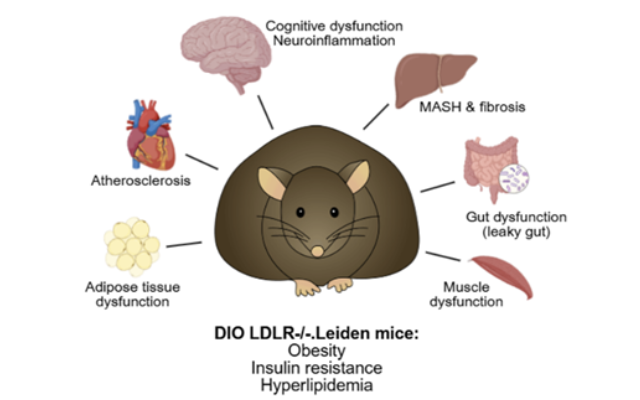
A powerful model to study multi-organ metabolic disease
TNO supports pharmaceutical and biotech organizations in evaluating therapies targeting obesity and its associated metabolic diseases. Combining our Ldlr-/-.Leiden model with integrated multi-organ read-outs, we generate translational datasets that provide insight into disease progression and treatment response across tissues. Our tailor-made efficacy and mechanism-of-action studies are designed around your specific research questions and supported by a broad range of mechanistic endpoints, enabling informed go/no-go decisions throughout drug development.
30+
years of preclinical metabolic disease expertise
100+
completed efficacy studies across disease indications
100+
pharma, nutritional & biotech partners
60+
peer-reviewed publications
Key advantages
Translational efficacy models
Validated mouse model capturing multi-organ metabolic dysfunction observed in human obesity.
Multi-organ readouts
Integrated assessment across liver, adipose tissue, vasculature, gut, and brain.
Flexible study designs
Support for both preventive (progression) and therapeutic (regression) study setups.
End-to-end expertise
From study design and execution to data analysis and interpretation.
AI-powered histopathology
Our AI-based histopathology platform enables standardised, fast, and high-throughput quantification of liver pathology, including steatosis, inflammation, and fibrosis. This reduces inter- and intra-observer variability and improves sensitivity to detect treatment effects. The platform can be applied to both TNO-generated and externally generated histology samples.
Use cases
Drug efficacy testing
Assess treatment effects on MASH progression or regression including fibrosis up to stage F3.
Mechanism of action studies
Investigate how compounds influence metabolic, inflammatory, and fibrotic processes.
Biomarker & endpoint validation
Generate translational datasets to support biomarker strategies.
Choose the right preclinical research partner
TNO bridges the gap between preclinical obesity research and clinical outcomes. Our model captures multi-organ disease complexity and is continuously validated against clinical data, ensuring high translational relevance.
- Proven translatability through clinically aligned mouse models
- Multi-organ disease insight in a single model
- Ethical and responsible research execution
- Clear, actionable data to support decision-making

Ready to accelerate your obesity research?
Get in touch to discuss your research objectives and explore how TNO can design and execute a tailored preclinical obesity study for your compound.
In an initial discussion, we:
- align on your research objective
- propose suitable model-diet combinations and study design
- provide a first outline and indicative cost range
Contact us
-
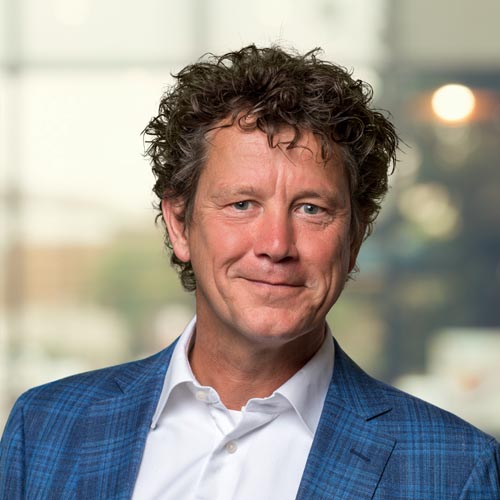
Robert Ostendorf
Functie:Senior Business Development Manager translational pharmaceutical researchI am passionate about TNO’s unique expertise in translational (preclinical) research. My work focuses on efficacy, ADME/DMPK and target safety of new pharmaceutical interventions, with special interest in cardiovascular, metabolic and fibrotic diseases, and biomarker research.
Looking for contract research support, or see opportunities for collaboration? Please, reach out.
-
Standplaats:Leiden - Sylviusweg
-
Email:Email Robert
-
LinkedIn:Robert on LinkedIn
-