

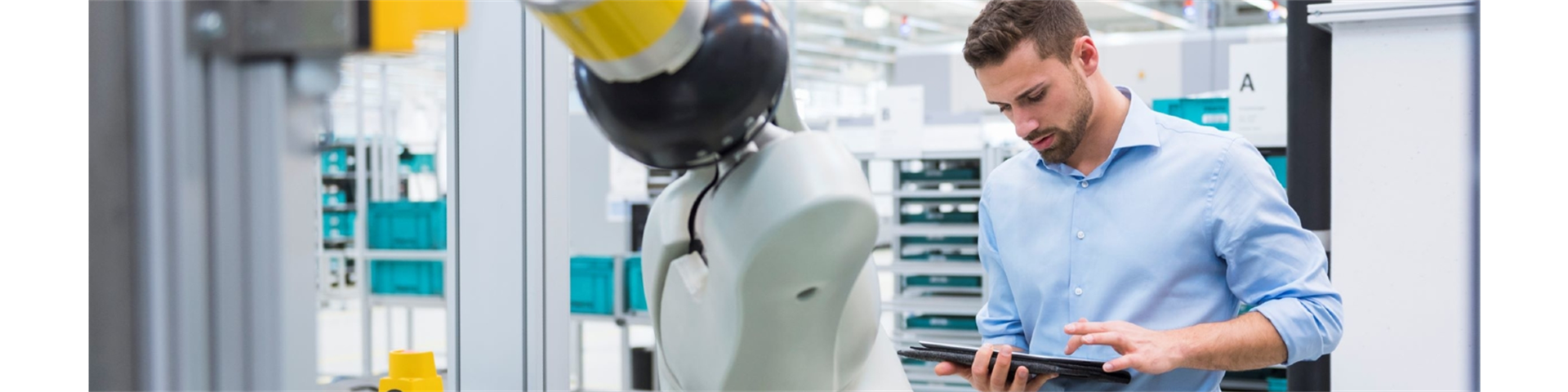
Working productively with technology and AI
Technological developments are advancing rapidly and having a significant impact on our work. However, it is unclear what our work will look like in the future. This is why TNO is researching the changing nature of work, focusing on improving the quality of labour, innovation, productivity, and competitiveness. Together with sector organisations, regions, educational institutions and individual organisations we conduct human-centered experiments, pilots and research with new technology to enhance both the quality of labour and help companies become more innovative and productive.
Technological developments have always resulted in the loss of jobs and the creation of new ones. However, less attention is being given on how jobs are changing. Organisations should also take other factors into account, like the ageing population and energy transition, to assess what the work will entail and what skills workers need. The introduction of new technologies, like artificial intelligence (AI) and Large Language Models (LLMs), requires the development of new concepts for human-centered implementation.
Human-centered approach key to success
In our 'Smart work' programme, we focus on improving the functioning of technology for employees and within organisations. Our approach is for organisational policy, as well as work and task organisation and technology, to be designed and structured in a human-centered way. By ensuring the right division of tasks and interaction between technology and employees, sustainable benefits are created for both employees and employers. Employees who help shape their technology get more out of it.
Thanks to TNO’s unique and multidisciplinary expertise, we know what is needed to successfully implement existing and new technology in organisations. This way, we can contribute to solving labour shortages by improving process innovation and labour productivity in a humane manner. We promote the adoption of technology in organisations to increase their productivity, enable human-centered application of AI and ensure a good quality of work.
Developing, testing, and implementing in practice
We develop and test methods, approaches, applications, tools and criteria to develop and apply existing and new technology in a human-centered way. We provide participatory methods to collaboratively shape to all kinds of technology with employees in a human-centered and bottom-up approach. To this end, we conduct lab and survey research and carry out experiments and pilots with new technology in the workplace, measuring its effects on productivity, employability and quality of work.
Additionally, we are also exploring how to enable employees to gain control over AI. We do this in collaboration with companies that focus on technology, particularly in industries such as manufacturing, logistics and construction. The aim is to keep the often scarce human resources in sectors like manufacturing effectively, flexibly and sustainably employable with the help of human-centered technologies, This includes technologies sucah as augmented reality (AR), collaborative robots and exoskeletons as well as feedback sensors, big data and AI.
Together towards a human-centered and sustainable use of technology
TNO works on various national and international projects. For example, collaborations with various Smart Industry parties (industries, large companies, and SMEs): including the Experience Centre Factory of the Future on the Brainport Industries Campus in Eindhoven and Fieldlab RoboHouse in Delft. TNO has developed various demonstrators in the field of support technologies such as digital instructions, AR and projection technology for assembly, service and remanufacturing. We support companies to choose and set up the right support technology aligned with the processes, objectives and employees of the company.
The European Horizon project BRIDGES 5.0 is exploring how to consider better outcomes for employees, the environment and society as a whole during the digital transition in industry, specifically to achieve productivity and technological improvements. The focus is on evaluating and improving two established forms of training interventions – teaching and learning factories – that facilitate skills adaptation in the manufacturing industry and contribute to a human-centered , sustainable and resilient economy. The Sharehouse Warehouse Living Lab, which is also part of BRIDGES 5.0, helps find solutions for optimal collaboration between humans and technology in the logistics sector.
In SEISMEC, another major European Horizon initiative, we are conducting research in various human-centered pilots with innovative technology, at different scales and within various industrial sectors and socio-technical contexts in 14 European countries.
Another theme we are researching is effective support in demanding working conditions. One example is a wearable skeleton, an exoskeleton, which can reduce the physical strain on workers. For example, amongst other things, we have studied the effect of the exoskeleton on physical strain, behaviour, fatigue and productivity in plasterers. We test the application of exoskeletons with companies and help them in implementing and evaluating. Parallel to this, we continue to develop the next generation of active exoskeletons, which potentially have a wide range of applications.
Would you like to work with us?
Would you like to learn more about our activities in the field of human-centered working with technology and AI? Or are you, as a company, facing labour shortages and wondering if technology could help? If so, please do not hesitate to contact us. We are ready to help anyone struggling with process optimisation or efficiency improvement, who wonders how AI could truly be used as a tool for employees, and how they can be involved in shaping, implementing, and adopting technology. We also welcome companies that wants to invest in a future-proof organisation and human capital, as well as policy makers who want to stimulate technological advancement.
Contact us
-
Rob van der Maarel
Functie:Marketingmanager-
Standplaats:Leiden - Sylviusweg
-
Email:Email Rob
-
-
Steven Dhondt
Functie:Senior scientist at TNO and Professor at KU LeuvenMy main focus is on the impacts of the newest technologies on organisational and work practice. At TNO, I coordinate the Smart Working-research programme, developing insights on the impacts of robotics and digitization on organisational practices.
-
Standplaats:Leiden - Sylviusweg
-
Email:Email Steven
-
-

Gu van Rhijn
Functie:Senior Project Manager-
Standplaats:Leiden - Sylviusweg
-
Email:Email Gu
-
-

Diane Confurius
Functie:Lead Researcher-
Standplaats:Leiden - Sylviusweg
-
Email:Email Diane
-
-
Gerben Hulsegge
Functie:Scientist Integrator-
Standplaats:Leiden - Sylviusweg
-
Email:Email Gerben
-
-
Aijse de Vries
Functie:Senior Scientist-
Standplaats:Leiden - Sylviusweg
-
Email:Email Aijse
-
Get inspired
Substances Information System: powerful online search engine for chemical substances further expanded
New expertise centre to help companies innovate more safely and sustainably

Over 300,000 workers in the Netherlands experience heat stress at work

TNO Announces the launch of ObjectivEye
Prospective Life Cycle Assessments for future-proof product design
