Criminals are using AI smarter and smarter; how do we stay one step ahead?
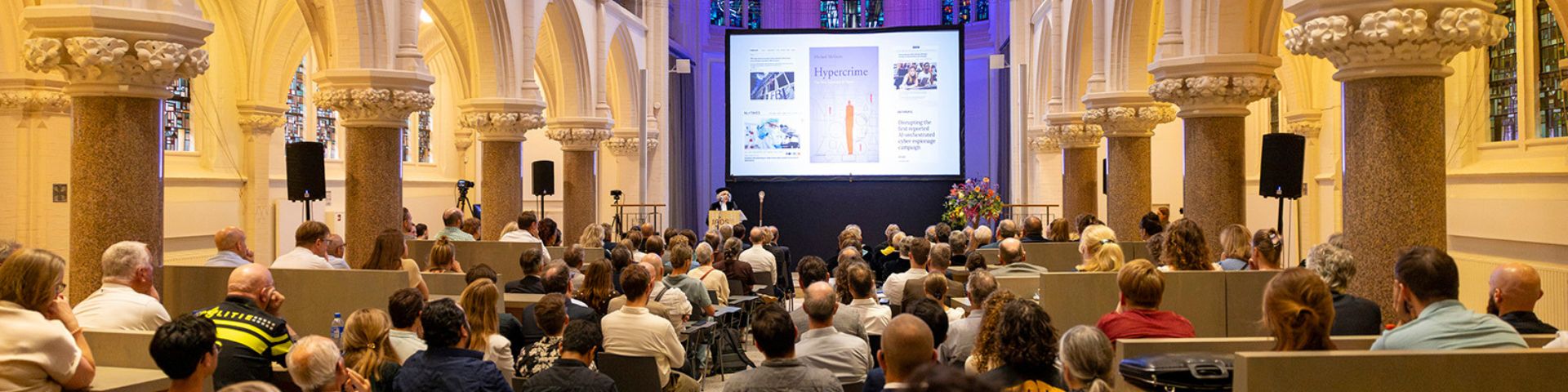
Criminal networks are using AI and other digital technologies with increasing effectiveness. According to Prof. Ana Isabel Barros, Principal scientist at TNO, the key therefore lies not in more AI, but in how we use it. This is the only way we can tackle the growing complexity of organised crime and subversion. In her inaugural lecture on July 8, she highlighted the opportunities AI offers, but also where the technology falls short.
Understanding AI and crime
The developments Barros describes are more relevant than ever. Due to increasing digitisation and globalisation, criminals now operate effortlessly in both the physical and digital realms. They are able to adapt quickly to measures designed to stop them and often adopt new technologies faster and with fewer restrictions than the organisations fighting them. Moreover, organised crime, cybercrime, and geopolitical conflicts are becoming increasingly intertwined.
'The real challenge is to combine technology with human expertise, critical thinking, and collaboration within and across organisations. Only then can we capitalise on the opportunities offered by AI without losing sight of the risks.'
Crime is changing fundamentally
'The nature of crime is fundamentally changing,' says Barros. 'The front lines are no longer confined to the streets or within national borders, but extend far beyond national boundaries and deep into the digital realm. Criminal activities are increasingly taking place at the intersection of the physical and digital worlds, where developments in one dimension have direct consequences for the other, and vice versa. This interconnection not only increases criminals’ effectiveness but also amplifies the nature and impact of disruptive crime.'
Hypercrime calls for a new approach
According to Barros, this development calls for breaking down traditional barriers between law enforcement, local government, and national defense, as well as between domains such as cyber and physical, or military and civilian. Given criminals’ rapid ability to adapt, it is essential to invest in predictive capabilities, early detection, and the resilience of citizens and organisations.
Barros summarises these developments under the term 'hypercrime': a form of crime in which physical and digital threats, organised crime, and geopolitical developments are becoming increasingly intertwined.

The role of AI
Against this backdrop, Barros examines how AI is, on the one hand, being exploited by criminals and, on the other hand, can help to identify patterns, vulnerabilities, and connections earlier. She emphasises that technology is not a magic bullet: careful and responsible use, with an eye toward ethical and legal frameworks, is essential.
This leads to a pressing question that was central to the speech: Are we still leading the way, or are we in danger of falling behind? According to Barros, the answer lies not only in better technology: 'The race isn’t won with better AI alone,' she said. 'The real challenge is to combine technology with human expertise, critical thinking, and collaboration within and across organisations. Only then can we capitalise on the opportunities offered by AI without losing sight of the risks.'
Data science and AI for a resilient society
Barros’ research is taking further shape within the JADS Center for Data Science and AI against Organised and Subversive Crime. Her chair, funded since 2020 by the Ministry of Justice and Security, the Province of North Brabant, the Municipality of Tilburg, RIEC Oost Brabant, and RIEC Zeeland West Brabant, is based at the Tilburg School of Humanities and Digital Sciences for the benefit of the Jheronimus Academy of Data Science (JADS).
Within the Center, researchers focus, among other things, on identifying patterns and networks within organised crime, the role of technology in this context, and the development of effective interventions and policy strategies.
Contact us
-

Frans van Ette
Functie:Director Autonomous Systems & Decision Support-
Standplaats:Den Haag - New Babylon
-
Email:Email Frans
-
Get inspired
Security of supply of critical medicines: A prerequisite for healthcare and military readiness
Cybersecurity

ACROSS: Can adaptive camouflage help make soldiers invisible to enemy detection?
National security in the Netherlands: 5 themes in focus

Cyber and electronic warfare