Security of supply of critical medicines: A prerequisite for healthcare and military readiness
‘Tropical Storm Helene is sweeping across the US state of Florida. The extreme weather has claimed dozens of lives and caused flooding, landslides and extensive damage to buildings.’ This was breaking news at the end of September 2024. What was not specifically mentioned in the media was that one of those buildings was a Baxter factory. Baxter, the world’s leading supplier of intravenous fluids and IV bags, was suddenly unable to deliver these products.
From local disruption to global shortages
‘Because there were insufficient alternatives available for Baxter’s products, shortages emerged within our healthcare system and were felt across the entire sector. In addition to this storm, several other natural and man-made disasters in recent years have had serious consequences for the supply of essential medical products to the Netherlands,’ says Bart, Principal Scientist at TNO within the unit Health & Work.
He believes the recurring shortages of critical medical products are symptoms of a complex underlying issue: ‘Dutch healthcare has become structurally dependent on highly concentrated international supply chains. Production and access to raw materials are limited to a small number of locations and suppliers.
Only a few years ago, the COVID-19 pandemic painfully demonstrated how a health crisis can severely disrupt society. We saw that shortages of critical medical products not only place immense pressure on healthcare systems, but that a health crisis can also have far-reaching economic consequences.
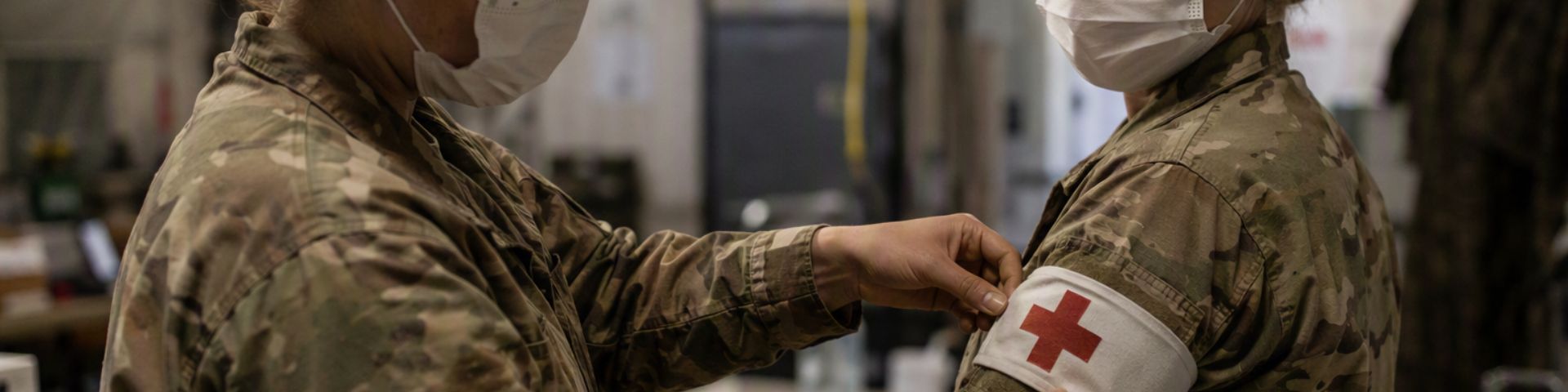
Moreover, this crisis made us realise that the security of supply of critical medicines is also a prerequisite for military readiness, because civilian and military supply chains rely on the same vulnerable international suppliers.’

‘The availability of medical supplies is important not only for civilian healthcare, but also for the operational readiness of our armed forces.’
The need for supply security
Shortly after the COVID crisis was brought under control, Mission V was established. Mission V, chaired by Bart, forms part of the mission-driven innovation policy of the Dutch Ministry of Economic Affairs and Climate Policy. This policy focuses on complex societal challenges and promotes innovation through public-private collaboration. The Ministry of Health, Welfare and Sport is responsible for the mission’s substantive direction.
Maarten, a policy officer at the Medicines and Medical Technology Department of the Ministry of Health, Welfare and Sport, explains: ‘This fifth mission was created with a focus on society-disrupting health crises resulting from pandemics and antimicrobial resistance.
To strengthen preparedness for geopolitical threats, the theme of ‘security of supply of critical medical products’ was added. Within the broader category of medical products, our primary focus is on medicines. Partners in the mission team include businesses, funding organisations such as NWO and ZonMw, and knowledge institutions including TNO, all working together to guide innovation that enhances resilience in crisis situations.’
Vulnerable international supply chains
‘The fact that shortages keep occurring points to structural vulnerabilities in supply chains. And what is a vulnerability under normal circumstances can become a breaking point during a crisis,’ Maarten confirms. ‘One major weakness is Europe’s dependence on international production chains. Many essential medical products are manufactured outside Europe, particularly in China and India.
The shift of production from Europe to other continents has made us vulnerable. Geopolitical tensions, trade disputes or transport disruptions can have direct consequences for the supply of medical products. At the same time, Europe is losing valuable knowledge, expertise and scaling capabilities alongside these manufacturing processes – all of which are crucial during crises.
This vulnerability is now also recognised at European level. Initiatives such as the Critical Medicines Act and lists of critical medicines provide tools to improve the availability of essential medicines in a targeted way.’
The Critical Medicines Act (CMA)
In March 2025, the European Commission proposed the Critical Medicines Act (CMA). This legislation aims to improve the availability, supply and production of critical medicines within the EU. In addition, the CMA seeks to enhance access to other medicines of common interest, such as treatments for rare diseases. The legislation also addresses the issue of certain medicines being unavailable in specific markets.
- Strategic projects involving critical medicines or their ingredients may be designated, giving them easier access to funding and accelerated procedures.
- Public procurement will be used to strengthen the resilience of supply chains for critical medicines and improve access to other medicines of common interest.
- The Commission will support joint procurement initiatives between Member States, upon request, to address differences in the availability of and access to critical medicines and other medicines of common interest.
- International partnerships with like-minded countries and regions will be explored to diversify supply chains and reduce dependence on a limited number of suppliers.
The impact on military readiness
On the importance of supply security for Defence, Bart says: ‘The availability of medical products is important not only for civilian healthcare but also for the operational readiness of our armed forces. In conflict or crisis situations, medicines such as antibiotics, anaesthetics, pain relief medicines and intravenous fluids are essential for treating casualties and supporting military medical systems.
When supply chains come under pressure, this can have direct consequences for the deployability of military personnel. At the same time, a large-scale crisis is likely to cause a sharp increase in demand for medical products, both within civilian healthcare and military structures. Furthermore, shortages could be used as a means of political pressure by non-EU countries.’
An innovation agenda focused on solutions
‘Simply identifying the problems is not enough,’ Bart notes. ‘The Mission V collaboration platform focuses on solutions that strengthen the security of supply of critical medical products. Innovation plays a vital role in this.
One key area is pharmaceutical manufacturing. New technologies in biotechnology and chemistry can make production processes more efficient, flexible and scalable. Examples include 'on-demand manufacturing', modular production facilities, continuous manufacturing processes and systems that can rapidly scale up during crises.
There is also work to be done in the use and management of medicines. Smarter stock management, more efficient distribution, digital monitoring and alternative treatment strategies can all help make better use of available resources.
Economic and policy frameworks also matter. Due to low margins and significant price pressure, producing critical medicines in Europe is currently barely commercially viable. New business models, adapted procurement strategies and long-term purchasing guarantees could contribute to a more stable market outlook.’

‘We provide broad knowledge and research expertise, but above all we help create an ecosystem.’
TNO as a systems partner
‘Within Mission V, TNO occupies a unique position,’ says Bart. ‘We contribute a broad knowledge base and extensive research experience, but we primarily help to create an ecosystem. Bringing together policymakers, industry, businesses and knowledge institutions may well be TNO’s most important contribution.
Within this growing network, knowledge and experience are shared to accelerate the journey from innovation concept to practical application. We have built this expertise through research into health and resilience, as well as through extensive experience in supply chain and risk analysis for critical goods and in modelling demand and inventory. Through public-private collaboration, we also act as a key knowledge partner in implementing innovations in real-world practice, particularly where civilian healthcare systems and Defence intersect.
In the civil-military context, TNO acts as a systems partner by bridging the worlds of healthcare, industry, research and Defence. We help translate needs such as operational readiness and crisis response into concrete solutions, supply chain agreements and innovations that can be applied in both civilian and military settings. For complex challenges such as supply security, a joint approach is essential. No single organisation can solve this issue alone.’
Opportunities for Dutch biotechnology and chemistry
Maarten sees significant opportunities in strengthening supply chains and believes the Netherlands can take a leading role: ‘We have strong biotechnology and chemistry sectors. These domains can become important pillars within Europe for developing new production processes and medical technologies. Increasing European production of critical medical products contributes not only to strategic autonomy but also to new economic activity and knowledge development. Innovative manufacturing methods, new materials and advanced technologies can form the basis of a future-proof industry.’
Combining civilian and military strengths for a robust healthcare infrastructure
The challenges are substantial, but so are the opportunities. By actively supporting these developments through Mission V, the Netherlands can secure an important position within Europe. We are now at the beginning of a joint exploration and are also seeking cooperation with the Ministry of Defence. The military medical expertise of the Dutch armed forces in logistics and supply management could make a valuable contribution to developing healthcare supply chains that remain resilient during crises and conflicts. Experience with civil-military scenarios can serve as a natural connecting factor.
The intended outcome of Mission V is a set of practical solutions and agreements that demonstrably improve supply security. We aim to develop a joint civil-military innovation and investment agenda, create better insight into vulnerabilities and alternatives within supply chains, and establish successful pilots for production and scale-up, preferably within Europe. In addition, we are working towards clear frameworks for stock management, prioritisation and distribution during crises. In this way, we can build a more resilient European healthcare system that safeguards both continuity of care and military readiness, not only during stable times but especially when pressure is at its highest.
Looking ahead: resilience requires structural cooperation
It is increasingly clear that the real and growing risk of large-scale crises makes supply security not only a healthcare issue but also a prerequisite for national security. For Defence, this means that the availability of critical medicines and medical consumables must become part of broader resilience and readiness strategies.
This requires long-term civil-military cooperation in areas such as joint risk and scenario analyses, clear agreements on prioritisation and distribution during crises, interoperable logistics processes and information systems, and investment in European production and scale-up capacity.
It also requires regular exercises so that organisations know one another, decision-making under pressure is well organised, and alternative pathways such as substitution, redistribution, rapid import or scale-up genuinely work. Within Mission V, TNO can help organise and accelerate this collaboration by bringing together knowledge, supply chain partners and Defence, while supporting solution pathways through research and practical trials.
Meet the expert

Contact us
-
Tjarda Krabbendam-Hersman
Functie:Director Human & Organisational EffectivenessTjarda is Division Director of Human and Organisational Effectiveness at TNO Defense and Security. Her portfolios include resilience, readiness, and combat preparedness. She works with her colleagues on knowledge and innovation for military and societal preparedness. Since 2023, Tjarda has been part of the management team of TNO Defense and Security. Prior to that, she was Program Manager for National Security and Cyber Security.
-
Standplaats:Den Haag - Oude Waalsdorperweg
-
Email:Email Tjarda
-
Get inspired
Escalation in fireworks-related violence requires new security and response strategies
Space and missile propulsion
The Netherlands is falling behind on R&D, and in ten years we will pay the price
TNO supports colleagues who also make a difference as reservists
Time setter story: Lars Geluk on TNO Traineeship