

From threat to resolve: accelerating under pressure in a new era
A safe and resilient society is something we build together. But the world is changing at a rapid pace. Where Europe long relied on stability, the threat of large-scale conflict has returned. For Defence, that means one thing: accelerating analysis, innovation and technological development. Technology that better protects military personnel. This urgency is evident in everything: from strategy to innovation, and from collaboration to implementation in both the short and long term.
New threat, new playing field
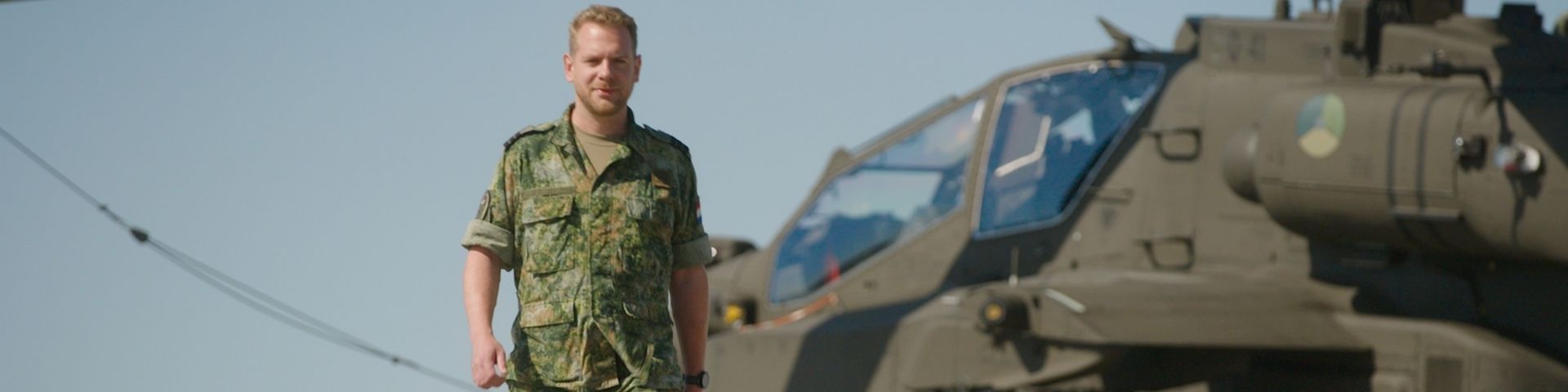
'The biggest change in recent years is that we once again have to take into account a large-scale conflict in Europe,' says Mathijs Verhoeff, Head of Research, Technology & Innovation at the Royal Netherlands Air Force. 'That means we must actively prepare for it now, together with our partners and at increased speed.'
Today’s security reality unfolds across five domains simultaneously: land, sea, air, cyber and space. It is precisely this combination that makes it so complex.
'The battlefield is no longer a single place,' Verhoeff explains. 'It happens everywhere at once. And developments in areas such as drones, artificial intelligence and the electromagnetic spectrum have accelerated enormously.' The war in Ukraine has made this starkly visible. Not only in tactics, but also in technology. What has been developed there in a short time, has set the standard worldwide.
'That also applies to a potential adversary. To be properly prepared, we must keep up with that acceleration. We are effectively in a modern arms race in which technology and development speed are decisive,' Verhoeff explains. There is also another reality at play: Europe must stand more firmly on its own two feet. Dependence on foreign support is decreasing, while the scale of the challenge is growing.
Quality and quantity
Within NATO, the Dutch Air Force is known for its quality, but in today’s playing field it is no longer sufficient. 'It has become a ‘numbers game’ again,' says Verhoeff. 'We are very good at what we do, but we are not large enough yet. And that applies to many European countries.'
The solution lies in a smart combination of high-end systems and scalable, affordable technology. 'That high–low mix will be essential. Alongside high-end systems, we will have a layer of cost-effective, often unmanned and autonomous capabilities. These can be developed, produced, adapted and deployed in larger numbers more quickly.'
Collaboration and co-creation
To achieve this shift, collaboration is crucial. Defence has worked with knowledge partners such as TNO and NLR for decades. However, in recent years this collaboration has been significantly scaled up. 'Communication and collaboration have become much more intensive,' says Verhoeff. 'People from TNO and NLR are at our headquarters on a daily basis. They think along with us every day about plans, choices and solutions.'
This close involvement makes a significant difference. The collaboration is fully integrated and focused on speed. 'We are no longer two organisations doing things for each other. We operate as one team. TNO colleagues are full-fledged members of our workforce.'
The collaboration has also shifted from supply-driven to demand-driven. 'It is no longer: what is interesting to research? It is: which problem needs to be solved tomorrow? We look at today’s battlefield across all domains: land, sea, air, space and cyber, while also keeping an eye on the rest of the world. At the same time, we look ahead to what the future requires and jointly shape further development.'
Shorter lines, faster results
This integrated collaboration with TNO leads to shorter communication lines and less delay. 'TNO helps build and test prototypes, which makes a huge difference,' says Verhoeff.
'You have fewer links in the chain, fewer contracts, and therefore more speed.' Speed is essential. 'The adversary is not waiting, so we must think, develop and implement faster.'
Practical challenges, direct impact
This reality translates into concrete challenges on which Defence and TNO are working together:
- Communication under disruption: how do you stay connected when radio communication is being jammed?
- Navigation without GPS: what if a satellite system fails or is disrupted?
- AI in decision-making: how do you support complex decisions with reliable data analysis?
- Rapid threat detection: how do you use sensors and AI to recognise patterns and movements?
One example is the search for alternatives to GPS. 'We see in Ukraine that GPS is often disrupted. We must be prepared for that,' says Verhoeff. 'One solution we are exploring with TNO is navigation based on the Earth’s magnetic field. It is still in its early stages, but promising.'
Innovation is also taking place in communications. 'Think of laser systems that allow you to transmit information very precisely, with minimal risk of detection. That kind of technology can make a major difference.'
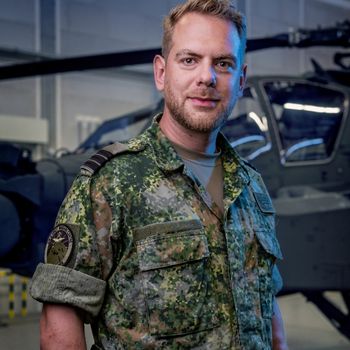
'When Defence knows what is needed and TNO knows what is possible, something greater than collaboration emerges: one team rapidly building solutions for the security of tomorrow.'
From idea to deployment, at speed
Innovation within Defence follows a careful process that is nonetheless becoming faster: from knowledge development to prototype, to testing—first in labs and simulations, then in realistic military environments.
'That collaboration plays a crucial role,' says Verhoeff. 'The importance of realistic, high-quality battle labs and simulations is increasing significantly. That is necessary because operational units simply have too little capacity for this.'
'Our units are continuously focused on training and readiness. Testing and development largely need to be organised separately.' At the same time, this speed requires a different mindset: 'We must sometimes accept that something is ‘good enough’. Not always a perfect 10, but a 7 that we can quickly put into practice and then continuously improve.'
Digital dependency as a vulnerability
We have been fully dependent on digital systems for years, and that makes us highly vulnerable. 'Everything is linked to the digital domain,' Verhoeff explains. 'From military systems to our civilian infrastructure.'
This dependency makes responding to threats more difficult. 'Cyberattacks are often hard to trace. And they do not always form a direct trigger for a military response. But they can certainly weaken us.' That makes robust, secure systems even more important.
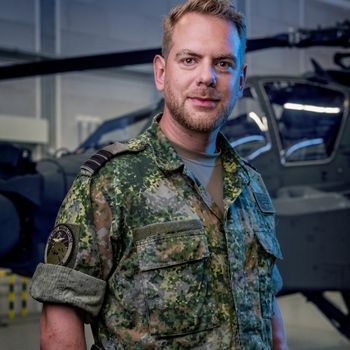
'We do not work in Defence to wage war, but to prevent it. By being strong, by deterring. If we do that well, we hopefully never have to use that strength.'
Looking ahead: Defence in five years
Verhoeff describes an organisation that is larger, but also more complex. 'We will be dealing with enormous volumes of data. AI will be indispensable in processing it and supporting decision-making.'
The earlier-mentioned high–low mix will also have become reality. 'More (semi-) autonomous systems, greater flexibility, and the ability to scale up quickly. That gives us operational strength.' There will also be a focus on space capabilities. 'We want to become more independent in gathering information, with our own satellites, sensors and improved global communications.'
Mathijs’ personal mission
'This work is more than a job. It is a combination of passion and responsibility. I am both an engineer and a military officer, and I find it fascinating to bring technology and operations together.' This bridging role between technological innovation and practical application is at the core of his work.
'I translate operational problems into technological questions and vice versa. That makes the work very concrete and impactful.'
Our shared mission
'If you work at TNO for Defence, you directly contribute to the security of the Netherlands,' says Verhoeff. 'You help us become stronger and innovate faster.
Close collaboration is key in that. And in doing so, you are working towards something bigger: a society in which we can maintain peace. That is ultimately what we are all striving for.'
More about innovation and technology at the front line
Curious about other perspectives on science & technology at the front line?
Contact us
-
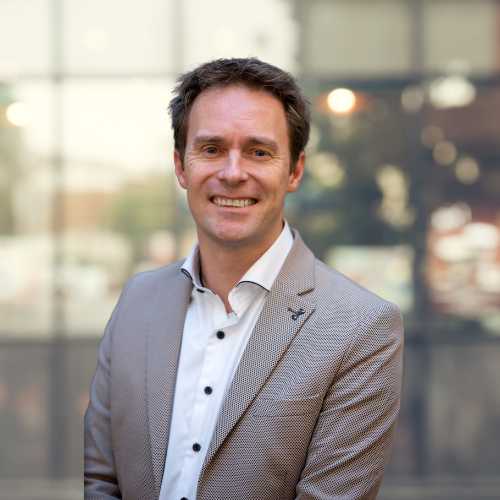
Philip Weimar
Functie:Director Electromagnetics & Military Operations-
Standplaats:Den Haag - Oude Waalsdorperweg
-
Email:Email Philip
-
Get inspired
Science & Technology on the frontline
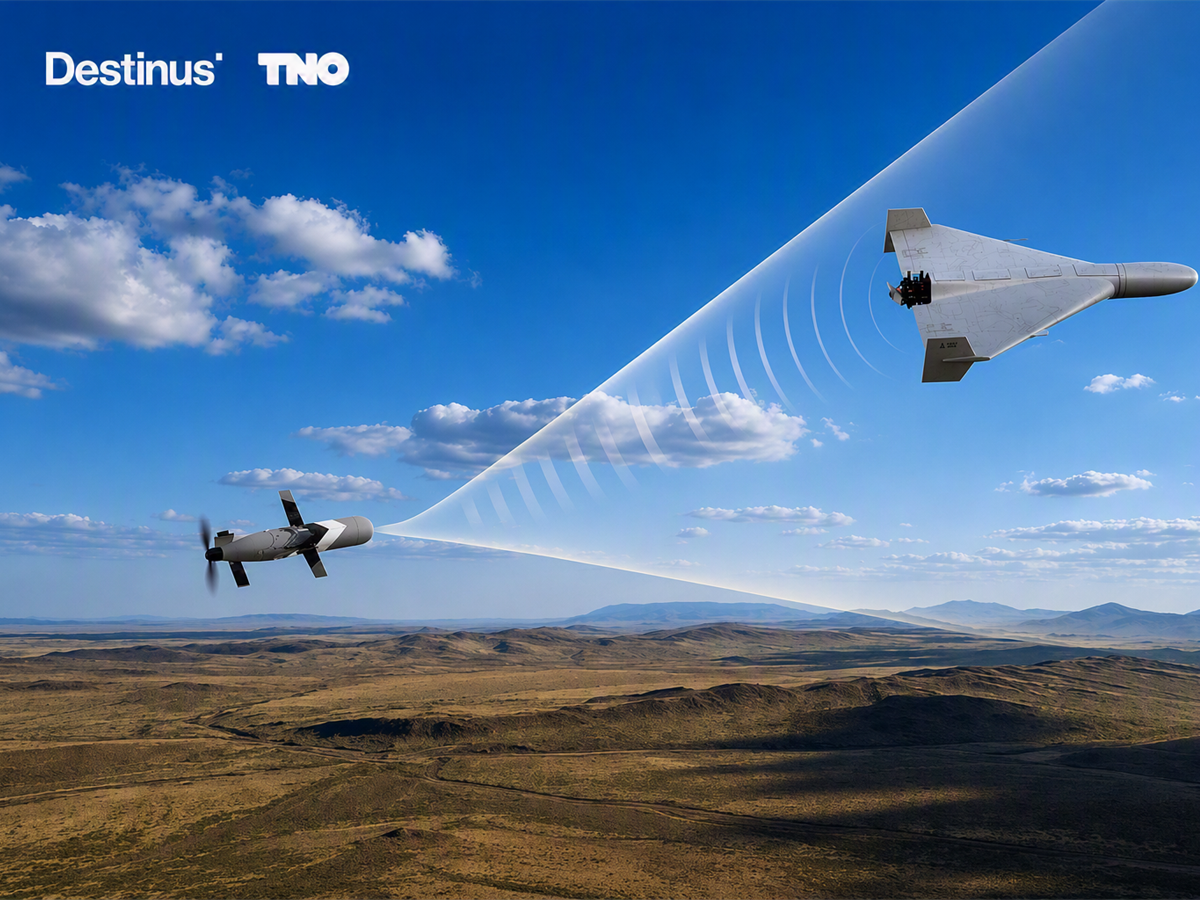
TNO and Destinus plan a joint venture to advance radar seeker technology for European defence
Time setter story: Mia Jukić
Time setter story: Project manager Christian Trampuz
How TNO’s Ines Corveira Rodrigues shapes tomorrow's quantum world
