

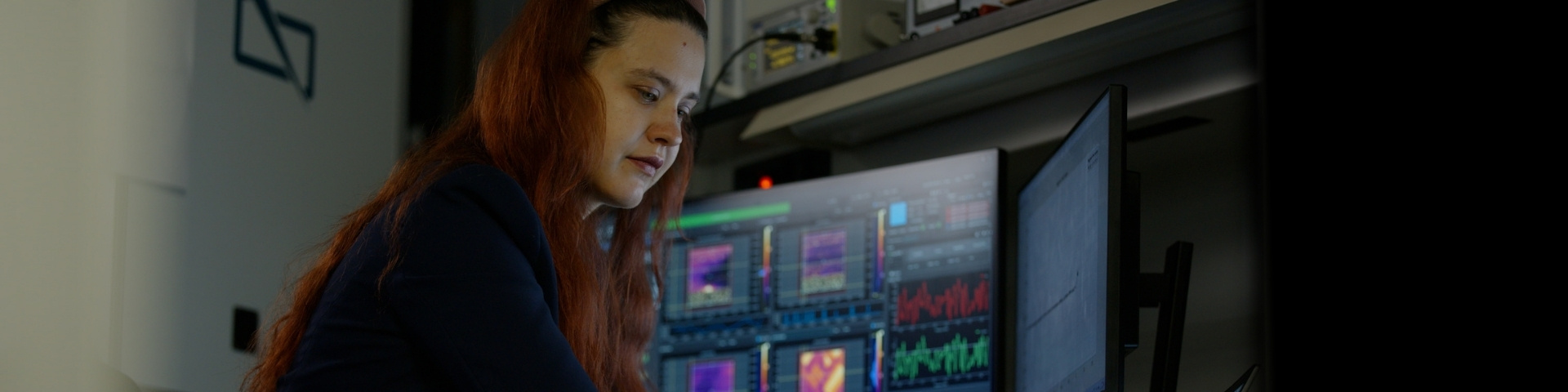
Timesetter story: Mia Jukić on the electromagnetic spectrum as an indispensable compass for safety and autonomy
Innovation is everywhere. Especially in times of geopolitical tension and growing uncertainty, it becomes clear how important it is to keep innovating. At TNO, people are working who leave their mark on our time by developing innovations and technologies that make our society safer. They are Timesetters. One of them is Mia Jukić, a scientist at TNO, Defence, Safety & Security. She works for Defence on magnetic navigation: a smart, robust alternative when GPS fails.
From Croatia to TNO, driven by values
For her PhD in mathematics, Mia moved from Croatia to the Netherlands. During the final year of her PhD, she started thinking about her next step. ‘I wanted to retain my scientific curiosity and see my work applied in practice,’ she explains.
TNO offered exactly that combination: innovative research with direct societal relevance in the Electromagnetic Signatures & Propagation department. Her personal background also reinforced her choice.
‘I grew up in Croatia, a country that had to fight for its independence. Contributing to safety and the protection of people feels very natural to me. Working on innovations for Defence aligns with my values.’
The electromagnetic spectrum without jamming and spoofing
At TNO, Mia works on the electromagnetic spectrum: an indispensable yet vulnerable domain for our modern society. Essential functions such as communication, navigation, financial transactions and emergency services depend on it. At the same time, its vulnerability is increasing rapidly.
‘Our reliance on GPS has grown tremendously,’ Mia explains. ‘At the same time, technologies for jamming and spoofing are becoming cheaper and more accessible, meaning disruptions occur more frequently and have a direct impact, for example on aviation and shipping.’
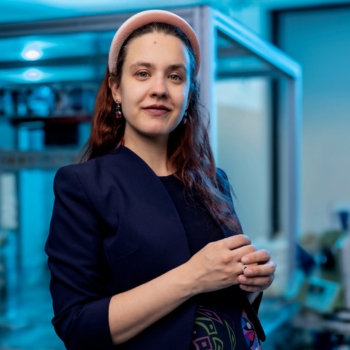
‘Imagine an aircraft or drone operating in an environment where GPS is unreliable or disrupted. That is no longer a hypothetical scenario. With alternative, passive navigation methods, we can still determine where you are.’
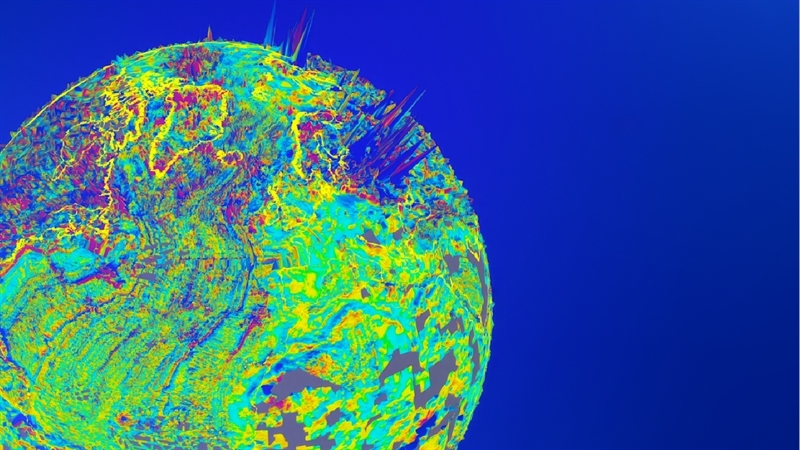
That is precisely why TNO develops new, robust solutions for Defence and other security domains. An important example is magnetic navigation. Instead of satellite signals, this technology uses natural variations in the Earth’s magnetic field. ‘You cannot jam or spoof those patterns,’ says Mia.
‘And because the system is passive (you do not transmit signals yourself) no one can detect that you are using it.’
This makes technology reliable, even in environments where GPS fails, such as underwater, underground or in tunnels. In this way, TNO contributes directly to Defence autonomy: reliable communication, access to information, and the ability to move safely and undisturbed, precisely when it matters most.
The spectrum as an ocean
To explain her work, Mia often uses a metaphor. ‘The electromagnetic spectrum is like an ocean,’ she says. ‘With different kinds of waves: long, slow waves such as radio waves, and short, high-energy ones such as X-rays.’
Magnetic sensing sits at the very quiet end. ‘It lies in the extremely low frequencies. There, the water is almost still. You are looking at subtle patterns in the Earth’s magnetic field.’
Enhancing military safety
The ultimate goal of her research is clear: reducing uncertainty for military personnel in the field. That certainty directly contributes to safety of personnel, systems, and ultimately society.
Another example is ships, which have magnetic and electric signatures. These are invisible to humans but not to sensors. Some naval mines respond to changes in these fields. By reducing signatures, a ship becomes less detectable. ‘That is crucial for the safety of ships and their crews,’ Mia says. ‘And that is exactly where we provide expertise and technological innovations.’
Collaboration and the innovation process
‘I find it inspiring how solving complex challenges requires a rich mix of expertise across domains, perspectives and levels. I really discovered that at TNO. It is a place where collaboration is central and where we combine forces to turn ideas into real solutions.’
Mia’s work is broad and varied. She plans and carries out measurement campaigns, analyses data, builds models, and takes part in international trials. Sometimes in the Netherlands, sometimes abroad, and on different platforms: ships, drones or other systems.
In addition, she presents results at conferences and shares insights with stakeholders, including the Ministry of Defence. ‘It is a combination of in-depth research work and clear communication.’
She works together with colleagues within TNO, with Defence, and with partners such as CMRE (the NATO research institute) and NLR. Innovation follows an iterative process. ‘Defence brings in the user cases. We translate these into research questions, conduct trials, learn, adjust, and continue building towards the right solution.’
“I find it inspiring how complex challenges require a mix of expertise. I discovered that at TNO: a place where we work together to turn ideas into real solutions.”
Continuing to grow and remaining humble
Defence research suits Mia because it is so tangible. ‘You can see what you are doing it for, she says. At the same time, she emphasises the importance of humility.
‘The more you know, the clearer it becomes how much there is still to learn. That is almost paradoxical. To arrive at good solutions, you must keep asking questions and keep seeking collaboration.’
Curiosity is her greatest driving force. ‘I like it when new insights change my opinion, even though I can be quite headstrong at times,’ she says with a laugh.
This is truly our time
‘Magnetic navigation is not a replacement for everything that already exists. The future lies in a smart combination of systems. It is precisely the passive, silent nature that makes this technology such a valuable addition,’ Mia explains.
‘The idea that our work will genuinely be used in a few years’ time, and may contribute to safety for decades to come, is hugely motivating,’ Mia concludes.
This is our time. To keep discovering. To collaborate. And to make safety possible, even as the world becomes increasingly complex.
Want to become a time setter?
Do you want to work on the world of tomorrow through groundbreaking projects?
More about innovation and technology at the front line
Curious about other perspectives on science & technology at the front line?
Contact us
-
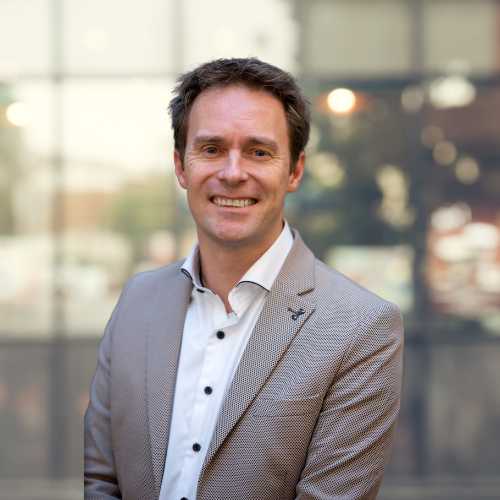
Philip Weimar
Functie:Director Electromagnetics & Military Operations-
Standplaats:Den Haag - Oude Waalsdorperweg
-
Email:Email Philip
-
Get inspired
Low frequency active sonar
Environmental effects of sonar
Ocean resilience and transparency
Signature management
Surface warfare