Solar-powered mobility: how vehicles can generate their own energy and take the pressure off the grid and logistics
The European energy transition is facing a dilemma: electric-powered transport is growing rapidly, yet countries are struggling with worsening grid congestion, limited space for new infrastructure, and spiralling energy prices. The SolarMoves project looked at ways to potentially reduce these bottlenecks using Vehicle-Integrated Photovoltaics (VIPV) – solar energy generated directly by vehicles themselves.
Reducing the growing demand for electricity
Driving an electric car in Europe today offers the comfort of clean, quiet driving, along with access to an expanding charging network. Behind the scenes, though, are some significant challenges. Grid operators are working hard to expand electricity networks, but the capacity of cables, transformers, and local substations can barely keep up with growing demand. Regions in the Netherlands, Belgium, Germany, and Italy are facing waiting lists to get connected. Companies cannot electrify their logistics because there is simply no grid capacity available.
At the same time, public mood is shifting. Individuals and companies want to be less dependent on volatile energy markets and geopolitical developments. The desire for energy autonomy is growing: this is not about going completely off-grid, but about greater stability, less vulnerability, and lower energy prices.

‘Electrification alone is not enough. We need innovations that structurally reduce energy demand. VIPV is exactly that.’
VIPV requires no additional land or excavation work. Solar panels are simply placed on surfaces we already use: vehicle roofs, bonnets, and even on the sides. That is what makes VIPV so elegant: energy is generated exactly where the demand is created. Not only in massive solar parks or rooftops, but making use of the millions of vehicles driving across Europe every day and parked in places where sunlight is available.
Drive for weeks without a single charge
One of the most striking findings from SolarMoves was how much VIPV can help vehicles achieve energy autonomy. In Central Europe, passenger cars can generate up to 55% of their own energy; in Southern Europe, this could even be up to 80%.
And that’s not just in theory. The study used 23 narrowly defined vehicle types – from compact city cars to heavy trucks – and combined detailed vehicle and driving profiles with meteorological data from Amsterdam and Madrid. The results showed that urban drivers, in particular, can benefit enormously. Those who make short trips, park frequently, and drive relatively short distances can drive for weeks in the summer without a single charge.
For drivers, this could significantly change their electric driving experience, as they can reduce the number of charges needed by around 40%, depending on usage, thanks to the lower need for external energy. Not only does that save motorists money, but it also directly eases the pressure on the energy grid.
Especially in urban environments, where public charging infrastructure is under pressure, this means less time spent driving around looking for a charger, shorter waiting times, and lower costs. That is the future of electric driving.
A smarter energy system through individual vehicles
VIPV can deliver strong benefits for individual users, but its real power is unlocked at system level: SolarMoves has shown that VIPV directly impacts how the European electricity grid functions.
The study concluded that, if every new electric vehicle between 2024 and 2030 were equipped with VIPV, total grid demand in Europe could be reduced by 15.6 TWh by 2030 – equivalent to the annual production of roughly 2,200 onshore wind turbines with a capacity of 3 MW.
VIPV not only reduces energy demand overall, but especially the peaks that overload transformers, particularly in spring and summer. As a result, VIPV vehicles effectively represent a kind of hidden potential for capacity expansion at local level: in the simulation using data from Amsterdam comparing the same vehicles with and without VIPV, the effect was equivalent to a 25% boost in transformer capacity. The CO2 emission reductions are also considerable: as grid electricity is not 100% carbon-free, switching all electric vehicles to VIPV would result in a 1.8 Mt reduction by 2030.
Final report SolarMoves
Interested in all the findings?
Sustainable and financially beneficial
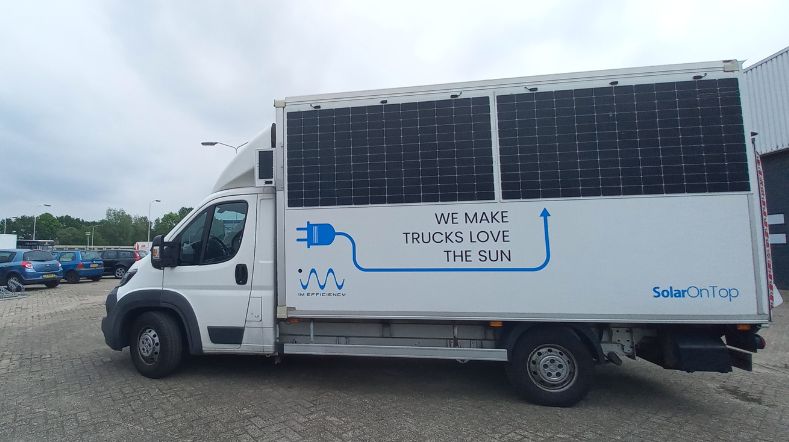
VIPV offers autonomy and convenience for passenger cars, but its value in logistics is just as compelling. Freight vehicles would be less dependent on the speed of charging, grid capacity, and diesel – and in some cases, it also works out cheaper. VIPV is perfect for trucks, vans, buses and trailers: these use a great deal of energy to operate their climate control systems, refrigeration units, and auxiliary engines, yet they all have ample roof space for solar panels.
When it comes to electric trucks, VIPV extends their daily driving range without charging by up to 15%, meaning fewer charging stops are required. For a sector where every minute counts, this provides more predictability and higher operational availability.
On trailers, the output can reach up to 55 kWh per day in summer, and even 90 to 110 kWh if the sides are fitted with panels too – enough to fully power refrigeration or hydraulic systems, with zero emissions.
For diesel trucks, VIPV even delivers direct financial benefits: since air conditioning, heating, and other systems would no longer need to run on diesel, this would decrease fuel consumption significantly, saving on fuel costs. This would allow the investment costs of VIPV to be recovered in less than 2 years. What’s more, diesel vehicles no longer have to keep the engine running continuously to keep products chilled, which reduces emissions even further as well as noise when parked.
Finally, VIPV also makes the electrification process in logistics less dependent on slow grid expansions. Distribution centres can then better plan their charging schedules, reducing peak loads and making energy demand at the depot more predictable. This not only helps companies reduce costs, but also makes them less vulnerable to grid congestion.
Research with real-world data
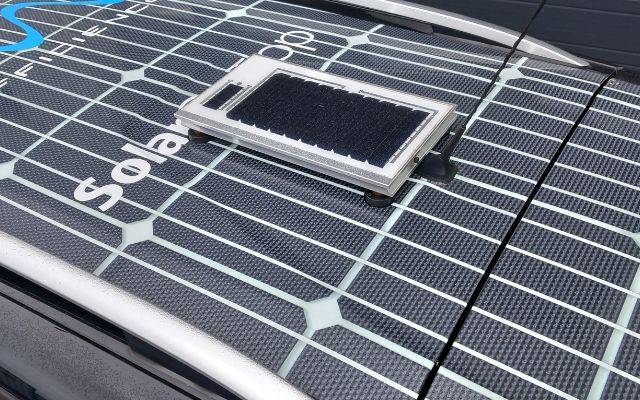
What’s different about the SolarMoves project is that not only did it create models, but it also collected 1.3 million kilometres of real-world solar irradiation data.
Sensors on cars, vans, trucks, buses, and trailers recorded solar irradiation, position, speed, and shading for months. This produced a unique dataset that provides insight into how VIPV actually performs under various conditions – from Amsterdam to Madrid, and from dense urban areas to open highways.
The measurements showed that actual solar irradiation was lower than assumed in the models. One explanation for this is that the models didn’t take parking behaviour into account. Most people park their vehicles in the shade: under trees, next to buildings, or even in garages. In some cases, this halved the solar irradiation received.
Although VIPV works well, human behaviour and vehicle location have a major influence on this. But this shows that behavioural changes and smart parking design could boost the impact of VIPV even further.
Bridging industry, science, and policy
TNO’s role in SolarMoves goes far beyond research alone. The combination of systems thinking, technical models, and turning insights into policy is what makes this work relevant for the European market.
The models developed by TNO, such as those for energy optimisation and vehicle energy consumption, form the foundation for consistent vehicle, fleet, and grid analyses, which are then used by policymakers, vehicle manufacturers, and suppliers. In addition, TNO made a vital contribution to understanding how VIPV would influence CO2 standards, vehicle type approval, and energy policy.
The road ahead: how do we scale up?
SolarMoves has demonstrated that VIPV is a powerful innovation, simultaneously improving individual autonomy, logistics efficiency, and system stability. But there’s more work to be done to fully achieve its potential. This includes developing a clear European framework that recognises VIPV in the Renewable Energy Directive and includes VIPV output in the Vehicle Energy Consumption Calculation Tool (VECTO) trailer calculation model for determining the fuel consumption and CO2 emissions of trailers.
The next step is to include VIPV in the Worldwide Harmonised Light Vehicle Test Procedure (WLTP) or similar regulations, so that CO2 reductions can actually be used at national level to secure tax incentives and develop guidelines for solar-ready parking areas.
Want to find out what VIPV could mean specifically for your fleet, region, or policy field?
TNO supports governments, grid operators, OEMs, and logistics companies in deriving the next steps out of the insights gained from SolarMoves: from technical feasibility studies and business cases to system impact analyses and scaling strategies. Get in touch to explore how VIPV can create direct value in your organisation.
Contact us
-

Lenneke Slooff-Hoek
Functie:Program coordinator-
Standplaats:Petten - Westerduinweg
-
Email:Email Lenneke
-
-

Gabriel Yousef
Functie:Business Developer-
Standplaats:Rijswijk - Kesslerpark
-
Email:Email Gabriel
-
About the project
SolarMoves is a global public-private consortium that spent 3 years (2023–2025) investigating to what extent solar-powered vehicles can play a part in the transition to full electric mobility in the EU. The aim was to explore the potential of generating solar energy on vehicles and assess its impact on policy and legislation on electric charging infrastructure in Europe.
As well as TNO, the consortium included the Fraunhofer Institute for Solar Energy Systems ISE, Lightyear, Sono Motors, and IM Efficiency. The project was carried out on behalf of the European Commission’s Directorate-General for Mobility and Transport (DG MOVE). Grant No. MOVE/2022/OP/0003
Get inspired
TNO's laser technology
Towards low-cost, high-performance solar power for future space missions

TNO develops world’s first perovskite solar roof tile
Real-world data confirms potential of vehicle-integrated solar panels
New EcoCertified Solar Parks: solar parks that deliver both energy and nature