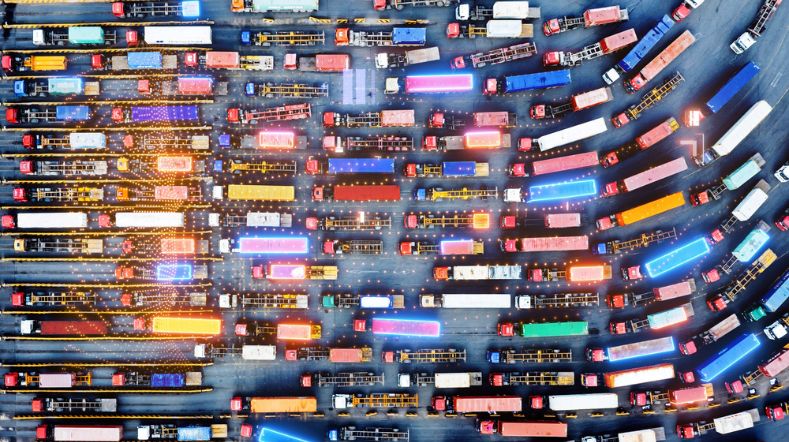
Fewer trucks, fewer traffic jams, higher profits through smarter logistics
Around 30% of lorries are driving empty. This costs the sector huge amounts of money, worsens congestion and increases the driver shortage. TNO has developed a smart solution that could turn the tide in logistics. The first pilot is on its way.
Ask any logistics entrepreneur about the challenges in the sector and you will hear an endless list: a shortage of drivers, high energy prices, long traffic jams and margins of just 1 to 3 per cent. “Many companies are currently operating around zero per cent,” says Etiënne Luijten.
He is director and founder of I&L Logistiek, a specialist in refrigerated, frozen and exceptional transport. A healthy company, he emphasises, with one hundred employees and 65 vehicles on the road, ranging from vans to trucks, thanks to continuous investment in innovation. “By constantly trying new things, learning from them and coming up with new ideas, we have managed to stay in business.”
Marc Huijgen, founder of the logistics Control Tower Best 4 Logistics, fears that many SMEs are on the brink of collapse. “It is always about the lowest price, but that is a dead end. Drivers from Poland, Lithuania, Romania and Bulgaria are now being replaced by even cheaper workers from the Philippines. I have seen them stepping out of trucks in flip flops at chemical industry sites.”
Not complainers, but doers
However, both entrepreneurs are anything but complainers. On the contrary, they have been actively working for years to solve one of the sector’s biggest problems: empty miles, what they call moving air.
Around 30% of the trucks on the road are driving without cargo, or only partially loaded. “That is unnecessary waste,” says Luijten. “It leads to more congestion and increases the driver shortage. It also makes it impossible to invest in a sustainable future.”
Luijten already works with a coordination platform that helps keep his vehicles well filled. But scaling this up remains a challenge. Increased collaboration and sharing loads may sound simple, but in practice it is not. “This has been an issue for years, but no one is taking action, not politicians, not industry organisations. And nine out of ten entrepreneurs are simply overwhelmed by day to day operations.”
Competition is still fierce, he explains, which has a major impact on trust between companies. Carriers prefer to operate independently, using their own planning systems and staying within their own bubble. They are reluctant to share customer data for fear of losing their clients.
Change happens slowly
The transport sector is also quite traditional, and change tends to be slow and meets resistance. Huijgen, who frequently combines and orchestrates transport flows, encounters this in practice.
“Many companies could manage transport much more intelligently, for example by combining shipments or engaging with their customers. Yet we still see entrepreneurs who do not make the effort or simply do not know how to save costs.”
As a result, initiatives from individual entrepreneurs rarely gain traction. However, the willingness to collaborate does exist. A recent survey by TNO and MT/Sprout shows that one in three respondents sees opportunities in closer collaboration with supply chain partners, while two in three are open to sharing logistics resources.
“Many companies could manage transport much more intelligently, for example by combining shipments or engaging with their customers. Yet we still see entrepreneurs who do not make the effort or simply do not know how to save costs.”
Smart logistics
So what is needed? Future proof smart logistics, which is also the name of TNO’s programme focused on large scale sharing of resources in connected logistics networks.
The programme develops solutions that take into account the sensitivities of entrepreneurs, as well as broader challenges such as scarcity and complex regulations. It may sound complex, but solutions do exist, says Inge Lucassen, a senior consultant at TNO specialising in data driven logistics.
By combining and enriching data, logistics can become more efficient, faster and more sustainable. This does require sharing transport data. “But how do you do that without your information ending up with competitors? And how can you make planning agreements without exposing confidential data?” Lucassen explains.
Algorithms at work
A decentralised data sharing solution can effectively tackle these barriers. TNO has developed a working prototype of a collaboration model in which an algorithm analyses data locally at each participating company and calculates an optimal solution.
The data are not collected, moved or stored in a central location. Carriers only share their trips with the algorithm. “The algorithm performs local calculations, producing highly specific results for each company, which are shared individually,” Lucassen explains.
This means no one gains insight into another company’s data, not even third parties. Participating companies can only use the results for their own optimisation. They can see where collaboration opportunities lie and how to combine trips more efficiently, but they cannot see what others are doing together.
Initially, the algorithm focuses on minimising empty kilometres. “Because that is how you make the most efficient use of both drivers and vehicles.”
Reduction in empty miles
Initial tests show a significant reduction in empty runs, around 25%. This has caught the sector’s attention. At the end of March, five container transport companies joined forces to test the prototype in practice and structurally reduce empty kilometres.
While container transporters are currently taking the lead, the solution is scalable and modular. This means it can be applied much more broadly, from last mile urban logistics to construction sites or flower transport. “If groups of companies want to collaborate, that should be possible. We want to make it easier for entrepreneurs to get involved.”
According to Huijgen, things can really be done differently. “All those trucks driving empty could be used much more effectively. But most SME entrepreneurs have never looked at the full transport picture. It is something they do on the side, which means they end up managing it inefficiently, and with rising costs, that is becoming unaffordable.”
Luijten agrees that the sector could operate with far fewer trucks and drivers. “Remaining autonomous while also collaborating will solve many problems. More efficient operations are essential if we want to keep the sector viable.”
Get inspired
Korea-Netherlands joint conference on smart mobility for future transportation
TNO, DAF and Einride collaborate to support deployment of Level 4 autonomous transport
Innovation Matters: TNO and Plantanious organise logistics for greater delivery reliability

Automated driving: from smarter speed advice to depot automation for buses
Self-organising logistics