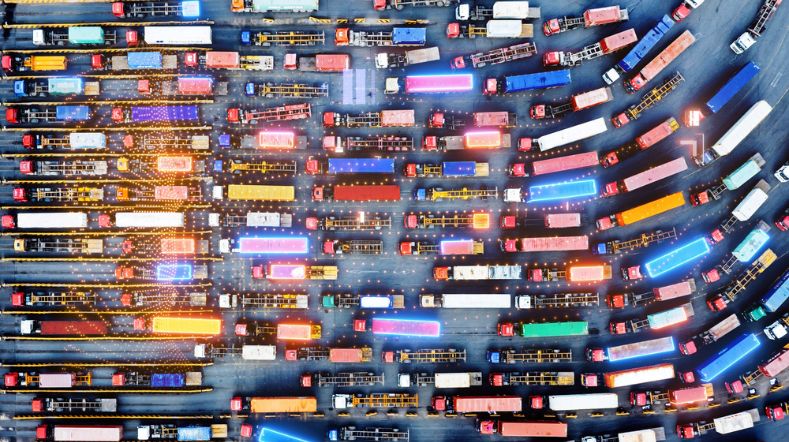
Innovation Matters: TNO and Plantanious organise logistics for greater delivery reliability
TNO is the driving force behind innovation in the Netherlands. Together with partners and clients, its experts develop solutions to a wide range of societal challenges, because: Innovation Matters. In this edition, we explore innovation in smart logistics. Horticultural company Plantanious approached TNO with a simple but crucial question: how can a plant be transported from A to B more efficiently?
For suppliers of fresh products, rapid transport is essential. As soon as logistics processes are delayed, the impact on customers and business operations is immediate.
Joost Jansen (Plantanious) explains: 'We produce a fresh product, and fast transport is extremely important. It is one of our biggest challenges and it can make operations quite hectic.'
10%
less traffic jams
25%
more storage
90%
fuller containers
Logistics challenges
The challenges faced by Plantanious are not unique. The entire logistics sector is dealing with increasing pressure on infrastructure, capacity and workforce availability.
As TNO explains: 'There are several major challenges facing logistics today. We are dealing with scarcity, limitations in physical infrastructure, energy availability and labour shortages. And we are all sitting in traffic. Products arrive late. Customers are unhappy. So we simply need to organise logistics more efficiently and more effectively.'
Beyond optimisation within single supply chain
Many organisations focus on optimising logistics processes within their own networks. However, according to TNO, a significant part of the solution lies in collaboration between companies.
Research conducted by TNO shows that shared logistics networks are more resilient to disruptions and offer greater flexibility than individual networks operating independently.
Jaco van Meijeren (TNO): 'We have conducted studies demonstrating that when organisations jointly organise their logistics operations, the problem-solving capability within shared networks is far greater than within their own individual networks.'
Achieving this requires not only technological innovation, but also new ways of working together. Companies need clear agreements on data sharing, responsibilities and mutual trust.
Innovation starts with trust
Collaboration begins with the ability to share information securely. Many organisations are understandably reluctant to make operational data available if they are uncertain about how it will be used.
For this reason, TNO is developing solutions that allow organisations to retain control over their own data while still benefiting from collective logistics optimisation.
Jaco explains: 'We are working on organisational innovations that create robust agreements trusted by all parties involved. This enables organisations to share data in a fully secure way and entirely in line with the requirements and conditions they have set themselves.'
In addition, TNO is developing decentralised planning algorithms. These allow companies to plan collaboratively without relying on a single central authority that collects all information or makes decisions on behalf of others.
'We are working on decentralised planning algorithms where there is no central governing party telling organisations what they should do or pointing out what they may have done wrong.'

'TNO has access to extensive data and also knows how to solve these challenges.'
From insight to implementation
For Plantanious, gaining a clear understanding of the scale of the challenges and the opportunities for improvement was the first priority. Data plays a central role in this process. Joost: 'TNO carries out preliminary research. To measure is to know. For us, that is incredibly important.'
By combining data, expertise in logistics systems and practical experience, an objective picture emerges of where bottlenecks exist and which solutions are most likely to deliver tangible results.
A key aspect of the collaboration is ensuring that innovations do not remain confined to the laboratory. TNO develops solutions together with businesses and continuously tests whether they align with real-world operations.
Jaco: 'We work closely together to understand what organisations need, what they want, and what fits with the way they operate in practice. This ensures that innovations truly deliver value when implemented in the real world.'
Learning across sectors
Although the collaboration originated from a specific challenge in fresh produce and floriculture logistics, Plantanious sees considerable value in a broader approach.
After all, challenges related to capacity, energy, infrastructure and workforce availability exist in almost every logistics chain. By bringing together experiences from multiple sectors, solutions can be scaled up more quickly and refined further.
Joost explains: 'TNO approaches this from a broader perspective. It is not only about the floriculture sector, but also about many other sectors. I believe that this is precisely how we can learn from one another.'
Working together
The logistics sector faces complex challenges that companies can no longer solve on their own. Labour shortages, congestion on the roads, limited energy capacity and rising customer expectations all demand new forms of collaboration.
That is why the co-innovation partnership between Plantanious and TNO focuses not on a single company, but on the network as a whole. By organising logistics collectively, sharing data securely and applying decentralised planning methods, businesses can achieve greater agility, improved supply reliability and ultimately a more efficient logistics chain.
Or, as Plantanious puts it: 'Customers are not happy when products arrive late. So we simply need to organise logistics more efficiently and more effectively. And TNO is helping us do exactly that.'
Want to collaborate for efficient and sustainable logistics too?
Contact us
-

Jaco van Meijeren
Functie:Senior Lead Consultant Supply Chain InnovationAt TNO, I focus on innovations of new and improved technologies, processes, strategies and practices within freight transport, logistics and the supply chain network to improve efficiency, reliability and sustainability for companies, governments and society. Main topics concern digitalization (data driven (de)central logistics planning) and automation (connected automated transport).
-
Standplaats:Den Haag - New Babylon
-
Email:Email Jaco
-
Get inspired
Korea-Netherlands joint conference on smart mobility for future transportation
TNO, DAF and Einride collaborate to support deployment of Level 4 autonomous transport
Fewer trucks, fewer traffic jams, higher profits through smarter logistics

Automated driving: from smarter speed advice to depot automation for buses
Self-organising logistics