
From dependence to control: microfactories as the key to European access to energetic materials
Europe faces a paradox. The urgency to scale up defence capabilities has never been greater, yet the raw materials that are indispensable for this effort are becoming increasingly difficult to obtain. Energetic materials such as TNT, RDX and nitrocellulose form the basis of warheads, propellants and rocket motors in ammunition. Without these substances, not only does production grind to a halt, but so do military readiness and sustainment.
At the latest edition of the Kooy Symposium on 8 April 2026, TNO and COMMIT presented an alternative approach that could fundamentally reduce this vulnerability: microfactories for energetic materials, housed in modular shipping containers. A technological and strategic solution with the potential to redefine European autonomy.
Europe’s vulnerable position
Europe’s dependence when it comes to energetic materials is substantial. Production capacity within Europe is limited, while demand from armed forces and the defence industry is rising rapidly. At the same time, supply chains are highly internationalised and increasingly exposed to geopolitical tensions, trade restrictions and conflicts.
For some critical substances, availability has already become so limited that delivery times extend beyond 2030, or the materials are no longer available at all for start-ups. Moreover, regulation, permitting procedures and safety requirements make the establishment or expansion of traditional production facilities complex and time-consuming.
The result is a structural vulnerability that directly affects the reliability of European ammunition supply chains. This situation is particularly problematic given Europe’s ambition to accelerate production and stockpiling. Without secure access to energetic materials, that ambition remains dependent on external factors over which Europe has little control.
Why energetic materials are a category of their own
Energetic materials differ fundamentally from bulk chemicals. They are typically produced in relatively small volumes, but under extremely stringent requirements for safety, quality and process control. From an economic perspective, these volumes are often unattractive to large chemical producers, while their strategic value for a country’s defence is enormous.
This mismatch between economic logic and strategic importance makes the current production model fragile. Large, centralised factories require high investment, long lead times and offer limited flexibility. In an era where threats can escalate rapidly, this model falls short.
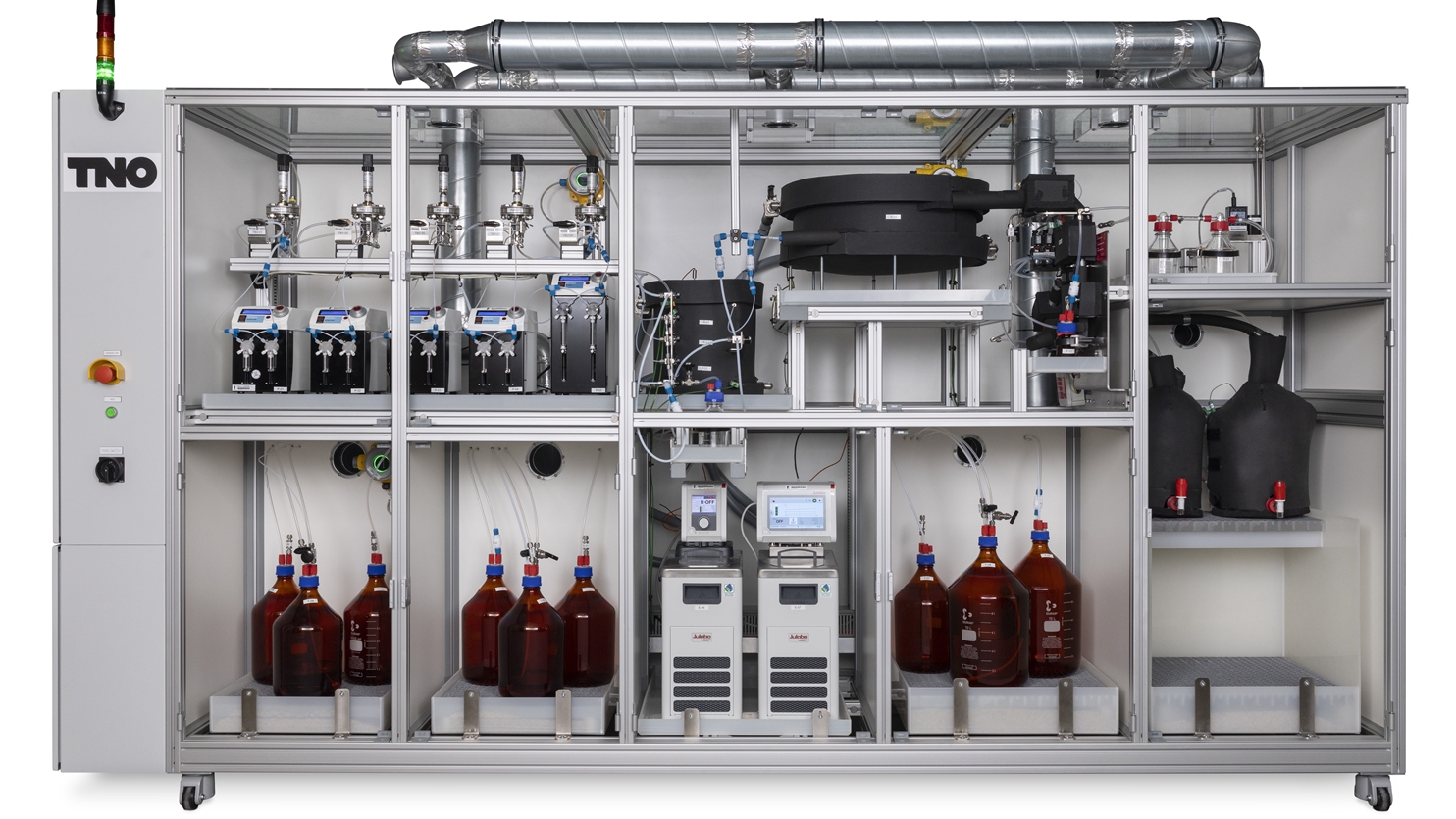
Microfactories: a different way of producing
TNO is therefore developing an alternative production model: microfactories for energetic materials, integrated into standard shipping containers. Instead of relying on a single large plant, this approach creates a network of compact, modular production units.
These microfactories are:
- Compact and modular, suitable for a range of energetic processes such as TNT, RDX, HMX and associated precursors;
- Fully automated, enabling 24/7 production with consistent quality;
- Scalable, by deploying multiple containers in parallel;
- Mobile, so production can take place where demand arises;
- Cost-efficient, with lower operational costs than conventional plants.
This enables rapid build-up of critical capacity without lengthy construction and permitting processes.
From concept to reality: the TNT microfactory
A concrete example is the development of a TNT microfactory. This is currently progressing towards a Technology Readiness Level (TRL) of 6–7, with the aim of delivering an operational prototype by the end of 2026, in collaboration with industrial partners.
Depending on the configuration, a single 40-foot container can produce anything from tens of kilograms to tens of tonnes of TNT per year. In parallel, TNO is working on microfactories for RDX and other scarce energetic substances. Together, these form a portfolio of modular production systems that can be deployed and scaled up in phases.
Crucially, this approach leaves room for collaboration with (Dutch) industry. TNO develops the knowledge and technology, while production, scaling and integration take place jointly with partners.
Strategic value for Europe
Microfactories are more than a technical innovation. They are a strategic instrument for gaining control over critical supply chains. By organising production closer to the end user, dependence on vulnerable international supply routes is reduced.
The strategic impact is significant:
- Greater autonomy, through direct access to critical substances;
- Improved robustness, as disruptions in global supply chains have less impact;
- Flexibility, thanks to relocatable production in response to risks or sabotage;
- Scalability, allowing rapid ramp-up in times of heightened threat and scale-down during prolonged periods of stability;
- Potential ITAR-free status, provided the technology is firmly anchored in Europe.
In addition, vertical integration can limit the transport of energetic materials across Europe, offering both safety and logistical advantages.
Relevance for Ministries of Defence
For Ministries of Defence organisations, microfactories strengthen strategic stockpiling and shorten resupply times. They support compliance with NATO obligations and enhance continuity during prolonged conflicts.
Commander Paul Flos (COMMIT) states:
‘Europe can no longer afford dependence. With microfactories, we are making the transition from vulnerability to control: direct access to critical energetic materials, wherever and whenever the security situation demands it.’
Operationally, microfactories offer even more benefits. Local production reduces logistical vulnerability, decreases the need to transport hazardous substances over long distances, and improves sustainment in a conflict environment. Deployable microfactories also make support to partners and forward defence concepts more realistic.
Relevance for industry
Microfactories also open up new perspectives for industry. They create opportunities for modular production, new forms of collaboration, and the rebuilding of a European industrial base for energetic materials. In doing so, companies can contribute to strategic autonomy while responding to growing demand.

‘For TNO, microfactories mark the shift from research to direct operational impact. By bringing innovative, safe and scalable energetic production closer to the end user, we strengthen the security of supply for critical materials together with industry, and enhance the deployability of our armed forces.’
From dependence to control
Europe faces a fundamental choice. Clinging to centralised, vulnerable production models means continued dependence. Investing in flexible, scalable alternatives offers the prospect of control. Microfactories make that transition tangible.
By combining safety, flexibility and economic viability, they contribute to a more resilient European defence ecosystem. Or, as it was aptly summarised during the Kooy Symposium: from “Europe on the drip” to “Europe in control”.
Contact us
-

Frans van Gemerden
Functie:Director Protection, Munitions & Weapons-
Standplaats:Den Haag - Ypenburg
-
Email:Email Frans
-
Get inspired
TNO and MBDA sign agreement to advance laser weapon capabilities
Why continuous knowledge development is crucial in munitions safety
TNO’s Unit Defence, Safety & Security strengthens ties with South Korea
How the use of passive radars and satellite signals can detect and identify aerial threats
Responsible for safety: the crucial role of the range operator in bulletproof protection