
Energy sharing
Since 2026, energy sharing has been included in the Dutch Energy Act. This creates opportunities for households, businesses and energy communities to participate more actively in the energy system. Energy sharing can contribute to greater local use of renewable energy, increased engagement of citizens and businesses, and potentially a more efficient use of the electricity grid.
At the same time, energy sharing raises new questions. How should energy sharing be organised while preserving consumers’ freedom to choose their energy supplier? What does this mean for participants, suppliers, distribution system operators and other market parties? And under which conditions can energy sharing genuinely contribute to affordability, flexibility and a future-proof energy system?
TNO investigates the legal, economic, technical and social aspects of energy sharing. In doing so, we support policymakers, energy communities, distribution system operators and market participants in developing new forms of energy market participation.
What is energy sharing?
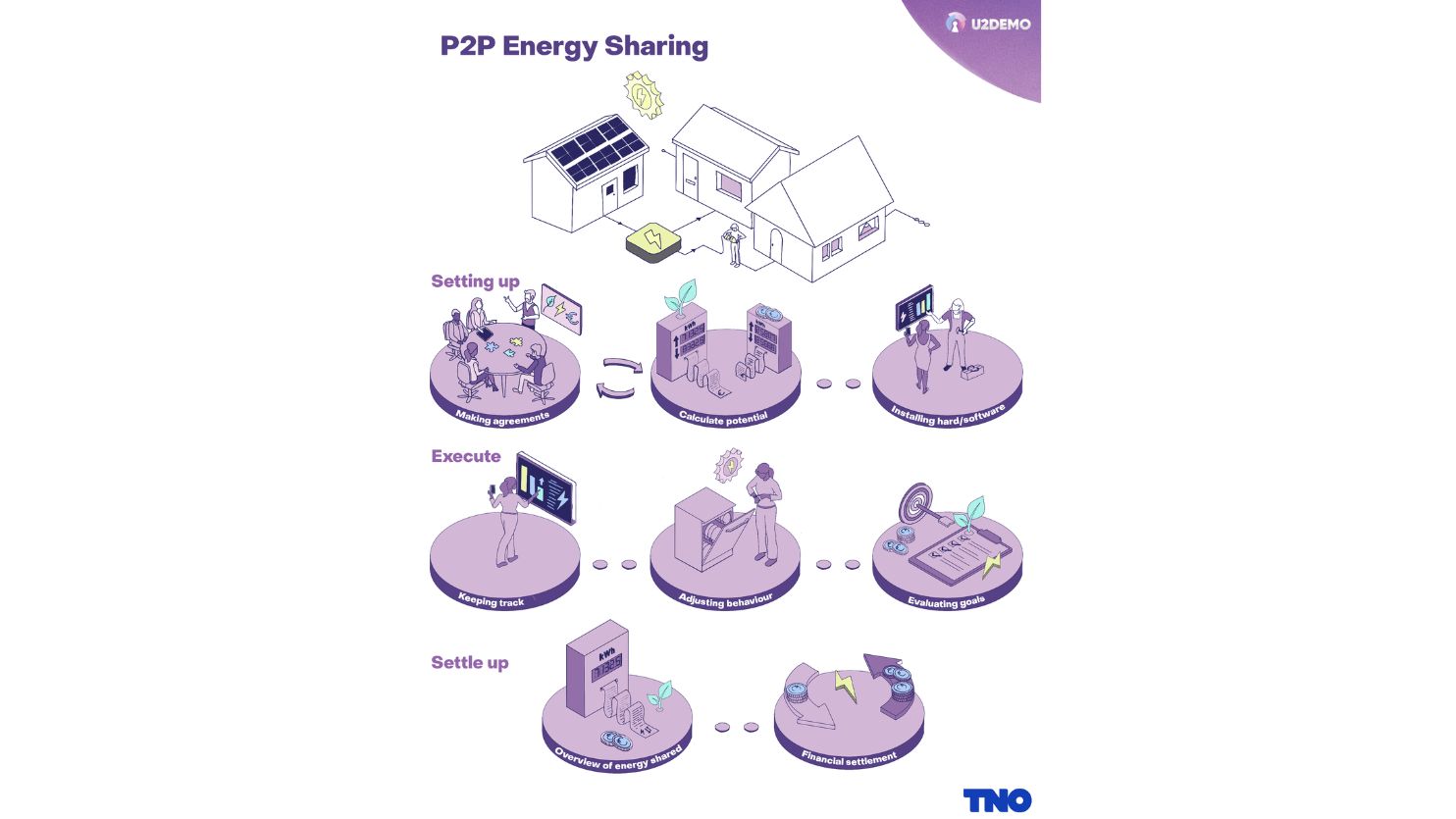
Energy sharing means that generated electricity is allocated to other users, for example within an energy community or local initiative. The concept originates from European legislation, which requires Member States to enable energy sharing.
Under the Dutch Energy Act, members of an energy community may share energy under certain conditions. In the future, energy sharing between parties with different energy suppliers will also become possible. The necessary legislation and regulations are currently being further developed.
Under the current proposal, participants make agreements about who shares energy, what proportion of generation is shared and at what price. These agreements are then linked to the electricity that is actually generated and consumed.
Read the report on Energy Sharing
Why is energy sharing relevant?
Energy sharing is intended to involve citizens and businesses more actively in the energy transition. It can contribute to:
- Greater use of locally generated renewable energy
- Access to renewable energy for households without their own generation assets
- Economic benefits for participants
- Increased engagement in the energy transition
- More efficient use of the energy system
In addition, energy sharing, combined with appropriate price incentives, can contribute to greater flexibility in the energy system. Participants are encouraged to use locally generated energy directly, helping to align supply and demand more effectively.
The extent to which energy sharing actually delivers these benefits depends heavily on the chosen design and regulatory framework.
Who is energy sharing relevant for?
Energy sharing offers new opportunities to utilise locally generated energy within a community and to actively involve members in the energy transition.
Energy sharing can contribute to local sustainability goals, energy participation and the development of local energy systems. At the same time, it raises questions about regulation, governance and societal impact.
Energy sharing may influence energy consumption patterns, grid loading and system flexibility. Understanding its effects on the electricity grid is essential for maintaining a reliable and affordable energy supply.
New forms of energy sharing require suitable market processes, data exchange mechanisms, contractual arrangements and settlement methods.
For businesses, energy sharing provides opportunities to make more efficient use of locally generated energy and to collaborate on decarbonisation and flexibility solutions.
Energy sharing therefore affects not only individual participants but also the way local energy systems, energy markets and energy infrastructure are organised.
Lessons from Europe
Energy sharing is already possible in several European countries. However, the chosen models differ significantly. Belgium and Portugal, for example, use systems in which the amount of energy actually shared is determined retrospectively.
One important lesson from other European countries is that energy suppliers, distribution system operators and balancing responsible parties need insight into who is sharing energy and under what conditions. Without this information, additional costs may arise that ultimately fall on consumers.
The societal impact also varies between models. European experiences show that the design of energy-sharing schemes influences who benefits, how costs are distributed and the role energy sharing can play in creating an inclusive energy transition.
U2Demo: From Energy Sharing to Practice
Within the European U2Demo project, TNO works with international partners to develop and validate innovative models for energy sharing and peer-to-peer energy trading. Open-source solutions are being developed and tested in energy communities in the Netherlands, Belgium, Italy and Portugal.
TNO contributes expertise in energy-sharing models, stakeholder roles, coordination and information exchange, translating these into functional architectures and IT components. Modelling and practical validation help determine how solutions can be made scalable, interoperable and replicable across different contexts, supporting the wider implementation of energy sharing across Europe.
Read more about U2Demo
Open questions for policy and the market
Energy sharing offers opportunities for participants but also raises new questions regarding market design, grid congestion, flexibility and affordability. TNO investigates how energy sharing can be implemented in practice and what effects different design choices may have on users, energy communities, suppliers, grid operators and the energy system as a whole.
Together with energy communities, governments, grid operators and market participants, we are working on questions such as:
- What societal impact can energy sharing have?
- Which allocation, registration and settlement models are both fair and practical?
- What role can energy sharing play in addressing grid congestion and increasing flexibility?
- How can energy sharing be combined with flexibility services and energy hubs?
- Under what conditions is energy sharing attractive and financially viable for all stakeholders?
- What lessons can be learned from energy-sharing models in other European countries?
TNO collaborates with initiatives such as Slim Strandnet in Scheveningen and Klimaan in Mechelen as part of the European U2Demo project.
Are you working on energy sharing?
Would you like to gain insight into the technical, legal, economic or societal aspects of energy sharing?
Together with public and private partners, we develop knowledge on the societal impact, technical implementation, economic feasibility and policy conditions of energy sharing. In this way, we support policymakers and market participants in developing effective and future-proof energy-sharing models.
➡ Listen to our podcast on energy sharing
➡ Contact our experts
Contact us
-

Mathijs Bodelier
Functie:Social designer and researcherMathijs Bodelier is a Social Designer and Researcher. He develops and studies human-centered solutions for the energy transition. His work focuses on consumer behaviour, energy communities, energy sharing, and the adoption of sustainable technologies. By combining design thinking, qualitative research, and stakeholder engagement, he helps ensure that innovations are better aligned with real-world needs and practice.
-
Standplaats:Utrecht - Princetonlaan
-
Email:Email Mathijs
-
Get inspired
Business sustainability
Community energy initiatives
Discover how behavioural change can help shape tomorrow’s energy system
Webinar: The energy and wellbeing impact of streaming

Local authorities see energy support as a key transition enabler in tackling energy poverty