

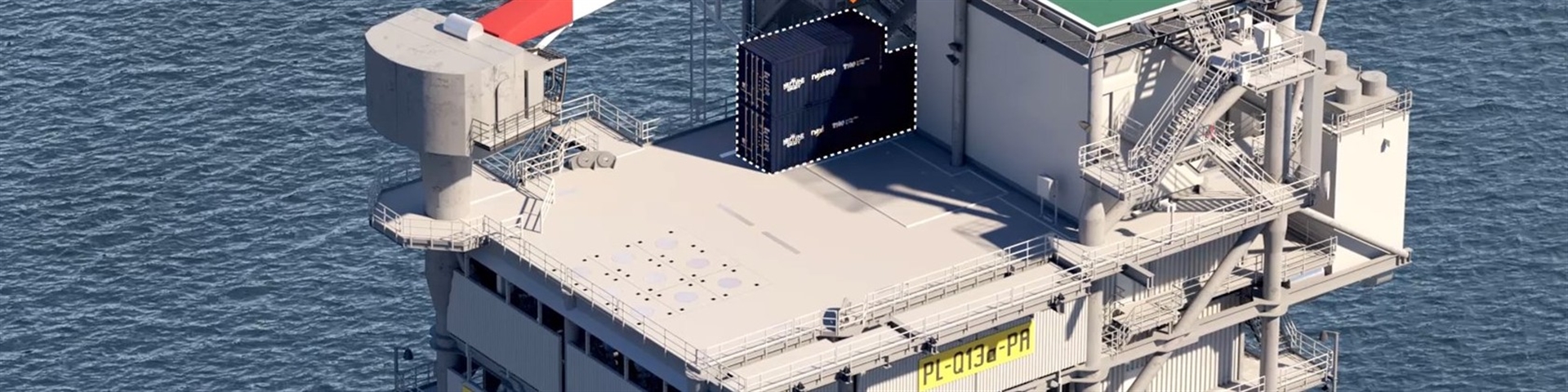
PosHYdon: Green hydrogen from seawater thanks to unique trial plant
Status
Completed
Partners
Nexstep, Neptune Energy Netherlands (Eni), Gasunie, Eneco, DEME Offshore, NOGAT, Noordgastransport, NEL Hydrogen, InVesta, TAQA, Hatenboer, Iv-Offshore & Energy en Emerson Automation Solutions
After five years of research, development and operational experience, PosHYdon has been successfully completed. As part of the project, green hydrogen was produced for the first time anywhere in the world on an operational gas platform in the Dutch North Sea.
The technical, operational and regulatory lessons learned provide an important foundation for the further development of offshore hydrogen and integrated offshore energy systems.
The energy transition requires new approaches to generating, storing and transporting renewable energy at scale. Offshore hydrogen is increasingly viewed as a potential building block of future integrated energy systems. PosHYdon explored how offshore wind energy, seawater and existing offshore infrastructure can be combined to produce and transport green hydrogen at sea.
A world first in the North Sea
PosHYdon is the world’s first demonstration project to integrate an electrolyser on an operational offshore gas production platform. The project brought together a broad consortium of companies, research organisations and public authorities to gain practical experience with offshore hydrogen production.
During the project, technical performance, operational processes, safety aspects, and regulatory and legislative frameworks were examined and evaluated. In doing so, PosHYdon not only demonstrated that offshore hydrogen production is technically feasible, but also highlighted the conditions and requirements that will shape future offshore energy projects.
Practical experience for future energy systems
According to René Peters, Business Director Energy Infrastructure at TNO, the true value of PosHYdon lies in the practical experience gained under real operational conditions.
“PosHYdon has demonstrated what is technically possible and provided valuable insights into both the opportunities and challenges of offshore hydrogen production. These experiences help industry, policymakers and other stakeholders make informed decisions about the further development of offshore energy systems.”
The project results contribute to a better understanding of the role hydrogen can play within a reliable, sustainable and affordable energy system.
Insights for policy, industry and investment
PosHYdon shows that the development of offshore hydrogen extends well beyond technology alone. Successful deployment requires close collaboration between renewable energy producers, infrastructure operators, technology developers, industrial users, investors and governments.
The experiences gained through the project provide valuable guidance for policy development, investment decisions, and future demonstration and scale-up projects. This includes not only technical feasibility, but also operational processes, infrastructure requirements and the organisation of collaboration across the energy value chain.
From technology to system readiness
One of the important lessons from PosHYdon is that successful offshore hydrogen projects depend not only on production technology, but also on the conditions required to integrate renewable hydrogen into existing energy systems. The project provided valuable experience with gas quality requirements, certification approaches, measurement protocols and calibration methods.
PosHYdon demonstrated that measurement, certification and stakeholder alignment are not supporting activities, but critical building blocks for future offshore hydrogen systems. Reliable measurement and certification are essential for safety, regulatory compliance, renewable energy claims and the further development of the hydrogen market.
The experience gained in PosHYdon highlights the value of developing these enabling conditions alongside the technical design from the beginning of a project, rather than addressing them shortly before operation.
Lessons learnt from PosHYdon
Read our final report to find out what lessons have been learnt from the PosHYdon project and discover which technical, operational and regulatory lessons lay the foundations for the next generation of offshore hydrogen projects.
Sharing knowledge with stakeholders
The completion of PosHYdon will be marked by a stakeholder event bringing together representatives from government, industry, research organisations and other key stakeholders to discuss the project’s results and future significance.
During the event, the consortium will present the lessons learned from the final report and explore the role offshore hydrogen could play within future integrated offshore energy
The next step towards large-scale offshore hydrogen production
PosHYdon has confirmed that offshore hydrogen production is technically feasible. At the same time, the project has shown that the greatest challenge does not lie in the electrolyser itself, but in integrating technology, infrastructure, permitting, safety and collaboration within a single coherent system. This practical experience provides an important foundation for the next phase of offshore hydrogen development in the North Sea.
The energy transition now calls for the next step: moving from a successful pilot to large-scale offshore hydrogen production. Achieving this will require new demonstration and scale-up projects that apply the knowledge gained through PosHYdon to installations on the scale of hundreds of megawatts.
Working together on the next offshore hydrogen hub
TNO invites industry, energy companies, infrastructure operators, technology developers, investors and governments to work together on the next generation of offshore hydrogen projects. By building on the knowledge and practical experience gained through PosHYdon, we can jointly take the next step towards offshore hydrogen production at a scale of around 500 MW and beyond.
Interested in becoming part of this next phase? Get in touch with us to explore opportunities for collaboration.
Contact us
-
Rene Peters
Functie:Business Director Energy Infrastructure-
Standplaats:Rijswijk - Kesslerpark
-
Email:Email Rene
-
LinkedIn:Rene on LinkedIn
-
Get inspired
Time setters: 200 times less iridium needed for green hydrogen production

The Netherlands takes the lead in development of third-generation electrolyser

North Sea countries unite forces to accelerate offshore hydrogen production

Breakthrough electrolyser development: 200 times less iridium needed
Methane pyrolysis
