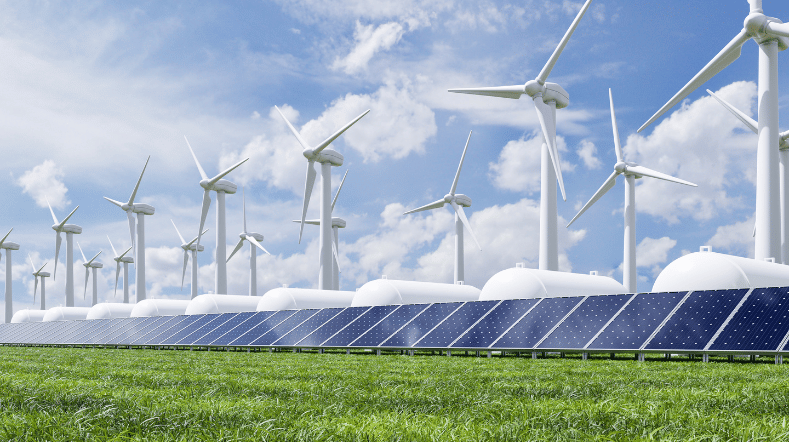
Discover how you can make an impact on tomorrow’s energy system today
The energy transition presents a wide range of technical, economic and societal challenges. How can governments provide the direction needed to achieve a sustainable, fair, affordable and autonomous energy system? How can businesses decarbonise while facing grid congestion constraints? And how can network operators gain the certainty needed to invest? TNO understands these challenges and provides the insights and solutions that enable partners to make informed decisions about the energy system of the future.
The uncertainties and challenges on the road to net zero
The transition to a carbon-neutral energy system brings significant challenges and uncertainties, with far-reaching economic and societal implications.
Building a resilient energy system at national and international level
The energy transition is closely linked to international developments in energy trade, value chains and geopolitics. That is why TNO works both nationally and internationally towards a sustainable and resilient energy system.
We support the development of the Dutch energy system through scenario analyses, system studies and policy advice, while connecting these efforts to international collaboration on topics such as hydrogen, CO₂ value chains and sustainable fuels. In this way, we help partners make choices that are affordable, feasible and future-proof, both in the Netherlands and in a rapidly changing global context.
The energy transition requires strong public leadership that connects policy and implementation within a sustainable, affordable and future-proof energy system. Provinces and municipalities face the daily consequences of grid congestion, delayed construction projects and complex decisions concerning heat networks and spatial planning.
Through smarter use of grid capacity, targeted public-private partnerships and inclusive solutions, governments can enable economic growth, strengthen energy autonomy and ensure that citizens and businesses alike benefit from the transition.
The transition to a net-zero energy system requires network operators to make strategic decisions regarding roles and responsibilities, contract structures and market models. Deep knowledge of the energy network alone is no longer sufficient.
Successful long-term investments require insights beyond the meter, including reliable data on societal and demographic trends, industrial decarbonisation and developments in the built environment. Through data-driven decision-making and effective partnerships with regional authorities, network operators can build a future-proof energy system that delivers value today.
Dutch businesses are ready to decarbonise and grow, but are increasingly constrained by grid congestion. Limited grid connections and a shortage of charging infrastructure are hampering investment, economic growth and job creation across companies and regions.
With smart tools and better insight into bottlenecks and available capacity, SMEs and industrial estates can continue to grow despite grid constraints.
What does TNO offer?
At TNO, we aim to contribute to a future-proof energy system that is sustainable, fair, affordable and autonomous. We do this at multiple levels, supporting governments, industry, businesses and citizens.
At national level, decisions about tomorrow’s energy system will determine the Netherlands’ future earning capacity and resilience.
At regional level, investments in infrastructure influence business growth, employment opportunities and access to affordable energy for citizens.
Through scientifically validated insights, models and tools, we provide decision-makers with clear perspectives for action. In doing so, we consider not only technical feasibility and economic performance, but also spatial impact, energy poverty and strategic autonomy.
For governments
Our models, field research and behavioural insights help the Dutch government gain a comprehensive understanding of grid capacity and make better use of it. Through the Buildings Electrification Consortium (GO-e), TNO is investigating smart flexibility services as an alternative to grid reinforcement.
Flexibility from electric vehicles and heat pumps is often sufficient to reduce congestion, provided the right incentives are introduced to encourage behavioural change. These insights can help avoid costly grid expansion.
Using scenarios and energy models such as TulipaEnergy, policymakers can immediately assess the impact of policy choices across the entire energy value chain.
What are the effects on energy costs for households and industry? What does this mean for the deployment of renewable energy sources such as offshore wind?
Projects such as Market Organisation of the Dutch Energy System (MODES) identify the market design required for a carbon-neutral energy system by 2050. In this way, we support policymaking with integrated, science-based insights and expertise.
For provinces and local authorities
By combining energy data at district, neighbourhood and building level, TNO advises how residential areas and business parks can be designed to reduce pressure on the electricity grid.
We use tools such as the Heat Profile Generator, which calculates heat demand by area, and Hestia, an open-source simulation model that maps the entire Dutch housing stock and evaluates policy measures.
TNO is developing a universal and scalable approach to designing heat networks. Standardisation helps reduce costs and accelerate deployment.
Projects such as CHILL provide insights into which types of heat networks are most suitable for specific areas, ranging from conventional systems to very low-temperature heat networks.
Through the ABLE project, we connect small-scale, expandable heat networks to the grid to help reduce congestion on business parks.
The energy transition has a significant spatial impact, while space in the Netherlands is limited. This is why TNO works on integrating energy considerations into spatial planning.
Within the Space for Energy programme, we connect provincial and municipal plans with network operators’ investment decisions. Using data, visualisations and models such as the Spatial Energy Explorer, we demonstrate how spatial choices affect energy infrastructure.
For network operators
Reliable data on demographic and societal trends, industrial decarbonisation and developments in the built environment are crucial for making long-term investments in a reliable and future-proof energy system.
TNO has extensive experience in establishing and strengthening collaborations between governments, network operators and market players, which are essential for the successful deployment of heat networks.
Together with network operators, we develop solutions such as scalable flexibility services through the GO-e programme, enabling electric vehicles and heat pumps to contribute automatically to grid stability.
We present the challenges faced by network operators to ministries in an objective and evidence-based manner, helping to ensure that policies are aligned with practical realities.
For businesses
For complex challenges that extend beyond individual companies, TNO helps analyse, identify and bring these issues to the attention of national policymakers on behalf of Dutch businesses.
Building on insights into national industrial energy challenges, we provide practical local solutions for businesses, particularly SMEs and industrial estates.
For example, the Energy Potential Scan helps businesses make better use of sustainable energy by aligning local energy demand profiles with available data and resources.
Through Energy Hubs, including initiatives such as the EIGEN programme, we develop smart energy solutions for business parks.
Contact us
-

Laurens Nordkamp
Functie:Senior Business Developer-
Standplaats:Amsterdam - Radarweg
-
Email:Email Laurens
-
LinkedIn:Laurens on LinkedIn
-
Get inspired
Transition to sustainable energy remains financially feasible

Satellite charging points offer temporary relief from grid congestion

From grid congestion to resilience: flexibility accelerates the mobility transition

Decentralised developments offer major potential for reducing grid investment
Solutions for grid congestion and efficient use of the electricity network