Over 90 years of TNO innovations
Since 1932, TNO has been bringing research and innovations to market, making an impact on our society and on the Netherlands' earning capacity.
From idea to impact
Innovation only truly creates value when it is put into practice. That is why TNO works in partnership with businesses, governments and knowledge institutions both within and outside the Netherlands to advance innovations. We develop new technologies, support start-ups and spin-offs, and help them grow. By combining knowledge, investment and practical experience, we bring innovations to market more quickly and increase our impact.
90 years of TNO innovations:
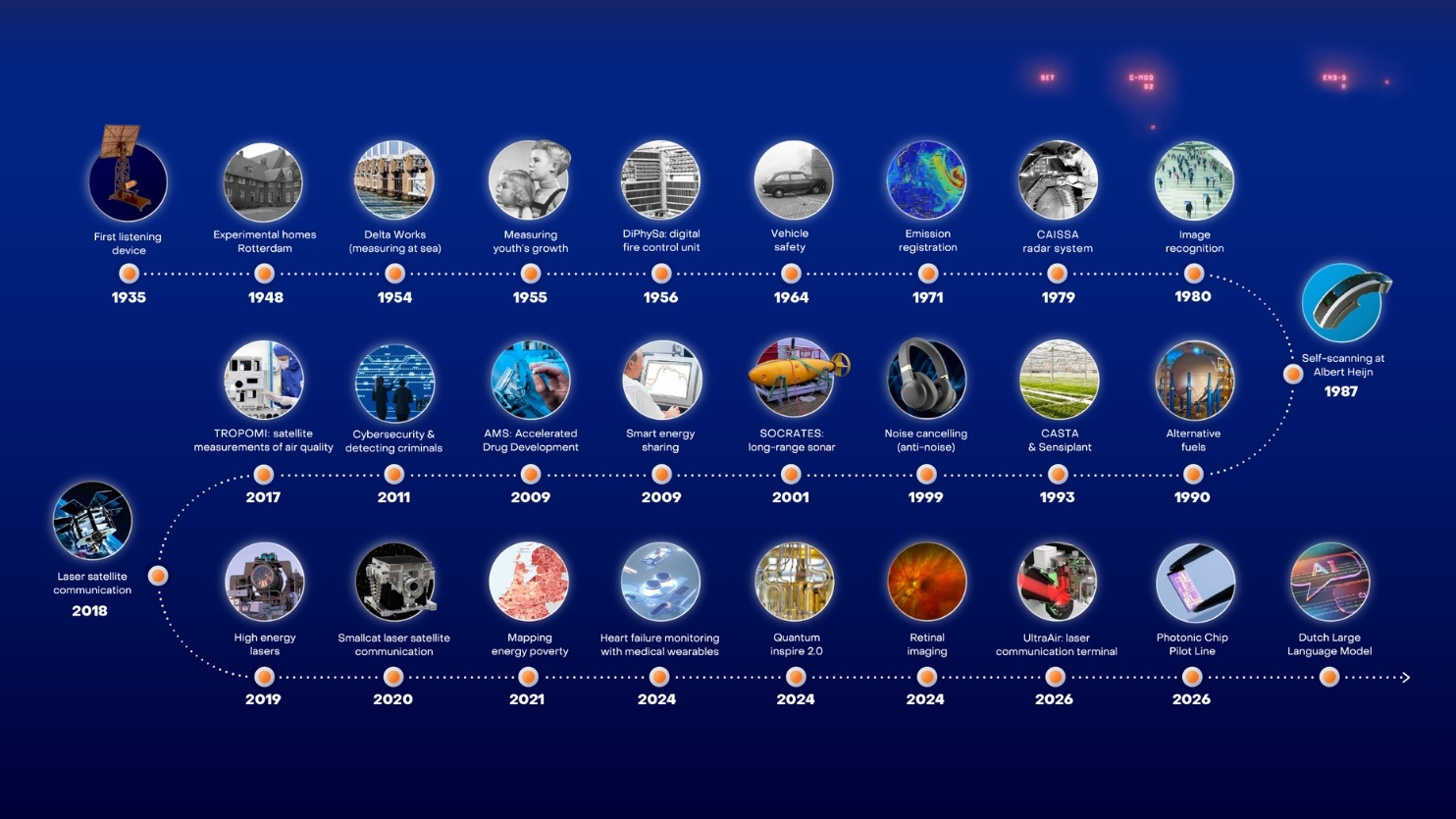
- 1935 – First listening device hears further
A parabolic listening device was developed to detect aircraft more quickly in poor visibility. This technology gave the Netherlands an advantage and is still used today in directional microphones. - 1948 – Experimental housing project in Rotterdam completed
48 innovative experimental homes were completed in Rotterdam to introduce new construction methods, insulation techniques and modern installations for post-war housing development. Innovations included heating and ventilation systems that were highly advanced for their time. - 1954 – Delta Works: measuring at sea
For the Delta Works, TNO developed measuring instruments for the sea and tidal conditions. This sensor technology laid the foundation for the digital models still in use today. - 1955 – Tracking children’s growth
Since 1955, TNO has been measuring the growth of children in the Netherlands. These data form the basis of growth charts and improved healthcare. - 1956–1960 – Digital fire-control system
TNO developed a digital system that made anti-aircraft guns far more accurate. The project was internationally pioneering and an early step in digital defence technology. - 1964–1971 – Vehicle safety
Thanks to TNO research and the introduction of crash test dummies, the seat belt became mandatory. This led to a significant reduction in road casualties. - 1971–2003 – Emissions Register
TNO mapped emissions from industry and transport. For decades, these data formed the basis of environmental policy. - 1979 – CAISSA radar
TNO developed a radar system capable of tracking multiple targets simultaneously. This technology forms the basis of modern naval radar systems. - 1980 – Image recognition
TNO developed software to analyse images automatically. This was an important step towards AI-based image recognition. - 1987 – Albert Heijn self-scanning system
Together with Albert Heijn, TNO developed the first self-scanning system. The concept later became a global standard in supermarkets. - 1990 – Alternative fuels
TNO researched hydrogen as a clean energy carrier. This knowledge is now being applied to large-scale hydrogen production. - 1993–2006 – CASTA & Sensiplant
TNO software made greenhouses lighter and more efficient. Later, Sensiplant helped growers manage water resources more intelligently. - 1999 – Noise cancelling
TNO experimented with anti-noise technology in aircraft. This technique underpins modern noise-cancelling headphones. - 2001 – SOCRATES sonar
TNO worked on advanced sonar systems to detect underwater objects at an early stage. This increased the safety of naval vessels. - 2009 – Smart grids
TNO developed smart energy grids that balance energy supply and demand. This technology is now incorporated into virtually every smart meter. - 2011 – Cybersecurity & QUIN
TNO developed software that helps police predict criminal behaviour. This strengthens digital investigation capabilities. - 2017 – TROPOMI
The TROPOMI satellite instrument measures air pollution down to city level. It helps governments develop environmental policy. - 2018 – Laser satellite communications
TNO is working on data links using lasers in space. This makes communication faster and more secure. - 2019 – High-energy lasers
TNO is researching lasers designed to disable drones in flight. This technology enhances protection against emerging threats. - 2020 – SmallCAT
The SmallCAT, measuring just 10 × 10 × 10 cm, established a laser communication link between a satellite and a ground station in The Hague. This was a milestone in demonstrating the feasibility of compact laser communication systems. - 2021 – Mapping energy poverty
In collaboration with Statistics Netherlands (CBS), TNO investigated how energy poverty has developed since 2019. - 2024 – Heart failure monitoring with medical wearables
This wearable technology improves patients’ quality of life while reducing pressure on healthcare professionals. - 2024 – Quantum Inspire 2.0
A prototype full-stack quantum computer serving as a testing environment for application development. - 2024 – Retinal imaging
An advanced retinal camera that uses light to measure oxygen levels in the blood vessels of the retina. - 2026 – Photonic Chip Pilot Line
Construction begins on a prestigious project under the EU initiative Chips for Europe. - 2026 – Dutch Large Language Model
A responsible alternative to existing large language models (LLMs), built using high-quality Dutch data obtained through lawful means.
Well-known innovations from TNO
The supermarket self-scanner, noise-cancelling headphones and mobile payments: these are innovations you may use every day. They all originated from TNO research. Today, these innovations are an integral part of modern life, but the original research behind them dates back to the twentieth century. Discover the stories behind these innovations.
Did you know that the idea of self-scanning in supermarkets is already around forty years old?
In 1987, Albert Heijn approached TNO to develop a compact barcode scanner that would allow customers to scan their own items while shopping. This resulted in the first prototype being tested in a store in Tilburg.
A few years later, with the support of an American manufacturer, TNO developed a new version of the barcode scanner that could be rolled out nationally and internationally.
Even so, it took some time before self-scanning became commonplace. It was only from the mid-2000s onwards that self-scanners began appearing more frequently in supermarkets, including those of Albert Heijn's competitors.
Today, this innovation has become almost indispensable in supermarkets.
You increasingly see people wearing noise-cancelling headphones. By generating an opposing sound wave, background noise can be significantly reduced.
As early as 1994, TNO carried out experiments with anti-noise technology. By placing magnetic sensors on aircraft propellers, researchers were able to determine the frequency spectrum of engine noise.
This signal was then fed into a tone generator, which analysed the spectrum and produced an opposing sound for each frequency. This anti-noise was played through loudspeakers in the aircraft cabin, enabling pilots to communicate with each other without wearing headsets.
Today, noise-cancelling technology is widely used in consumer audio equipment.
No more carrying a wallet full of cards. Instead, you can pay using your smartphone. It may sound like a modern phenomenon, but the first research in this field was conducted as early as 1995 by KPN Research, which became part of TNO in 2003.
TNO later carried out extensive research into Near Field Communication (NFC), the technology required for communication between a smartphone and a payment terminal, with great success.
This laid the foundation for the first steps in the Netherlands towards the payment system of the future.
Get inspired
Europe's chemical industry can become more sustainable without losing its foundations
Escalation in fireworks-related violence requires new security and response strategies
TNO AI event 2026
Five tips for driving plug-in hybrid more efficiently

Thorizon and TNO Launch Materials Programme for Molten Salt Reactors