PV SMART i4.0
Status
2026 – 2029
Partners
16 partners from the Netherlands, Belgium and Germany
Ordering a bespoke solar panel, as easily as putting together a wardrobe from IKEA. That is the vision behind the PV SMART i4.0 project. Sixteen partners from the Netherlands, Belgium and Germany are making the production of integrated solar systems smarter, faster and more affordable, using Smart Manufacturing and Industry 4.0 technology.
Grid congestion calls for smarter solar energy
Grid congestion is putting growing pressure on the electricity network in the Netherlands, Belgium and Germany. Integrated solar energy, solar panels that are not a separate add-on but become part of, for example, a façade, a noise barrier or a cycle path, offers a way forward: electricity generated and used on the spot, close to demand and without placing extra strain on the grid.
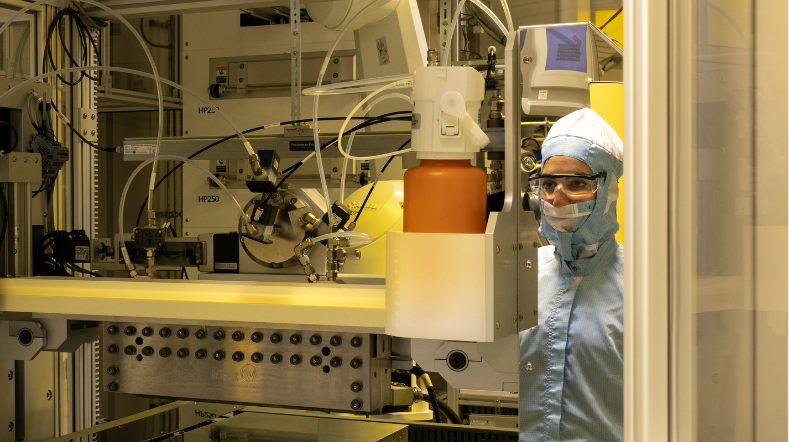
Yet this market remains small. The production of integrated PV systems (IPV) is still largely manual work. Every end user's requirement calls for a new bespoke design and a long series of manual production steps, from engineering to installation. That makes IPV expensive and vulnerable to competition from cheaper, non-European alternatives.
Manufacturers, system integrators, suppliers and the many SMEs active in the Meuse-Rhine Euroregion in hardware, sensors, software and systems integration all stand to benefit from a more efficient value chain. Grid operators, public authorities and future end users benefit too, through less grid congestion, new employment in the border region and a wider range of affordable products.
From manual work to Smart Manufacturing
PV SMART i4.0 addresses this challenge with Smart Manufacturing, automation and Industry 4.0 technology. Sixteen partners from the Netherlands, Belgium and Germany are working together from 2026 to 2029 on a faster, smarter and more scalable production chain for integrated solar energy.
TNO is the lead partner of the project and makes an active contribution to two of the three work packages. The consortium brings together broad, complementary expertise: ten companies, nine of them SMEs, four universities and universities of applied sciences, and two research organisations from across the Meuse-Rhine Euroregion. From hardware specialists in sensors and vision systems to developers of control algorithms, software and systems integration, all needed to improve the entire value chain, from product design to installation at the end user.
A configurator for bespoke solar panels
The project consists of three work packages. In the first work package, the partners are developing feedback loops that optimise smart manufacturing processes using data, so that production faults are identified more quickly and processes keep improving.
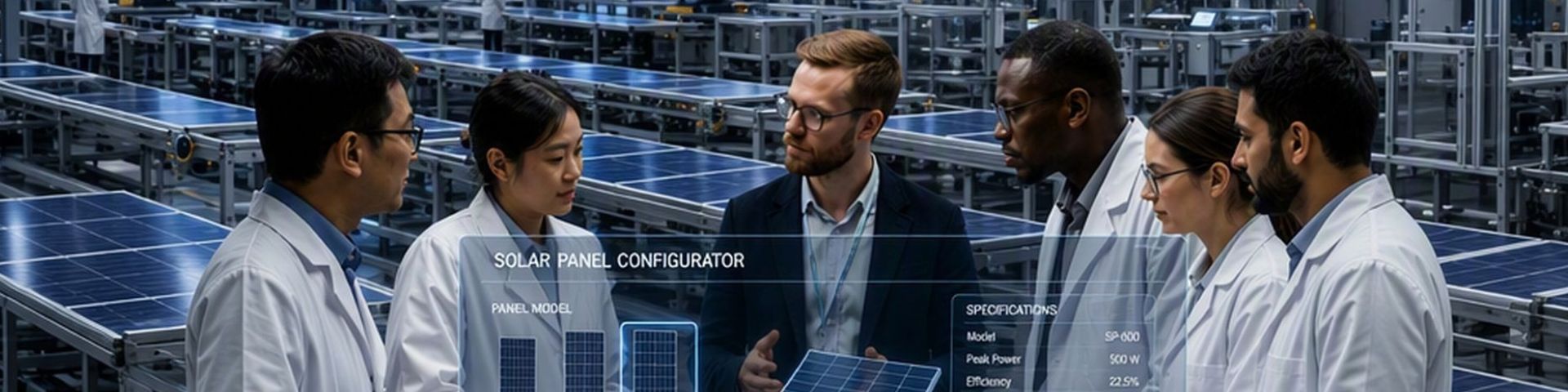
The second work package delivers a configurator framework that automates the entire value chain, from the production of solar panels through to installation at the end user. Comparable to putting together a wardrobe in the webshop of e.g. IKEA, but for a bespoke solar panel: a step-by-step route to a design that fits the customer's wishes and local building regulations.
The third work package focuses on knowledge transfer: an education programme with demonstration tools for the entire IPV market, from building-integrated photovoltaics (BIPV) to infrastructure applications (IIPV) such as solar cycle paths and solar noise barriers. The project got under way in mid-2026, co-financed by the European Union through the Interreg Meuse-Rhine programme.
Looking ahead
If PV SMART i4.0 succeeds, the result will be an IPV industry that produces faster, cheaper and at a greater scale than is currently possible. That opens the door to new markets that have barely got off the ground so far, such as PV balconies, solar cycle paths and solar noise barriers, and makes bespoke solar energy accessible to a much wider audience. End users gain more choice from affordable products.Manufacturers and system integrators gain a more efficient chain to produce in. And grid operators and public authorities benefit from reduced grid congestion.
Taking this step from research to market will continue to require cross-border collaboration between companies, knowledge institutions and public authorities in the Meuse-Rhine Euroregion, even after the project has ended. In this way, a local, European IPV industry is emerging that is less dependent on imports from outside Europe, and that contributes to the energy transition across the whole Meuse-Rhine Euroregion.
PV SMART i4.0 is being carried out as part of the Interreg Meuse-Rhine (NL-BE-DE) programme and cofinanced by the European Union, the Dutch Ministry of Economic Affairs and Climate Policy, the German State of North Rhine-Westphalia, the Dutch Province of Limburg and the Province of North Brabant. Voor more information and project updates please visit https://www.interregmeuserhine.eu/en/projects/pv-smart-i40/
Want to know more?
Would you like to help build the next step in affordable, integrated solar energy? Or find out more about PV SMART i4.0? Get in touch with our experts.
Contact us
-

Roland Valckenborg
Functie:Senior Project Manager TNO SolarMy ambition is to accelerate the energy transition towards a fully renewable energy future, with solar power playing a leading role. I am fully committed to advancing this transition on a national level, European level, and global level not forgetting the developing countries.
Please feel free to get in touch to explore how we can join forces in the development of solar energy, from upstream high tech PV-cell developments till downstream applications of solar integrated in our built environment and infrastructure.
-
Standplaats:Eindhoven - High Tech Campus 21
-
Email:Email Roland
-
Get inspired
Wind energy webinars

SWITCH tackles the energy issues of the future
SWITCH field lab of TNO and Wageningen University & Research/ACRRES opened
Study solar systems in dairy farming launched
Solar panel production back to Europe