

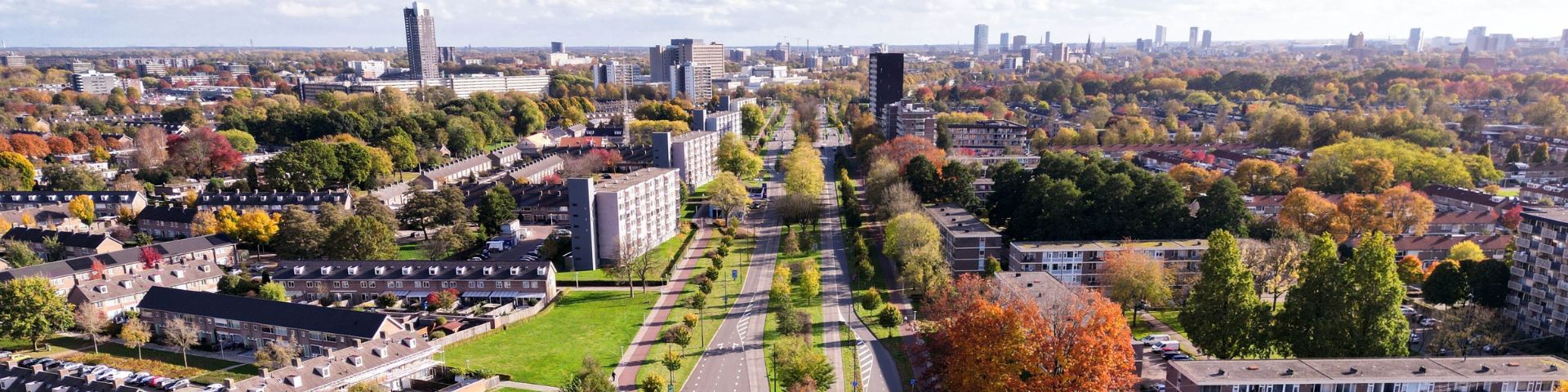
Social cohesion in the built environment
The Netherlands is seeing rapid development and urban densification. The challenge is not only to add homes and facilities, but also to create neighbourhoods where people feel at home, meet one another and look out for each other. This matters because connection to one’s neighbourhood and neighbours is associated with well-being, health, social safety and residents’ ability to cope collectively with change or crises. Yet social cohesion is not always fully embedded in spatial planning, policy and investment decisions. It is often perceived as intangible and difficult to measure.
Social cohesion as the foundation for healthy and liveable neighbourhoods
Social cohesion is about relationships between residents, their involvement in the neighbourhood and the trust needed to act together. The physical environment can help foster this. This includes accessible public spaces, green areas, community facilities, routes and places that encourage people to meet. But good design alone is not enough. Activities, local networks, management and opportunities for resident-led initiatives also influence whether people actually meet and feel a sense of ownership of their living environment.
TNO therefore takes an integrated approach based on three interconnected dimensions: hardware (the physical living environment), software (social activities and interaction) and orgware (organisation, management, collaboration and local networks). By examining these dimensions together, we can identify which combinations of design, programming and organisation contribute to connected, healthy and liveable neighbourhoods.
From the living environment to connected neighbourhoods
TNO researches how the living environment can strengthen social connectedness and the societal value this can create in terms of health, social safety, quality of life and broader well-being.
We identify which characteristics of neighbourhoods and area developments encourage social interaction, involvement and trust, which measures work for which groups, and under which conditions they are most effective. This helps organisations make evidence-informed decisions about policy, design and investment, and develop meaningful collaboration with residents.
Measuring and strengthening
We combine scientific knowledge, data analysis, practice-based research and co-creation with public and private partners. Building on our integrated approach to hardware, software and orgware, we develop indicators, impact models, assessment frameworks, digital tools and methods for collaboration. This makes it possible to measure social cohesion, demonstrate impacts and support targeted decision-making.
What does cooperation yield?
The collaboration is always tailored to the project phase and issue. TNO can support with:
- analysing the relationship between the built environment, health and social cohesion;
- developing design and action perspectives for neighbourhoods and area developments;
- developing indicators and approaches for monitoring and evaluating interventions;
- demonstrating societal impacts and substantiating investment decisions;
- conducting practice-based research and joint pilots with residents and public and private partners;
- strengthening collaboration with resident-led initiatives and other local partners.
We work together with municipalities, provinces, housing corporations, area developers, design and consultancy firms, social organisations, knowledge institutions, resident-led initiatives, investors and financiers, among others. Our starting point is always a concrete challenge and the knowledge or evidence needed to take the next step.
Working together on connected neighbourhoods
Are you working on the development of a neighbourhood, district or wider area and looking to better integrate social cohesion into design, policy, monitoring, collaboration or investment decisions?
TNO brings together expertise in the living environment, health, social dynamics and impact assessment. Together, we can explore what is already working, where additional knowledge is needed and how insights can be translated into practical applications. Would you like to explore how knowledge, data, measurement tools and impact assessment can help move your challenge forward? Get in touch.
Contact us
-
Bas Kremer
Functie:Business Development Manager-
Standplaats:Leiden - Sylviusweg
-
Email:Email Bas
-
-
Jeroen Pronk
Functie:Senior ResearcherContact me if you want to know more about how the social and physical living environment can support the health and well-being of youth and adults and help reduce health disparities. You can also reach out to me about designing co-research with youth and/or adults.
-
Standplaats:Leiden - Sylviusweg
-
Email:Email Jeroen
-
-

Noëla Hantschel
Functie:Scientist Innovator-
Standplaats:Leiden - Sylviusweg
-
Email:Email Noëla
-