
TNO launches VIMtima: a new Organ‑on‑Chip model to improve vaginal health research
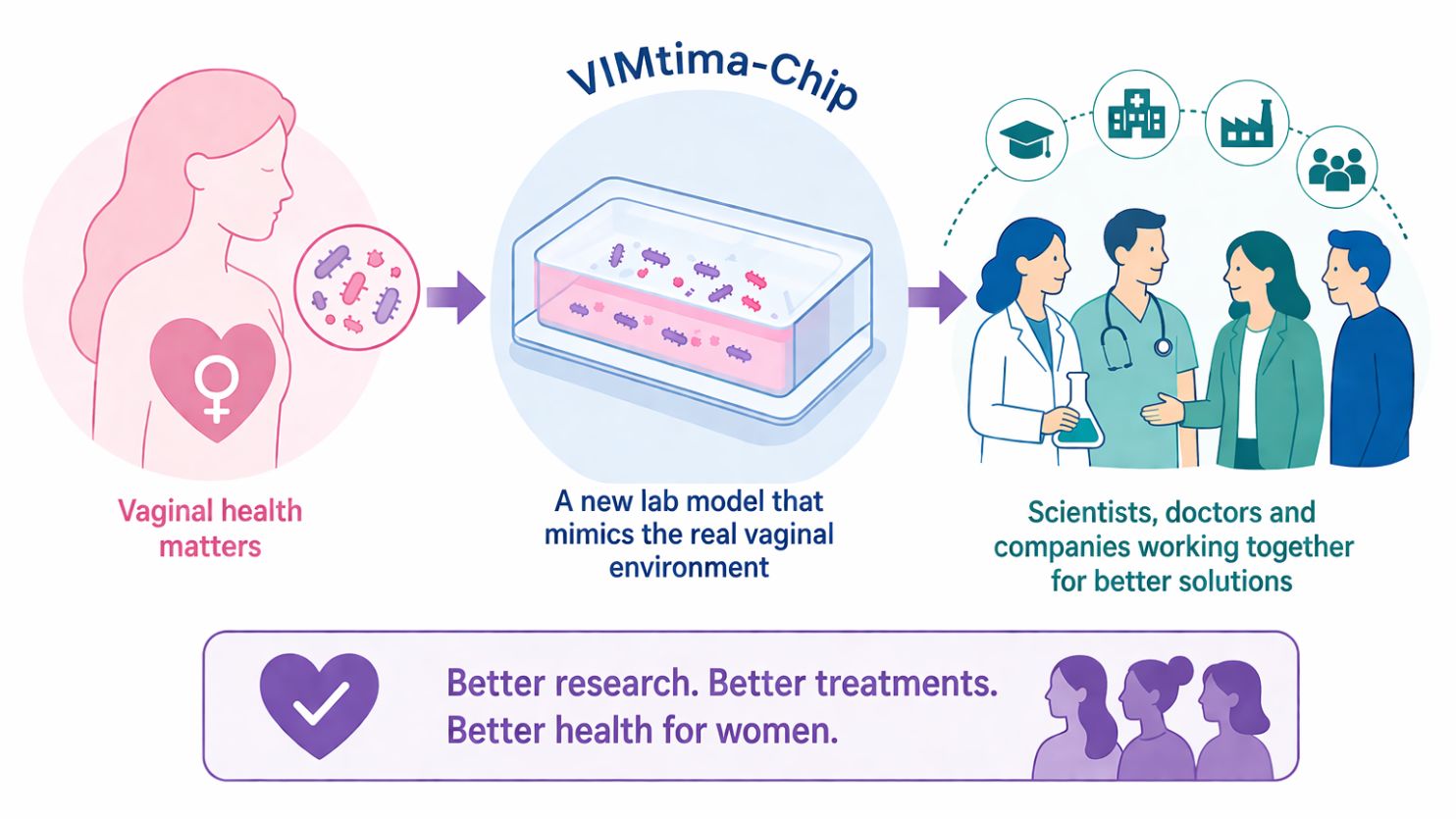
TNO has officially kicked off the VIMtima project, a multi‑partner public‑private collaboration aimed at improving research and treatment options for vaginal health. During the project kick‑off at TNO in Leiden, partners from science, healthcare, and industry came together to start the development of an advanced Organ‑on‑Chip model that realistically mimics the vaginal microenvironment.
Vaginal health plays a crucial role in women’s overall wellbeing yet remains underrepresented in biomedical research. Current preclinical models often fail to capture the complexity of vaginal tissue and its interaction with the microbiome, limiting the ability to develop effective and personalized interventions. The VIMtima project addresses this gap by creating a human‑relevant, animal‑free research platform.
A realistic lab model for vaginal host–microbe interactions
At the heart of the project is the VIMtima‑Chip, an innovative microfluidic Organ‑on‑Chip that integrates ex vivo human vaginal tissue with human‑derived vaginal microbiome communities. By closely mimicking the physiological vaginal environment, including oxygen conditions and barrier function, the model enables researchers to directly study host–microbe interactions under both healthy and imbalanced conditions.
The consortium will further develop the platform into a medium‑throughput system compatible with standard 24‑ or 48‑well plates, allowing reliable testing of interventions such as probiotics, intimate care products, and other therapeutic strategies.
Strong collaboration across disciplines
The VIMtima project brings together an international consortium of eight partners spanning research, healthcare, technology development, industry, and societal organizations. TNO coordinates the project and contributes expertise in Organ‑on‑Chip technology, microbiome research, and translational modelling. Amsterdam UMC and Radboud UMC provide clinical expertise, access to human vaginal tissue, and patient‑relevant data to support translational validation.
Locsense contributes advanced sensor technologies, including TEER measurements, enabling real‑time monitoring of tissue barrier function. Freya Biosciences supplies well‑characterized human vaginal microbiome samples and microbiome profiling expertise, while Yoni brings benchmark interventions and a consumer‑focused femtech perspective.
Reckitt participates in the project as a financial partner. They bring valuable industrial insights into vaginal health and consumer product development to support future adaptations. Finally, Stichting Proefdiervrij supports the project’s ambition to accelerate the transition to animal free, human relevant research methods.
‘Our goal is to provide a physiologically relevant and scalable model that helps accelerate innovation in women’s health,’ says the Dr. Joanne Donkers, lead scientist. ‘By combining scientific expertise with clinical insight and industrial perspective, VIMtima creates a strong foundation for better research and better treatments.’
‘VIMtima perfectly aligns with our mission to accelerate the transition to animal‑free research,’ says Anne Burgers from Stichting Proefdiervrij. ‘By developing a human‑relevant Organ‑on‑Chip model for vaginal health, this project shows how innovative technology can replace animal testing while delivering better science and real benefits for women’s health.’
From better research to better health for women
In addition to technology development, the project places strong emphasis on implementation and acceptance by end‑users, including researchers, clinicians, and industry. By aligning early with regulatory and standardisation efforts and by validating results against clinical data, VIMtima aims to support the broader adoption of Organ‑on‑Chip technologies.
The collaboration project HH-PPS-25061-OoC (VIMtima) is co-funded by PPP Subsidy awarded by Health-Holland, to stimulate public private partnerships.
Contact us
-
Joanne Donkers
Functie:ScientistJoanne Donkers is a scientist in the Metabolic Health Research expertise group. During her PhD, she missed the applicability of her research. That is why she ended up at TNO.
-
Standplaats:Leiden - Sylviusweg
-
Email:Email Joanne
-
-
Edwin Abeln
Functie:Senior Business Development Manager Health & Work-
Standplaats:Leiden - Sylviusweg
-
Email:Email Edwin
-
LinkedIn:Edwin on LinkedIn
-
-

Arnout Mieremet
Functie:ScientistThe central aspect of my research is to better understand the interactions between the human body and the microbiome. By developing and applying in vitro model systems, these interactions can be explored in high detail.
-
Standplaats:Leiden - Sylviusweg
-
Email:Email Arnout
-
Get inspired
Can your own smartwatch predict an IBD flare? A bring-your-own-device study from IBDigital

Meet the expert: RDCP
TNO as an orchestrator of lifestyle in healthcare

Fully digital personalised nutritional advice delivers measurable health benefits

Accelerating biomarker innovation is critical for the future of healthcare