
Eco-friendly firefighting: innovative solutions and zero PFAS
Large fuel fires have been extinguished with a special type of foam since the 1960’s. These foams, known as AFFF (Aqueous Film Forming Foams), containPFAS (per- and polyfluoroalkyl substances). PFAS are unique because they enable a thin, heat-resistant layer to quickly spread over a fuel. The result? A strong, water-based shield that puts out fires effectively. However, the very essence of PFAS that makes them formidable in fire suppression—their carbon-fluorine bonds—also makes many of these chemicals hazardous. Therefore, TNO is actively developing materials to replace PFAS, including in AFFF.
Safety and environmental impact
The safety of PFAS chemicals has come under scrutiny due to increasing reports of toxic exposure. The chemical structure of PFAS makes them very stable, meaning they don’t break down easily in the environment. This stability leads to accumulation in the bodies of humans and animals, and PFAS can be found in our air, water, and soil. This raises concerns about long-term environmental and health effects.
Green fire fighting: TNO’s innovative foam solutions
TNO is at the forefront of creating environmentally friendly firefighting materials. With new EU regulations on the horizon, we’re replacing harmful PFAS substances with safer alternatives. Our journey began with innovative foam formulas for small extinguishers, developed in partnership with Saval. Today, they proudly manufacture these fluorine-free foams (F3) and extinguishers in Breda.
Sustainable firefighting foam that meets U.S. military’s standards
Our latest endeavor is a project is supported by the U.S. Strategic Environmental Research and Development Program, SERDP. It is focused on developing a foam that meets stringent performance requirements (e.g. MIL-PRF-32725), while also addressing issues related to sustainability and scale-up. To do this we explored multi-component formulations consisting of clay nanoparticles, water-soluble polymers, surfactants, and extinguishing agents.
By systematically tuning the composition and concentrations of these materials, it was possible to improve the firefighting performance, while simultaneously addressing specific military requirements (e.g. surface/interfacial tension, viscosity, toxicity, etc.). The most promising formulations were tested at the U.S. Naval Research Laboratory (NRL) using 28 ft2 (2.6 m2) pools of gasoline and Jet A fuel. Through these “real-world” scenarios, we received excellent insights on how to refine our formulations, which ultimately led to successful results at this scale.
Alternatives to PFAS chemicals for industry
In addition to firefighting foams, TNO actively develops alternatives to PFAS chemicals for electronics and semiconductor applications. These industries face unique challenges due to their complex manufacturing processes and stringent quality standards. By systematically assessing how these products are used, we can develop new, responsible materials that can effectively transition organizations to organic, fluorine-free alternatives.
Current projects and progress
- ENABLE project: We’re creating new binders for battery cathodes that don’t rely on PVDF. In this work, we explore alternatives that can meet the voltage, temperature, and processing requirements needed for next-gen Li-ion batteries.
- 10Ace project: In collaboration with ASML and Carl Zeiss, we’re seeking PFAS-free solutions for the semiconductor industry, focusing on replacing commonly used components like O-rings, lubricants, and packaging materials. While these components appear visually simple, they can be notoriously difficult to replace because of requirements related to gas/particulate generation and UV resistance. Understanding these nuances is crucial, as it directly impacts how we develop PFAS-free alternatives.
The importance of collaboration
Our journey towards PFAS-free materials is complex but essential work. By learning how these products are used in practice, we hope to create safe, responsible alternatives. Collaborative efforts with academia, industry leaders, governments, and research bodies are crucial for fostering innovation and making progress in this field.
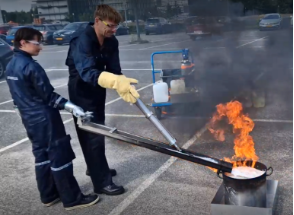
Eric Craenmehr and Jelle Rohlfs (TNO – Materials Solutions) as they extinguish a 1 ft2 fire (0.09 m2) with a new formulation.
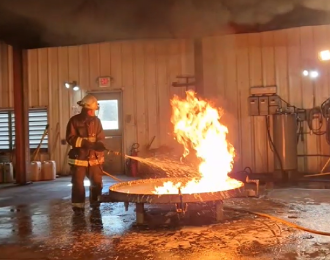
Firefighting test at U.S. Naval Research Laboratory (NRL) using 28 ft2 (2.6 m2) Jet A fuel and TNO formulation.
TNO explores PFAS alternatives with European partners
Contact us
-

Joe Trimboli
Functie:Senior Scientist Specialist-
Standplaats:Eindhoven - High Tech Campus 25
-
Email:Email Joe
-
Get inspired
ESA selects TNO to explore laser satellite technology for the Low-LEO layer of Europe’s IRIS² network

Hydrogen & CCUS Expert Workshop at the Hamburg Expo
Smart radar protects bats at Eemshaven wind farm
Forces combined: how TNO supports LionVolt to accelerate next-generation battery technology

Knowing where a signal comes from: airborne eDNA meets wind modelling