From TNO researcher to CEO: how Jeroen Borst built an international company
For many researchers, innovation does not end with a publication or a successful experiment. Sometimes, that is only where it begins. This was also the case for Jeroen Borst, CEO of Scenexus. What started as technology developed within TNO grew into an international company that helps make complex urban challenges easier to understand.
At TNO, we believe that technological or scientific innovation only creates real societal and economic impact when it is put into practice. By establishing spin-offs such as Scenexus, TNO helps groundbreaking technologies rapidly and effectively reach their full potential and create societal impact.
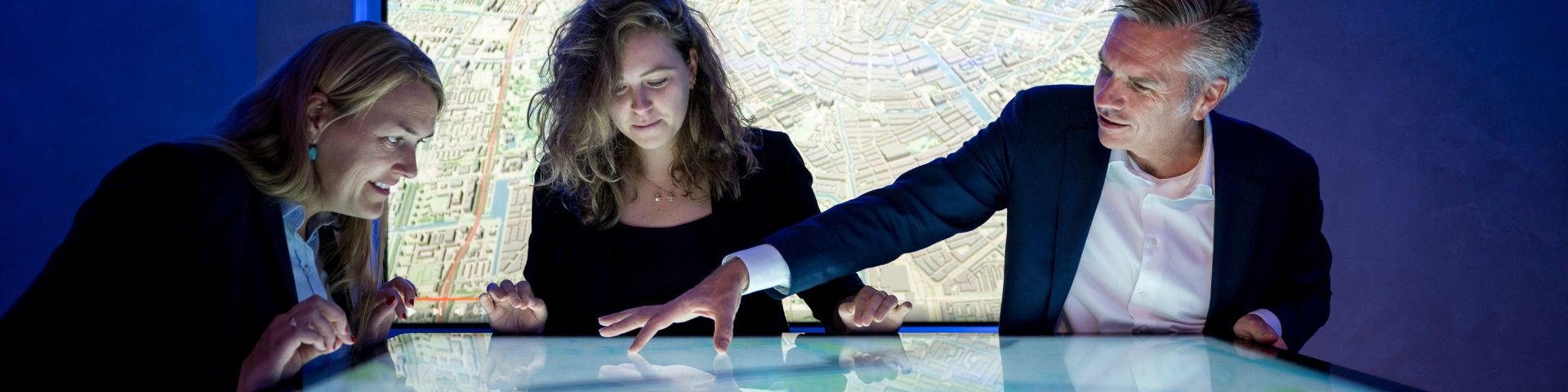
The technology offered by TNO spin-off Scenexus allows public authorities and urban planners to test future scenarios in minutes rather than weeks. From housing and mobility to energy and climate targets, the technology brings complex challenges together in a single interactive environment. Its ambition is significant: to help public authorities make better decisions and contribute to more resilient, liveable cities around the world.
Room to grow
When Jeroen joined TNO in the late 1990s, becoming an entrepreneur was not part of his plan. He was a physicist, fascinated by models, data and the question of how technology could help address societal challenges. What he did have was the freedom to explore new directions. That freedom proved pivotal.
'I started by developing models for air quality and health. Traffic models were added later. I didn’t know exactly where it would lead, but I was given the freedom to develop my expertise further.'
He took additional courses at Delft University of Technology, developed new expertise and began combining different disciplines. 'To me, that is one of TNO’s greatest strengths. You are not confined by a job description. You are given the opportunity to develop the expertise needed to create societal impact.'
'The question was no longer: can this technology succeed independently? It became: am I prepared to take responsibility for it myself?'
Putting research into practice
What started as a research question grew into an ambitious platform that enables public authorities to predict the impact of new housing developments, traffic measures or investments in energy infrastructure.
Jeroen worked with colleagues to develop the technology further. He did so not only as a researcher, but also as a project leader, manager and business developer. In hindsight, this varied combination of roles proved extremely valuable.
'Many people see a research career and entrepreneurship as two completely different worlds,' he explains. 'But in this role, I had the opportunity to gain experience with clients, teams, strategy and business development.'
Step by step, he developed a profile that combined in-depth expertise with commercial thinking and entrepreneurship. 'The fact that other people were putting their trust in me was more daunting than giving up my own pension scheme.'
The question that changed everything
When it became clear that the technology was ready for international growth, the idea of creating a spin-off emerged: Scenexus. But leading innovation within a large organisation is quite different from becoming an entrepreneur at a start-up.
For Jeroen, this also meant facing a personal decision. The safe route seemed obvious. He would oversee the spin-off process from within TNO without making the move to the new company himself.
Then a business trip to San Diego and a conversation with the mayor changed the way he viewed his own role. 'I spoke with potential partners and customers. The urgency was clear: cities needed this kind of technology. But then a question came up that stayed with me: if I’m not prepared to join Scenexus myself, why should potential customers do so?'
That made the question personal. 'The question was no longer: can this technology succeed independently? It became: am I prepared to take responsibility for it myself?'
Not long afterwards, Jeroen spotted a quote on a wall at a university campus:
Ships in the harbor are safe, but that is not what ships are built for.
'I immediately thought: this is about me.' He sent a message home. His wife replied almost immediately with a thumbs-up and the words: “Go for it.” That same day, he decided to take the leap.
From a secure job to his own company
The move involved much more than a change in job title. Jeroen left a familiar environment for a company that still had everything to prove. With that came all the uncertainties of entrepreneurship: convincing customers, developing a market, attracting investors and making decisions without the safety net of a large organisation.
What made it even more daunting was that he was not taking the leap alone. Colleagues decided to join him, giving up their own security in the process. For Jeroen, that responsibility felt almost greater than making the decision for himself. Not because he doubted the technology, but because others were placing their trust in him too.
'To be honest, I found that more daunting than giving up my own pension scheme,' he says. It demonstrates the confidence they had in the technology, but perhaps even more importantly, in the people behind the idea.
Impact as the driving force
Becoming an entrepreneur was never Jeroen’s original plan. His motivation remained the same as it had been when he was a researcher: ensuring that technology does not remain on the shelf, but is actually used to enable better decision-making.
Scenexus is the result: a company building on years of research, now with the speed and focus of a commercial enterprise.
His story shows that the journey from research to entrepreneurship does not always begin with a grand plan. Sometimes, it starts with technology that is ready for the market, a question you can no longer ignore and a willingness to take the risk yourself.
Jeroen did not suddenly become a different person. He remained a researcher in the way he thinks and approaches problems, but became an entrepreneur through what he was prepared to do.
Working at TNO
Jeroen’s story also reveals something about the culture at TNO. Innovation does not come from technology or investment alone. It happens when people are given trust and the freedom to grow. When managers recognise opportunities before you see them yourself. And when colleagues grow with you.
Jeroen was given the freedom to develop new expertise, work across disciplines and create innovations with societal impact. Sometimes that leads to new research programmes. Sometimes to international collaborations. And sometimes, it even leads to a company of your own.
More employee stories
Time setter story: Inez Erwin Magino on TNO Traineeship

Time setter story: Lars Geluk on TNO Traineeship
Time setter story: Karla Rojas Martínez on TNO Traineeship
Time setter story: Saskia Lensink about GPT-NL
Time setter story: Jesse van Oort