Turning textile waste into new chemical building blocks
73 percent of all textile waste in Europe end up incinerated or in landfills. Not because they are unusable, but because recycling technology has so far been unable to handle the messy reality of mixed textile waste: t-shirts with elastane, jeans with metal buttons, workwear with flame retardants. New TNO research is changing that. With knowledge built up from years of plastic waste research, now applied to textiles.
A Friday afternoon experiment with textile waste
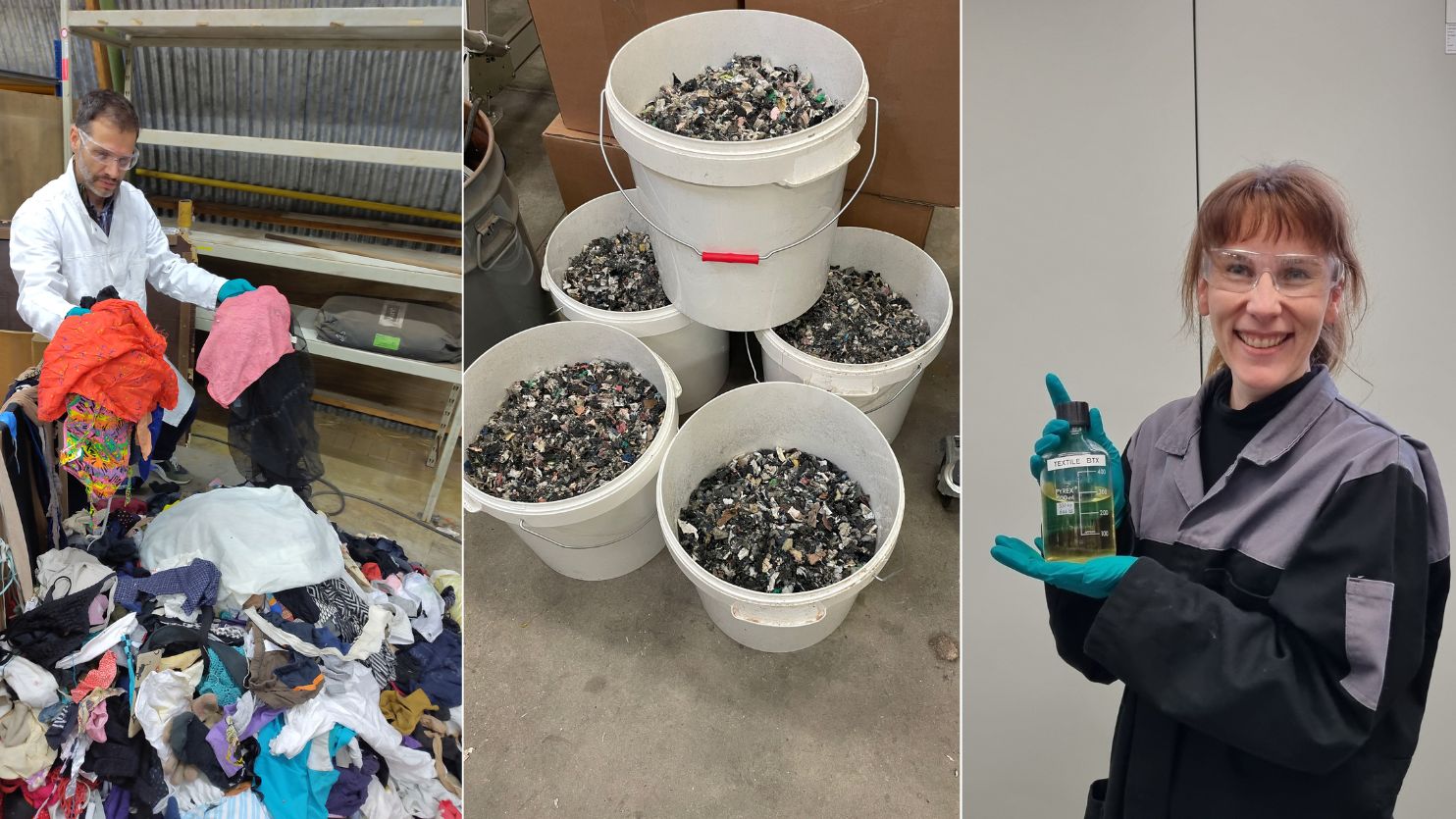
It is a Friday afternoon in October. In the TNO laboratory, Surika van Wyk and Carlos Mourao Vilela, both scientist innovators at TNO, start an experiment they have been thinking about for a while: what can we get out of a pile of textile waste that normally gets incinerated?
The testing material was not a clean laboratory sample, but a bag of real textile waste from a waste sorter. T-shirts, workwear, an old pair of jeans. Material that others consider worthless, but exactly what the team was looking for.
'We had an idea of what we would get based on the general composition', Surika explains. 'But you are always surprised by the interactions between different fibres and chemicals.' What followed confirmed their hypothesis and worked better than expected: a versatile product slate emerged, from synthesis gas for methanol production to benzene that can be used to make new polyester. Technology with the potential for significant industrial impact.
Why most textiles still get burned
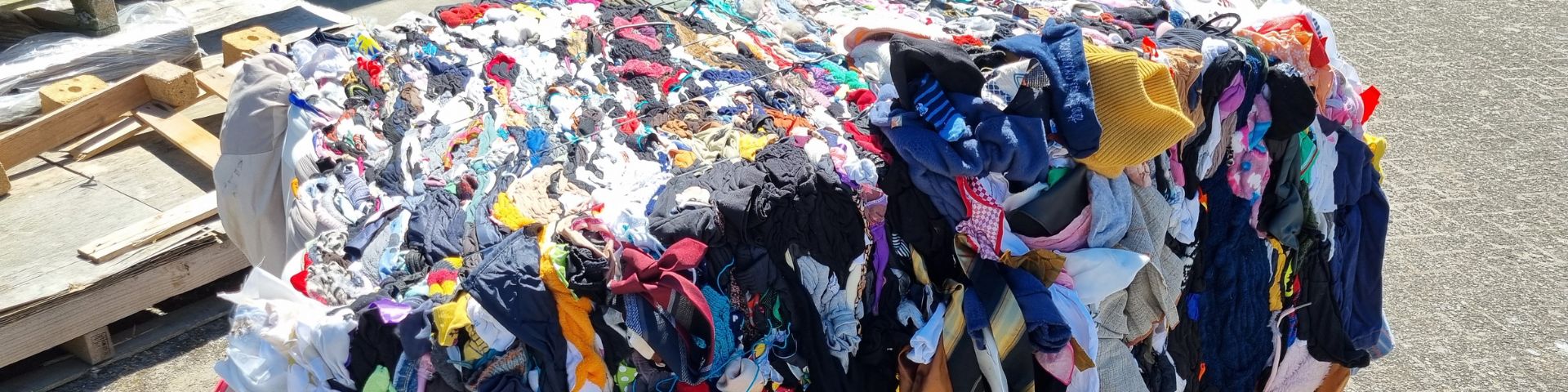
The textile industry is limited in its recycling possibilities. Current methods require clean, single-material streams. But real post-consumer textile waste contains 15 or more fibre types, plus dyes, flame retardants, buttons and zips. In the Netherlands, 215,000 tonnes of textiles are thrown away annually, equating to ~ 12 kg per person. More than 50% of that textile waste ends up in household waste bins and is then incinerated.
Meanwhile, regulations are tightening. The revised EU Waste Framework Directive requires Extended Producer Responsibility schemes for textiles by 2028. So the pressure to find solutions is mounting.
Curious about the scientific foundation behind our approach to mixed textile waste?
Read the paper on how thermochemical valorisation enables new circular routes for hard to recycle materials.
How thermochemical recycling works
The principle: heating textile waste without oxygen breaks polymer chains into smaller molecules. The temperature determines what you get out.
1. Shredding: textile waste is cut into small pieces
2. Feeding: material enters a bubbling fluidised bed reactor with hot sand particles (700-850°C)
3. Cracking: within seconds, polymers break down into gases
4. Cleaning: contaminants are captured in the gas phase and filtered out
5. Separation: products are separated based on their properties: synthesis gas, olefins, aromatics, methane
Read more about thermochemical recycling and watch the video on our textile breakthrough.
At lower temperatures (up to 750°C) the process yields more olefins and aromatics. At higher temperatures (above 800°C) syngas becomes the dominant product. This allows operators to tune the output to market demand.
Traditional gasification (above 1000°C) breaks everything down to just CO and hydrogen. TNO's lower temperatures capture molecules before they fully decompose. This 'shortcut' yields more valuable chemicals with fewer processing steps.
The process does not require sorted input. Dyes and flame retardants end up in the gas phase for treatment. Buttons and zips go to the ash fraction.
The shortcut to valuable chemicals
Traditional gasification converts everything into synthesis gas, carbon monoxide and hydrogen, which then requires extensive processing to rebuild into useful molecules. TNO's thermochemical recycling process takes a different route. By operating at intermediate temperatures (700-850°C), the technology captures valuable chemicals before they break down completely.
The result is a versatile mix of chemical building blocks: synthesis gas for methanol and fuels, aromatics like benzene for new polyester, and olefins that form the basis of most common plastics. The process does produce some CO2, mainly from the polyester fraction, but far less than full incineration. And crucially: the valuable carbon is captured rather than lost.
A key milestone came when the team successfully recovered half a litre of general aromatics of which 70% benzene from a multi-hour run processing real textile waste. Besides the science, this also took some practical effort. 'We are used to making small, beautiful pellets that feed easily into our reactor', Carlos recalls. 'Textile waste is fluffy, it blocks the screw feeder. We had to solve practical challenges first. But once we did, we proved the principle works.'
Instead of paying for waste, selling it
The technology opens possibilities across the textile ecosystem. For sorters, what they pay to incinerate could become revenue. Currently, sorters pay around 0.28 €/kg for incineration and additionally separating the different fractions is labour intensive.
For brand owners facing EPR obligations, it offers a credible circularity solution. For chemical producers, textile waste becomes an alternative carbon source as fossil regulations tighten.

'The contaminants go into the gas phase, where we can filter and capture them, rather than releasing them into the atmosphere.'
Medical textiles and military uniforms
There are also specialised applications where incineration is currently the only option. Medical textiles must be destroyed for biosafety reasons. Military uniforms are shredded for security. Workwear contains PFAS that poses risks when incinerated.
For these sectors, TNO offers an alternative that is also more environmentally friendly. 'The contaminants go into the gas phase, where we can filter and capture them', Surika explains. 'Rather than releasing them into the atmosphere.'
From waste sorter to feedstock provider
Carlos sees parallels with plastic waste discussions from 2018. Brand owners will need to consider circularity. But there will always be waste fractions that cannot be processed otherwise. 'That is where we add value', he says. 'For material with no further use, we can still valorise it.'
TNO has proven the principle at lab scale. The next step requires commercial partners to scale to demonstration level. The ideal outcome? Surika puts it simply: 'Sorters become feedstock providers. No more need for incineration.'
Also interested in working with TNO on recycling textile?
The EPR requirement for 75% textile reuse or recycling by 2030 is accelerating developments in the field. With the Dutch government’s ambition to achieve 100% circular textiles by 2050, our technology can make a substantial contribution.
Building on our experience in plastics and biomass, we are advancing from a strong foundation. A biomass demonstration‑scale development project is already in motion.
-
For textile sorters and waste processors: For waste streams that currently go to incineration, TNO can characterise the material and assess valorisation routes.
-
For technology partners: Work with TNO to help scale this technology from lab to large-scale demonstration.
-
For brand owners preparing for EPR: Explore circular solutions for your products, including the difficult fractions.
From biomass to plastics to textiles
TNO's approach builds on years of experience. The team developed thermochemical technology first for biomass, then adapted it for plastic waste from 2018. By 2023, they saw the next opportunity: textiles.
'Textile sits somewhere between biomass and plastics in composition', says Carlos. 'We already knew how to handle heterogeneous feedstocks. The question was: can we apply that to textile waste?'
The answer required working with real waste, not idealised laboratory mixtures. TNO obtained 400 kilograms of actual post-consumer textile waste from Dutch sorters. The exact material that would otherwise be incinerated.
Read more about textiles and sustainability
What if your polyester jersey could be made from renewable materials instead of fossil fuels? TNO developed a 3-step framework to help brand owners find the best sustainable alternative. The approach compares biobased polymers, drop-in replacements and CO2-based plastics on sustainability impact and economic feasibility. A data-driven method to make informed material choices.
Read more about the 3-step framework.
Textiles are the fourth-largest source of microplastics in the Netherlands, releasing around 100 tonnes per year. Synthetic clothing sheds small plastic particles when worn, washed and dried. These particles end up in air, water and food. TNO developed a measurement method to detect microplastic fibres from clothing and test solutions to reduce emissions.
Read more about the source of microplastics.
Solvent‑based recycling serves as a targeted upstream enabler for textile‑waste valorization by removing colourants, coatings, PVC‑related additives, flame retardants, and other components that hinder high‑quality reuse.
Its strongest added value lies in enabling direct polymer valorization—particularly mechanical recycling and polyester depolymerization—by providing much cleaner feedstocks and overcoming major barriers such as colourant contamination that currently prevent direct PET reuse from mixed textile waste. It also allows early recovery of valuable components, with only the most challenging residual streams sent to thermochemical recycling.
Read more about solvent‑based recycling.
Meet our expert


Contact us
-

Wojtek Kwos
Functie:Business Developer Circular PlasticsReach out to me with any questions related to circular plastics, particularly in the areas of modelling, pre-treatment, and advanced recycling methods.
-
Standplaats:Rijswijk - Kesslerpark
-
Email:Email Wojtek
-
LinkedIn:Wojtek on LinkedIn
-
Get inspired
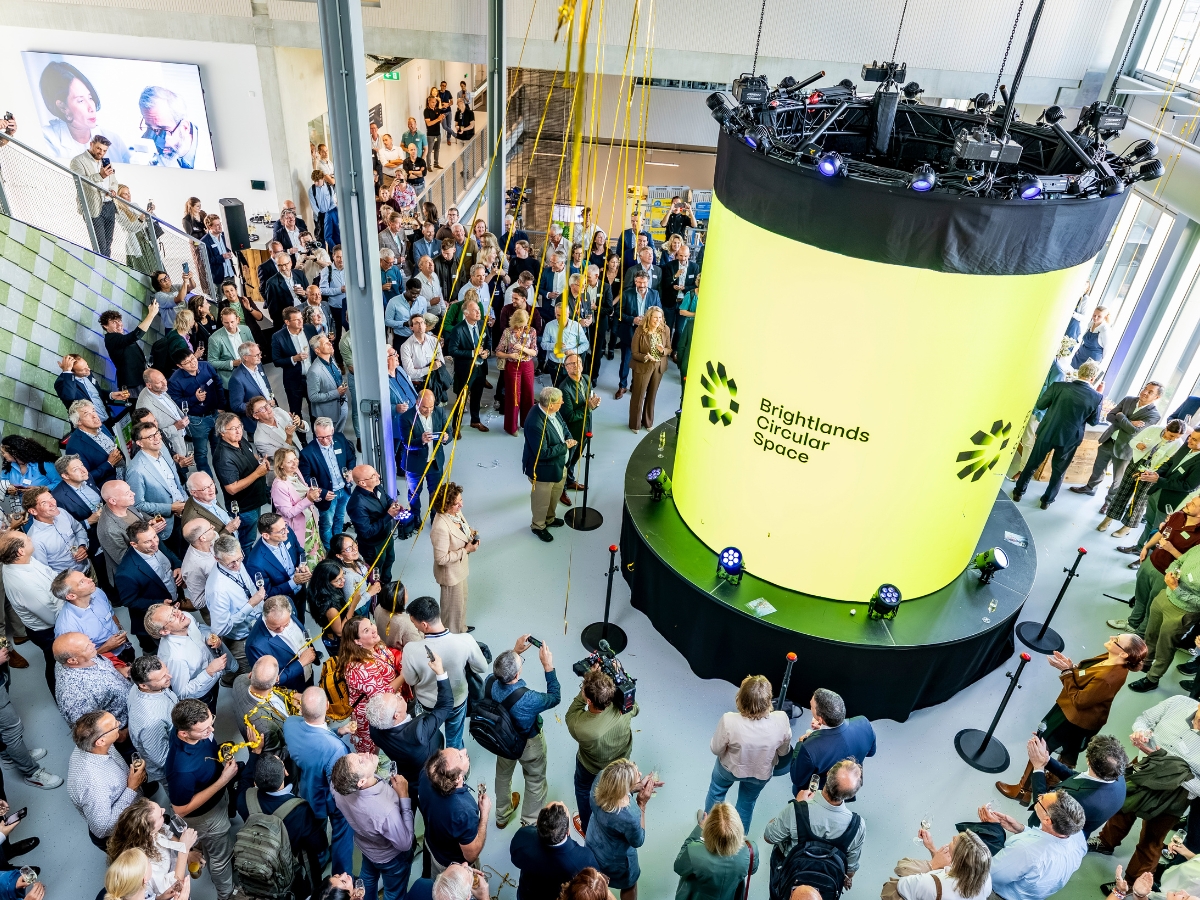
Brightlands Circular Space opens: TNO helps companies scale up plastic innovations faster
Product group analysis
SkiesFifty and TNO collaborate to strengthen independent insight in Sustainable Aviation Fuel investments
An objective standard to assess recycled plastic quality
Fewer microplastics and higher yields in plastic recycling