TNO's laser technology: a gamechanger for circular solar energy
The first generation of solar panels is reaching the end of its lifespan. To prevent scarce raw materials from being lost, smart solutions are needed. TNO researchers have made a breakthrough: a sustainable, innovative laser technology.
This laser technology represents a fundamentally different approach to recycling. In 2024, around 24% of the world's mined silver was used in solar panels. The new laser technology is expected to recover as much as 99% of that silver, while consuming far less energy than conventional methods.
Solar panels are built to last, which is precisely what makes separating their materials so difficult, and that is now proving a real challenge for recycling. TNO's laser-based approach offers a solution. The technology dismantles solar panels far more efficiently, while preserving valuable raw materials. That matters for keeping solar energy affordable and less dependent on scarce, imported resources. In doing so, so-called PV recycling brings an autonomous solar energy sector a step closer.

'This laser technology unlocks a goldmine of raw materials. By 2030, Europe is expected to see a substantial volume of decommissioned solar panels, a unique economic opportunity.'
Why solar panels are hard to recycle
Solar panels are designed to withstand at least 25 years of wind and weather. They need to resist heat, cold, moisture and mechanical stress, which is why components such as glass and solar cells are firmly bonded together using so-called encapsulants.
That durability is an advantage during use, but a drawback when it comes to recycling. The adhesive layers make it almost impossible to separate components without damaging them. Current recycling methods tend to be crude, with panels shredded or heated to high temperatures. These techniques fail to recover materials like silver and pure silicon at all, or do so at very high energy cost.
Recycling with light: from bonding to separation
TNO has developed an alternative approach to dismantling solar panels, one that turns the panel's own design against the problem. Panels are built to capture as much light as possible, and that very principle is the key to recycling them.
A powerful laser converts light in the solar panel's active layer into localised heat. This targeted rise in temperature releases the bond between the solar cells and the encapsulants, allowing the different layers to be separated in a controlled way, without heating the entire panel or resorting to chemical treatment. The technology can be applied across various types of solar panels.
The result is a much cleaner separation of materials. The glass stays intact and the solar cells are freed with barely any adhesive residue. The process uses less than 1 kWh of energy per module, a fraction of the energy required by conventional techniques such as pyrolysis, which uses around 25 kWh per module. 'Laser-based techniques show that things can be done differently: energy-efficient and without losing value,' says research lead Mirjam Theelen.
Mechanical disassembly of solar panels using laser technology
A goldmine of silver and silicon
Circularity is one driver, and scarcity of raw materials is another, and the value of these materials is far from trivial. Solar panels contain significant amounts of silver, an estimated 99% of which could be recovered. Currently, 25% of the world's mined silver goes into solar panel production, while demand for the material continues to grow.
Alongside silver, solar panels also contain high-purity silicon, which could be cleverly reused within Europe, in batteries or new solar cells, for example. Glass and plastics from the panels are also easier to reuse when recovered cleanly.
Recycling is often treated simply as a regulatory obligation, but this new laser technology has the potential to become a genuinely profitable process. The value of the pure materials recovered far outweighs the cost of recycling, making high-quality recycling both economically attractive and commercially promising, particularly as more solar panels reach end of life and waste volumes continue to grow.
From optimising to scaling up
TNO's research has now been running for three years and has clearly moved beyond the exploratory phase. In the lab, nearly all common types of solar panels have already been successfully treated and dismantled. Researchers continue to fine-tune the process, for instance by examining how different laser types affect the adhesive layers.
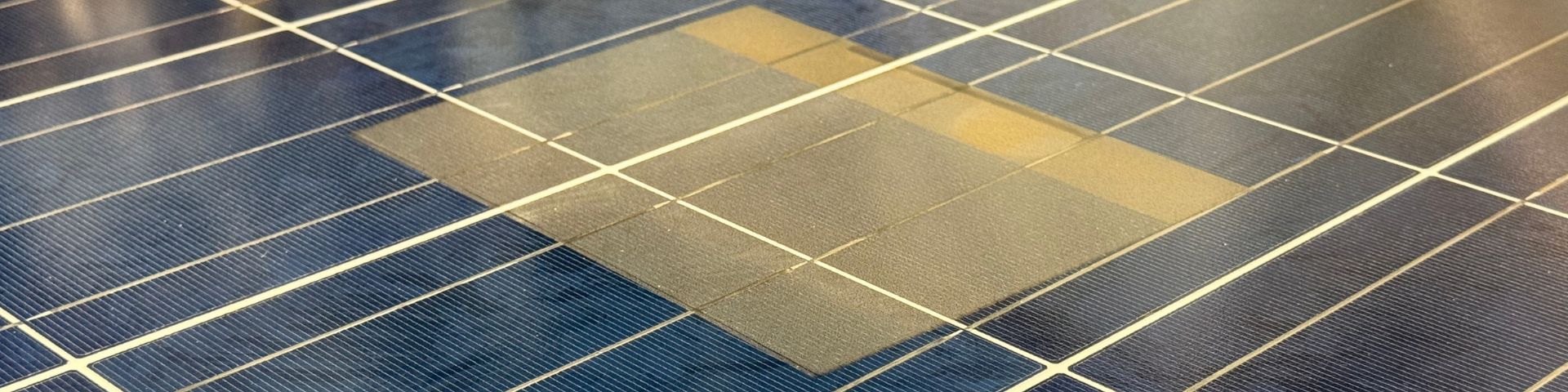
One striking feature is that the process partly reveals itself: as the laser does its work and the bond weakens, the surface subtly changes colour. This gives researchers direct feedback and helps them fine-tune the process with precision.
The research has since scaled up from laboratory setups to applications relevant for industrial recycling. The next phase focuses on integrating the laser technology into the full PV recycling process chain, with testing under real-world conditions.
TNO's distinctive role
TNO is working not only on the technology itself, but also on how it fits within existing and future recycling chains. Researchers collaborate with industry, policymakers, government bodies, machine builders, solar panel manufacturers and recycling companies, because a new technology only has real impact once it's clear when investment pays off, how regulation can align, and exactly what volumes are needed to make it commercially viable.
Several projects with industrial partners are currently underway, with further collaborations in the pipeline. Among other things, TNO is testing full modules together with a Dutch machine builder.

'We believe lasers are set to play a major role in solar panel recycling.'
Learning without borders
International interest in laser-based solar panel recycling is also growing. TNO is one of the frontrunners worldwide, with comparable research underway in Australia and the United States. These parallel developments create opportunities to refine solutions further. 'It's fantastic to be able to learn from one another,' says Theelen.
TNO recognises a clear distinction between fundamental academic research and the more application-driven approach needed to bring technology to market, and it is precisely in that translation that the strength of a knowledge institute like TNO lies.
Looking ahead: lasers as an integral part of solar energy
Light, in the form of lasers, is set to play an increasingly important role in recycling processes in the years ahead. Lasers are expected to become a standard feature of future recycling facilities, focused on minimal energy use and maximum material recovery. Theelen: 'With this laser-based technique, we're taking a major step towards a circular solar energy sector.'
Want to know more?
Are you a PV manufacturer or recycler interested in talking to TNO? Feel free to get in touch. Together, we can explore how this technology could be applied within a recycling process or chain strategy.
Contact us
-

Mirjam Theelen
Functie:Senior scientist solar energy-
Standplaats:Eindhoven - High Tech Campus 21
-
Email:Email Mirjam
-
Get inspired
Towards low-cost, high-performance solar power for future space missions

Solar-powered mobility

TNO develops world’s first perovskite solar roof tile
Real-world data confirms potential of vehicle-integrated solar panels
New EcoCertified Solar Parks: solar parks that deliver both energy and nature