How is plastic recycled?
There is a strong recycling culture particularly when it comes to paper, glass and metal. Yet the majority of plastic waste still goes straight into incinerators or landfill. At TNO, we develop advanced technologies to extract materials from waste and convert these into new raw materials suitable for numerous applications. But what are the different recycling technologies, and which are the best under which conditions?
Which recycling technology should be used when?
It all depends on the type and quality (cleanliness, mono or multi-material, etc.) of the plastics entering the recycling stream. The higher the quality of the sorted waste (mono-material and free from contaminants), the more cost-effective and easier it is to recycle. In addition, there are various drivers from a systems perspective of influence like application, logistics and regulations.
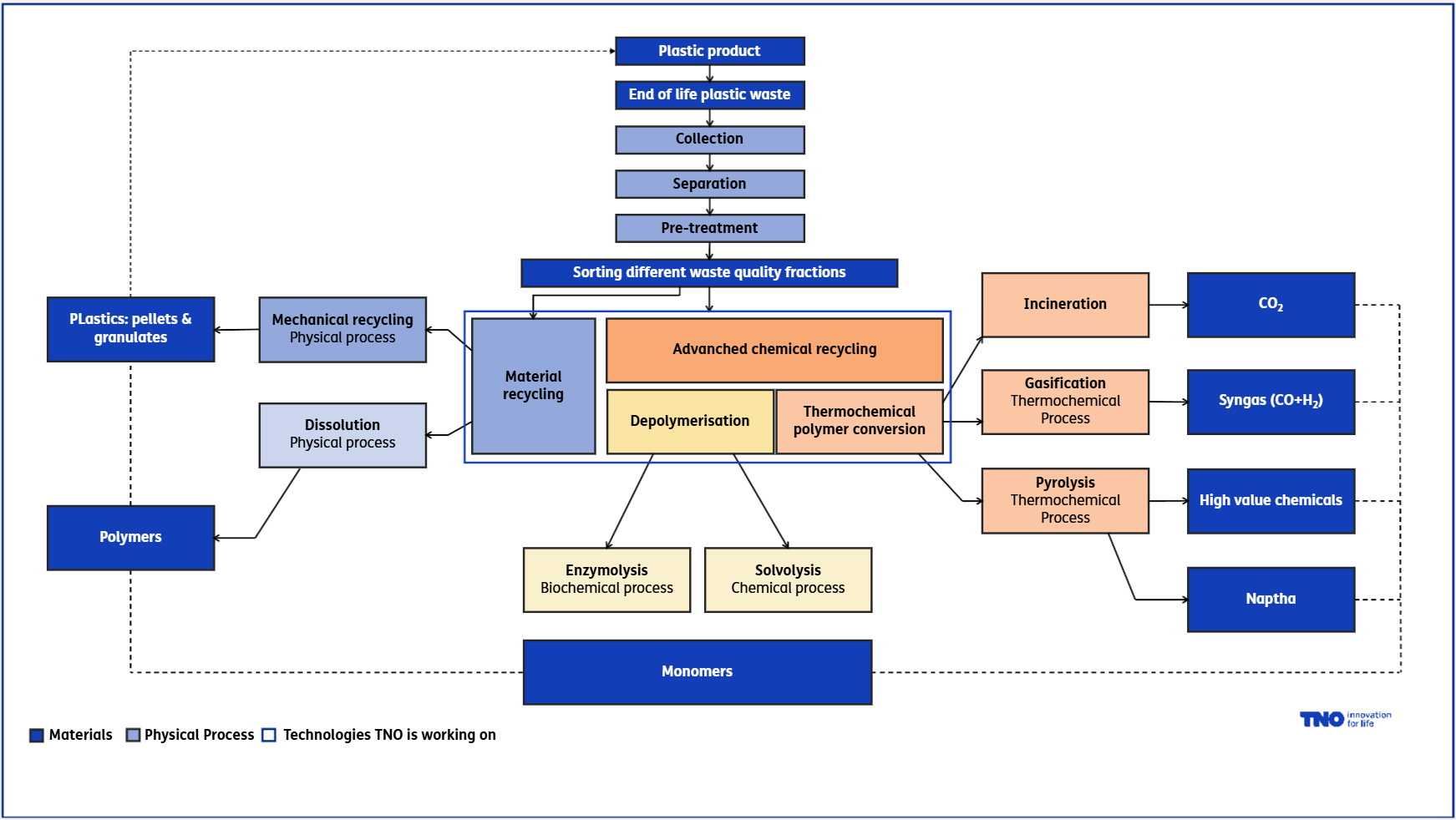
We have created a graphic that highlights the main stages and recycling technologies plastic products go through at end-of-life. This overview explains key recycling processes and methods at each stage.
Click on every part of the process for more information about the various steps of plastics in the waste stream.
Hotspots
Plastic product
A plastic product is an item made wholly or partly from synthetic polymer materials that are shaped during manufacturing to perform a specific function.
End of life plastic waste
Recycling begins when plastic productsand packaging are discarded as waste.
Collection
This waste is collected, e.g. from homes, schools, public areasand businesses, and is then sorted into variouscategories, to separate valuable materials like plastic from residue waste. Advanced technologies identify and sort the different materials.
Separation
Separation is the process of identifying and dividing mixed waste into different material streams, such as plastics, metals, paper, and residual waste.
Pretreatment
Once separated, the plastic waste undergoes pretreatment, i.e. it is washed and cleaned to remove impurities. At TNO, we have introduced the pioneering Upwash system using hydrothermal pretreatment technology. This increases both the amount and the quality of recyclable material.
Sorting different waste quality fractions
The research programme in the R&D Hub for plastic waste processing includes research on innovative sensing and sorting techniques to enhance the quality and quantity of recyclable plastic waste.
Material recycling
Material recycling is the most prevalent method for recycling plastics. When dealing with a relatively clean and well-sorted waste stream, this method is attractive due to its cost-effectiveness, lower environmental impact, and simplicity.
Material recycling is split into two categories: mechanical recycling & dissolution recycling. Both with a different output.
Advanced chemical recycling
Mechanical and Dissolution recycling cannot be applied infinitely and for all applications. To fully recover the quality of the plastics, we also need to rely on chemical recycling techniques.
Chemical recycling technologiesare split into two categories: depolymerisation & thermochemical conversion. In both cases, the polymers are broken down into chemicals from which new polymers can be made.
Mechanical recycling
The most common plastic recycling method is mechanical recycling. If you have a relatively clean, well-sorted stream, this is the preferred option in terms of cost, impact and complexity.
This method includes mechanical processes like washing, grinding, melting and compounding. It does not significantly change the chemical structure of the material, so plastics like PET (polyethylene terephthalate), HDPE (high-density polyethylene) and PP (polypropylene) can be reused directly.
The downside of mechanical recycling is the presence of contaminants. In addition, mechanical recycling loops have a degrading impact (e.g. shorter polymer length) which lowers the quality of the plastics.
Dissolution
Dissolution is a physical recycling method that dissolves only the desired polymer, and not the unwanted polymers, additives or contaminants. Dissolution is bridging the gap between mechanical and chemical recycling.
Several dissolution technologies for plastics recycling have been developed on pilot and market scale. TNO have proven that with its TNO Möbius technology high-quality polymers can be obtained and directly compounded into plastic products.
It involves the selective dissolution of the target polymers using an organic solvent, and a combination of separation technologies (e.g. filtration, adsorption) to remove any contaminants, additives and undesired polymers. It delivers higher quality products than mechanical recycling and is more suitable for complex waste flows.
Depolymerisation
Depolymerisation is used when polymers are broken down into smaller units – the original building blocks.
Enzymolysis
Enzymolysis is a biochemical process that involves the splitting or cleavage of a polymers into smaller parts through the action of an enzyme. After purification, it can be used to produce new polymers, with the same quality as virgin materials.
Solvolysis
Solvolysis is a chemical process in which a plastic polymer is broken down using a solvent, and often heat and/or pressure.
As a result of the chemical reaction, the polymer is split into smaller entities, the original building blocks. In this way it can be used to produce new polymers, with the same quality as virgin materials.
Thermochemical conversion
Thermochemical conversion is the breaking down of polymers at high-temperature, either in the absence or presence of oxygen. This produces an assortment of molecules that can be used in the petrochemical industry as the building blocks for chemicals, polymers and/or fuels.
Incineration
Incineration should be used in combination with full heat integration and Carbon Capture and Utilisation for maximum circularity. TNO has developed various carbon capture and utilisation technologies to optimise the elimination of CO2 and the sequestration of carbon.
Gasification
Gasification is the most versatile solution for highly complex waste streams not suited to chemical recycling. This technology converts waste into syngas (CO+H2) using a limited amount of oxygen. Syngas is a very versatile raw material for a large variety of chemicals and fuels. TNO uses different technologies to convert syngas into highly valuable products.
Pyrolysis
One widely investigated technology is pyrolysis, in which plastics are heated in the absence of oxygen to crack the chains of polymers. The process yields a complex mixture of hydrocarbons in solid, liquid and/or gas form, depending on the conditions and the quality of the feedstock. Technologies vary depending on the input used and the products targeted.
Most pyrolysis technologies aim to convert polyolefin-rich waste into pyrolysis oil. After further treatment and separation, this oil (naphtha) can be used in a steam-cracking process to produce olefins, the building blocks for polymers.
In this field, many organizations explore the use of a catalyst. By using catalysts, milder conditions like a lower temperature can be used and more selective products are obtained.
Another example is the TNO Milena Technology , a thermal cracking technology that applies a higher temperature and a specially designed process. It produces a range of high-value chemicals such as olefins, BTX and syngas, depending on the composition of the waste input. Generally, thermal cracking can deal with much more contaminated waste streams compared to pyrolysis techniques. As such, cascading of technologies becomes a feasible option.
CO₂ (Carbon dioxide)
CO₂ is a greenhouse gas released during processes such as incineration or chemical conversion of plastics.
Syngas
Syngas is a mixture of carbon monoxide (CO) and hydrogen (H₂) produced during thermochemical conversion processes such as gasification.
High‑value chemicals
High‑value chemicals are purified chemical compounds recovered from plastic waste streams that can be reused in the chemical industry.
Naphtha
Naphtha is a liquid hydrocarbon mixture obtained from processes such as plastic pyrolysis. After upgrading, it can be used as feedstock in steam crackers to produce new plastics.
Monomers
Monomers are the basic molecular building blocks obtained when polymers are chemically broken down. They can be repolymerised to produce plastics with virgin‑like quality.
Plastic pellets & granulates
Pellets and granulates are small, uniform plastic particles produced after recycling and compounding polymers. They are used as raw material for manufacturing new plastic products.
Polymers
Polymers are long molecular chains made from repeating monomer units and form the basis of all plastic materials.
This diagram shows what a product goes through once it entered its end of life phase. It describes the materials resulting from the various recycling technologies. These materials form the basis for new plastics, thus closing the loop. This overview marks the technologies we work with at TNO. It is based on a diagram produced by the NOVA Institute.
Which is the most sustainable, cost-effective and technically viable recycling option?
There are pros and cons to each technique. The most appropriate method for managing and recycling waste depends on the type and quality of the plastic waste in question.
To make a thorough comparison of recycling methods, we need to consider the complete cycle of each technology: how do we recycle something so that it can be reused as a raw material? A thorough comparison will take into account not only the recycling itself, but also the sorting, washing and collection processes. We also need to assess the efficiency, energy consumption, robustness, the impact and costs of the processes. Only then can we decide which technology to use.
The best overall approach can be assessed using scenario models. These show how sorting, pre-treatment and recycling techniques affect quality, quantity, technical and economic aspects and the resulting environmental impact. One example is the TNO Plastic Recycling Impact Scenario Model.
The race to circularity is on
Technically, a circular plastics economy would be achievable by 2050. However, even before we think about recycling, we should consider other strategies on the R-ladder for increased plastic circularity.
And its success largely depends on the diligence of the business and political spheres. A relevant system needs to be established, including laws and regulations for end-of-waste status, the import and export of materials and incentives for investors. Mandatory recyclate content in plastic products, for example, creates a long-term demand for circular plastics and forms the basis for a sound business case in technology and innovation investments.
The race to circularity is on, and we’re proud to be working with companies across the globe with a shared purpose. We can work together to build a sustainable future. Get in touch to find out how we can assist you on the road to full plastics circularity.
Contact us
-
Wojtek Kwos
Functie:Business Developer Circular PlasticsReach out to me with any questions related to circular plastics, particularly in the areas of modelling, pre-treatment, and advanced recycling methods.
-
Standplaats:Rijswijk - Kesslerpark
-
Email:Email Wojtek
-
LinkedIn:Wojtek on LinkedIn
-
-

Hella Koops
Functie:Senior Consultant Circular Plastics and Industrial TransformationHella focusses on sustainable innovations and developing circular value chains in the plastics domain and chemical industry. With a strong background in engineering, technology scale-up and systems thinking, she is involved a.o. in the development of new plastics recycling technologies and scenario projections of the circular plastics- and materials transition.
-
Standplaats:Utrecht - Princetonlaan
-
Email:Email Hella
-
Get inspired
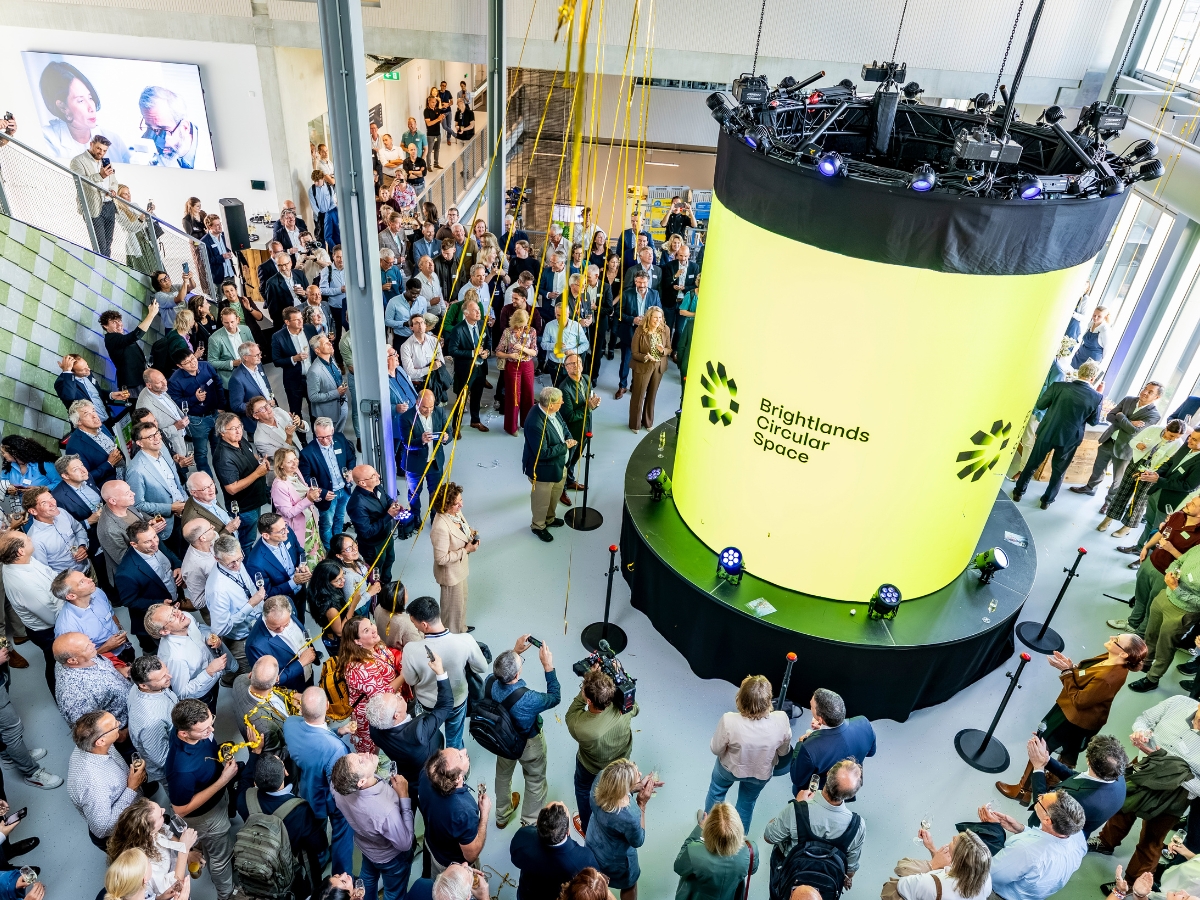
Brightlands Circular Space opens: TNO helps companies scale up plastic innovations faster
Turning textile waste into new chemical building blocks
An objective standard to assess recycled plastic quality
Fewer microplastics and higher yields in plastic recycling
New routes for sorting and composite separation