
Multiple bottlenecks are slowing the growth of Dutch tech start-ups
The Netherlands is home to many innovative start-ups, yet too few develop into internationally successful scale-ups. Only 21.6% of Dutch start-ups progress to the scale-up stage, compared with 24.1% across Europe and 52.2% in the United States. No single obstacle is holding them back. Rather, it is the accumulation of both external and internal bottlenecks that slows growth. These range from grid congestion and shortages of skilled talent to a lack of testing facilities. In an international competitive landscape where speed is often decisive, the Netherlands consequently loses business activity, economic value and strategic technologies. A coordinated approach is needed to help companies scale more rapidly.
Key findings
-
Dutch tech start-ups face barriers in financing, talent, infrastructure and regulation.
-
As a result, they scale up more slowly than competitors in countries such as China and the United States.
-
Opportunities to accelerate growth exist at both Dutch and European level, through government action and business operations.
-
International scaling success stories are not a blueprint. The Netherlands needs its own integrated approach to enable faster growth.
These findings come from new research by TNO, commissioned by NXTGEN Hightech (pdf), into the scaling of tech start-ups in the Netherlands. Researchers compared the Dutch ecosystem with those of, among others, the United States, China and Singapore. They also examined the challenges companies face internally through interviews with entrepreneurs from tech start-ups and scale-ups such as LeydenJar, VitalFluid and SandGrain.
The Netherlands is falling behind
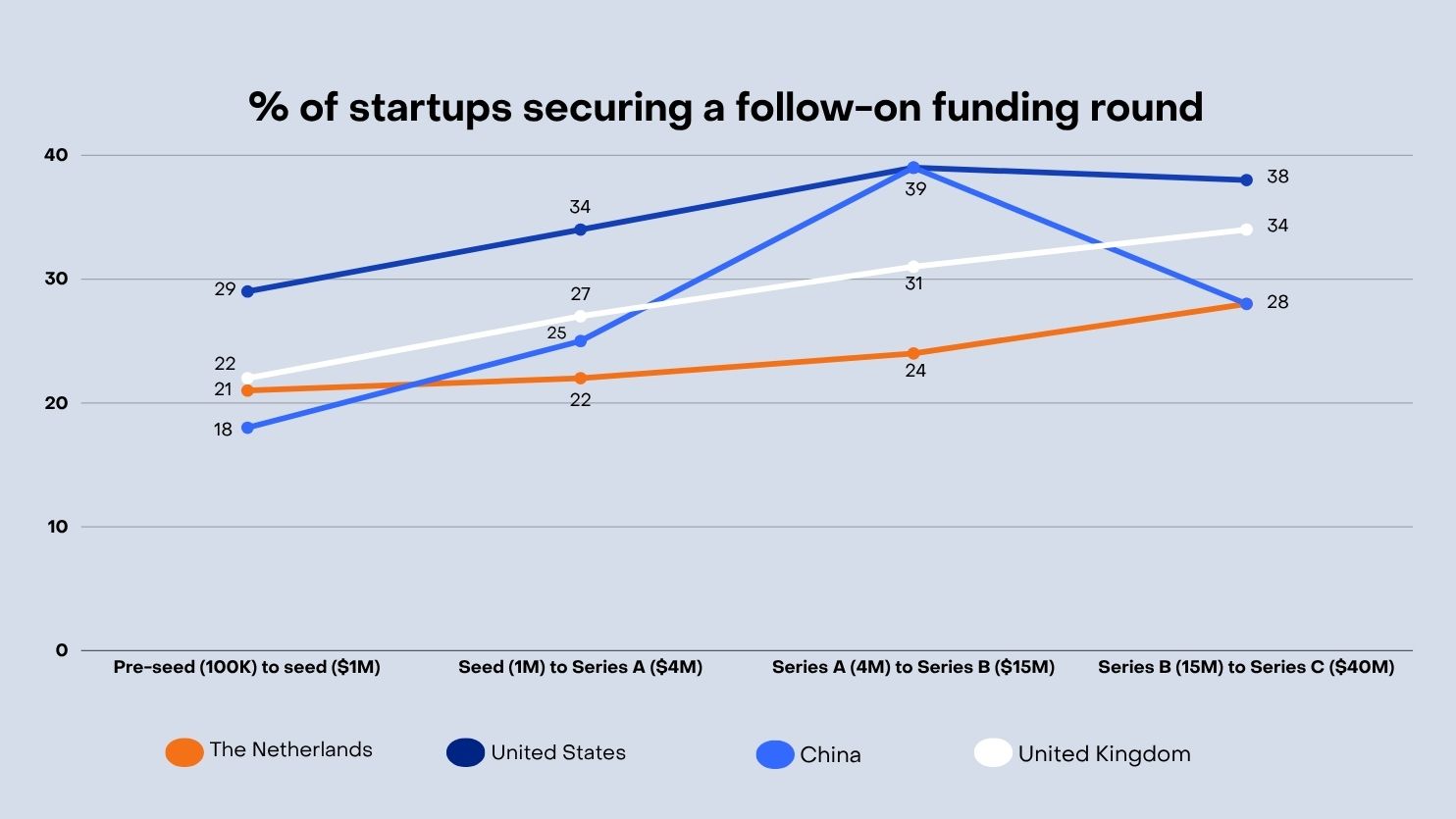
The international comparison shows that the Netherlands struggles to help start-ups grow quickly. American companies are also more likely to secure follow-on funding, and to do so faster. : 39% progress from a Series A to a Series B funding round, compared to 24% in the Netherlands (figure 1). European companies take an average of 5.8 years to make this transition, whereas US companies achieve it in just 2.3 years.
China and Singapore demonstrate how targeted government policy can accelerate growth. China combines substantial investment in strategic technologies with access to a vast domestic market, while Singapore focuses strongly on developing and attracting talent. The researchers emphasise that the Netherlands and Europe differ from China and the United States in terms of governance structures and fundamental characteristics such as population size. Their approaches therefore cannot simply be copied. They do, however, illustrate the conditions that are important for rapid growth. Europe must develop its own model that reflects its specific circumstances.
Bottlenecks reinforce one another
Dutch start-ups often encounter several obstacles simultaneously as they grow. For example, they require growth capital, while at the same time needing access to technical talent, suitable testing facilities and production space, permits, and sufficient capacity on the electricity grid. If one or more of these conditions are missing, scaling efforts can be delayed or even brought to a halt.
Internal factors also play a role. Many technology companies excel at developing innovative technologies but need to build new capabilities during the growth phase in areas such as manufacturing, sales, leadership and market development. Success therefore depends not only on strong technology, but also on the ability to rapidly translate innovations into products and services and bring them to market.
Delays are evident in practice
The companies interviewed recognise these challenges. Battery developer LeydenJar experienced approximately a one-year delay because a required electricity connection for a new factory was not delivered on time. Lengthy subsidy procedures also slowed growth.
VitalFluid, which develops plasma-activated water for use in horticulture, is primarily hindered by regulations. Existing European rules are not sufficiently aligned with this type of innovation, making market entry both time-consuming and costly.
Cybersecurity company SandGrain highlights the challenges of the phase between technology development and market introduction. During this period, companies must simultaneously win customers, generate revenue and convince investors, while competitors continue to move forward.
An integrated approach is needed
According to the researchers, there is no simple solution to the scale-up challenge. A coordinated approach is required. Increasing the availability of growth capital will only be effective if companies also have access to talent, facilities, energy infrastructure, appropriate regulations and a market for their innovations. European countries need to work together on these issues. The Netherlands alone does not offer a sufficiently large market to support these companies at the scale required.
The researchers note that progress is being made across Europe, but that the Netherlands can take significant action itself. This includes making more growth capital available for companies in later stages of development, investing in technical talent and leadership capabilities, and improving access to testing facilities, production space and energy infrastructure. In addition, simple and predictable regulations, combined with a government that more frequently acts as a first customer, could accelerate market adoption.

‘Start-ups currently lose too much time due to a combination of obstacles related to financing, talent, infrastructure and regulation. If we address these barriers in a coordinated way, more Dutch innovations can grow into internationally successful companies.’

‘Partnerships with businesses and knowledge institutions provide significant opportunities. By making better use of the specialised suppliers that the Netherlands already has, companies can scale more quickly and strengthen their position in global markets.’
Collaborating to accelerate scale-up
TNO is committed to bringing technological innovations to market faster by creating promising spin-off companies through TNO Ventures. To help these ventures scale more rapidly, TNO supports start-ups through its Fast Track programme and, together with Techleap and Invest-NL, combines expertise, networks and investment capacity through a strategic alliance.
‘The Netherlands has outstanding knowledge capabilities and a large number of innovative entrepreneurs, yet too few companies successfully scale. Start-ups currently lose too much time due to a combination of obstacles related to financing, talent, infrastructure and regulation. If we address these barriers in a coordinated way, more Dutch innovations can grow into internationally successful companies,’ says Lotte de Groen, Market Director at TNO Vector.
‘Globally significant companies do not emerge by themselves. Entrepreneurs must simultaneously acquire customers, organise production and develop their organisations. They do not need to build all of this knowledge and experience on their own. Partnerships with businesses and knowledge institutions provide significant opportunities. By making better use of the specialised suppliers that the Netherlands already has, companies can scale more quickly and strengthen their position in global markets,’ says Monika Hoekstra, Managing Director of NXTGEN Hightech.
Download the full report: ‘Speed as key success factor for scale-ups. The Dutch scale-up ecosystem in international perspective’
Meet the authors



Contact us
-

Lotte de Groen
Functie:Market director at TNO Vector-
Standplaats:Den Haag - New Babylon
-
Email:Email Lotte
-
LinkedIn:Lotte on LinkedIn
-
Get inspired
Collaborating to accelerate climate-neutral cities

Orchestrating Innovation Learning Programme
TNO appoints Lotte de Groen as Market Director of TNO Vector

Time setter story: Consultant Ilse Hellemans

High-tech industry in 2040