Beyond mobility: the real challenge is making the system smarter
Cities are getting busier, populations are ageing and transport needs to become cleaner and safer. More than a million people still die on the world’s roads every year. At the same time, rapid advances in AI, sensors, semiconductors and connectivity are opening up extraordinary possibilities. Imagine mobility that is accessible, convenient and safe, while also becoming cleaner and far more efficient. The promise is compelling. But we will not get there simply by building better vehicles. We need to make the entire mobility system smarter.
That means connecting vehicles, public transport, logistics, infrastructure and digital networks into one ecosystem. A simple example shows what that could mean. A car approaching an intersection may not see a cyclist hidden behind a building, while another vehicle or roadside sensor can. If those systems communicate, the car can effectively see around the corner. Intelligence no longer resides only inside the vehicle. It becomes distributed across the system.
The hard part starts outside the vehicle
Making that work is much harder than making one vehicle smarter. Physical AI has to cope with unpredictable traffic, bad weather, sensor failures and rare events, all in real time. A chatbot that makes a mistake produces the wrong sentence. A vehicle that makes a mistake can cost lives. Safety is only one challenge. Regulation needs to catch up, business models have to become viable, infrastructure needs to support connected mobility and data must be exchanged securely. Automation will also affect jobs, while simultaneously offering opportunities to address labour shortages.
These are not separate problems. They are interconnected elements of one systems transformation. We are not starting from scratch. Existing roads, regulations, institutions, technologies and human behaviours cannot simply be replaced. We need a clear destination, but also realistic routes towards it. Ambition must go hand in hand with realism, adaptability and flexibility. Trust becomes part of the infrastructure.
Technology is rapidly creating the foundation for this transformation. AI can become a coordinating layer across the mobility ecosystem, supported by sensors, semiconductors, edge computing and high-performance 5G and 6G networks. Connectivity does not replace the intelligence of an automated vehicle. It extends it. Vehicles can warn each other about accidents, roadworks or slippery surfaces before their own sensors detect them. Infrastructure and control centres can provide additional information and assistance. But greater connectivity also increases the importance of trust. AI must recognise its limitations and fail safely. Systems need to be understood and validated. And safety and cybersecurity need to be designed in from the start. In mobility, almost always right is simply not good enough.
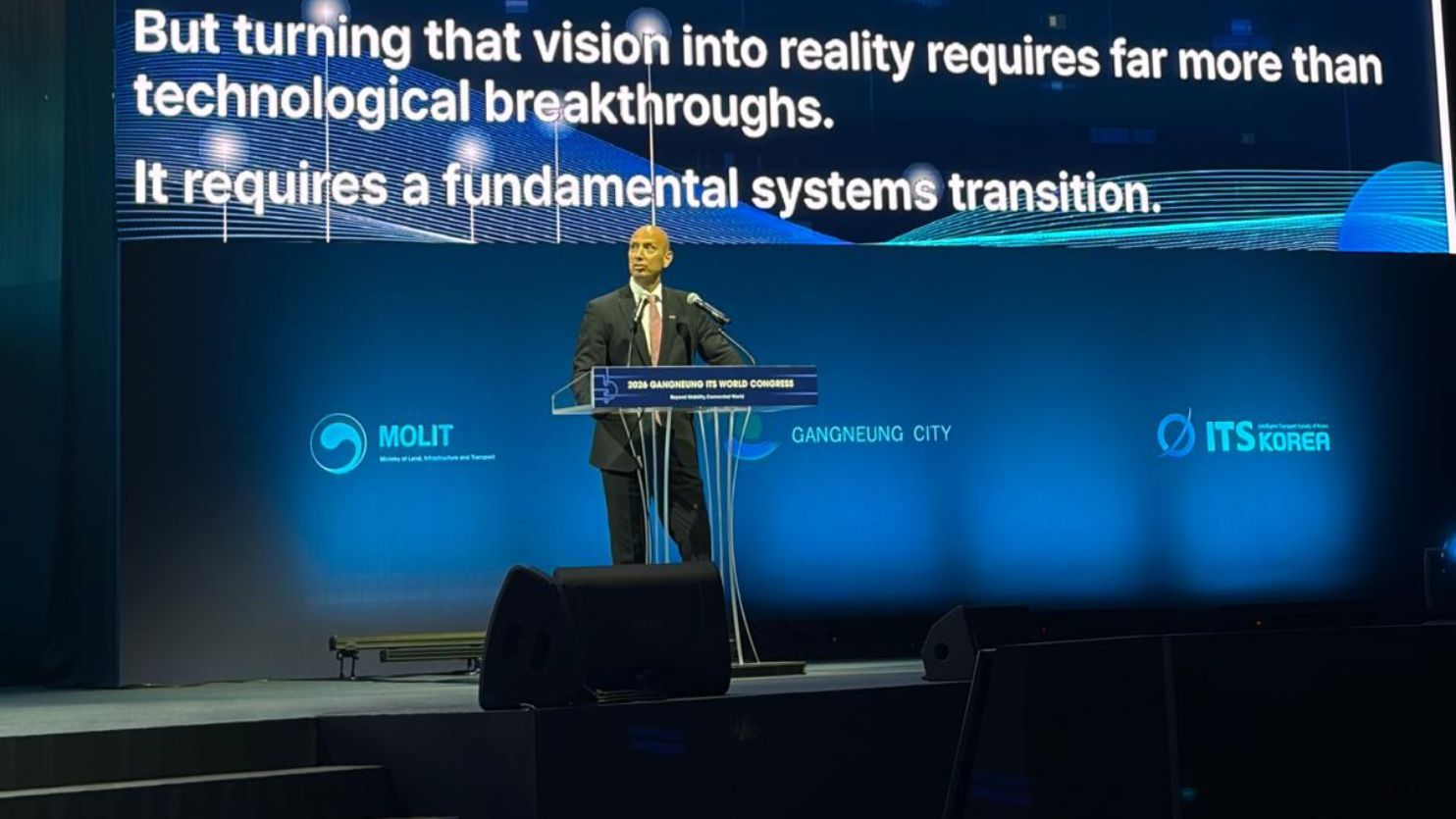
'We are building the system for humans, not humans for the system. That is what it truly means to move beyond mobility.'
We are building the system for humans
Yet even a technologically brilliant mobility system can fail if it overlooks one crucial factor: people. Engineers naturally think in terms of efficiency and optimisation. People do not always make their choices that way. If mobility were purely about travelling as efficiently as possible from A to B, everyone would buy the cheapest reliable compact car. Ferrari would not exist. For many people, mobility is also about freedom, independence, convenience, identity or passion. Those preferences cannot simply be engineered away.
Consider an 80-year-old who can no longer drive and gradually loses part of their independence. Automated mobility could allow that person to visit the doctor, buy groceries or see their grandchildren without depending on someone else. This is not primarily an autonomous-driving use case. It is a quality-of-life use case. That distinction gets to the heart of the matter. Technology is not the ultimate objective. Societal value is.
For TNO, this means looking beyond individual tec hnologies. It is about bringing technologies together, testing them in the real world and helping create systems that are safe, resilient and trusted.
Ultimately, we should not measure the future of mobility by how autonomous a vehicle is or how sophisticated its AI has become, but by what it delivers: safer roads, cleaner mobility, greater accessibility and better lives. We are building the system for humans, not humans for the system. That is what it truly means to move beyond mobility.
Read the full speech
Read the full speech by Tjark-Tjin-A-Tsoi via the link below.
Contact us
-

Maarten Lörtzer
Functie:Press officerSpokesperson for corporate affairs, defense & security, mobility & logistics, circular economy and air quality.
-
Standplaats:Den Haag - New Babylon
-
Telefoon:+31 6 20 42 07 32
-
Email:Email Maarten
-
LinkedIn:Maarten on LinkedIn
-
RNA editing makes a protective gene variant available to patients who lack it naturally

Europe's chemical industry can become more sustainable without losing its foundations

Escalation in fireworks-related violence requires new security and response strategies
TNO AI event 2026
Five tips for driving plug-in hybrid more efficiently