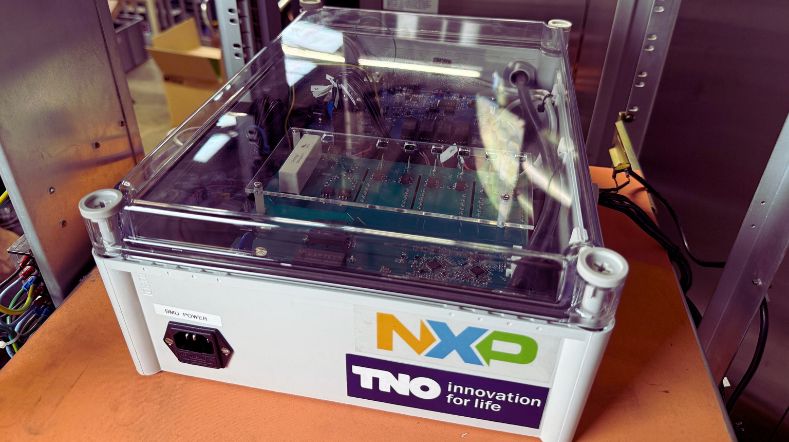
Forces combined: how TNO supports LionVolt to accelerate next-generation battery technology
The global demand for better batteries is growing rapidly. Faster charging and higher energy density are becoming critical requirements. Yet companies still face major challenges when they try to bring promising battery concepts from the lab to production. The collaboration between TNO and LionVolt demonstrates how product developers and research organisations can work together to accelerate innovation on a next generation battery.
As Europe seeks to reduce dependence on overseas supply chains, collaboration across the battery value chain becomes increasingly important. Developing a breakthrough battery is only half the challenge. Understanding how that battery behaves in the real world is what brings it closer to market. The LionVolt-TNO collaboration demonstrates how entrepreneurial drive and applied research expertise reinforce each other.
The real challenge starts after the breakthrough
Developing a breakthrough battery technology is only the first step. To make batteries commercially viable, developers need to test, validate, optimise and integrate them into complete battery systems.
This is where the collaboration between LionVolt and TNO comes in. LionVolt collaborates with several partners to speed up their innovation, in which TNO also contributes its key expertise on batteries. LionVolt develops next-generation battery cells based on a 3D lithium metal anode architecture. TNO Powertrain & Electrification team contributes expertise in battery behaviour, testing and battery management systems. Together, they work to understand how new battery technologies perform and how they can be scaled toward deployment.
'The expertise and facilities available within TNO are highly relevant to the developments we do.'
Extending battery life with smarter charging
A good example of the collaboration in practice is a recent project focusing on charging algorithms for next-generation batteries. Charging behaviour has a huge impact on battery performance and lifetime. While aggressive charging strategies can reduce charging times, they can also accelerate battery degradation. Finding the right balance is essential.
Together, LionVolt and TNO combined expertise in cell development and battery management systems to investigate how charging strategies could improve the performance of batteries, while extending the lifetime at the same time.
Researchers first tested individual battery cells before validating the charging strategy in a battery module. Multiple cells are connected and controlled by a battery management system. This demonstrates that the approach also works in a more realistic operating environment.
‘We develop 3D anodes and battery cells’, explains Sathiyaraj Kandhasamy, Lead Scientist at LionVolt. ‘Battery management systems are a different field of expertise. Working together with TNO allows us to understand how existing battery management technologies can support future battery chemistries, and where adaptations are needed to ensure market readiness.’
From spin-off to innovation partner
LionVolt was spun out from TNO 6 years ago. The roots of the collaboration go back to the Eindhoven-based research centre TNO Holst. Here, researchers laid the foundation for LionVolt's innovative 3D battery architecture, designed to combine higher energy density, improved safety and faster charging capabilities.
The spin-off marked the transition from research programme to independent battery technology company. Although TNO remained involved as a shareholder, continued collaboration was never a given: ‘We could have chosen to work with other research organisations’, explains LionVolt Co-founder & CTO Sandeep Unnikrishnan.
‘It was not part of the deal to continue working with multiple departments of TNO, but we saw clear value in doing so. The expertise and facilities available within TNO are highly relevant to the work we do.’
Over the past 6 years, the collaboration between LionVolt and TNO evolved. What started with support for 3D anode development at Holst Centre expanded into new areas, including battery behaviour, charging strategies, battery management systems and performance validation through collaboration with TNO's Powertrain & Electrification team in Helmond.

By working with LionVolt, we gain hands-on experience with new battery chemistries and their specific characteristics.'
How does the battery behave outside the lab?
One of the biggest challenges in battery development is understanding how a new battery behaves outside the laboratory. How does it age? How does it respond to different charging strategies? And how can its health be monitored over time?
For LionVolt, access to TNO's facilities and expertise has played an important role in addressing these questions. Through facilities such as TNO's Battery Lab and battery pilot facilities, researchers can make, test and validate batteries under realistic operating conditions.
Researchers from both organisations have worked together on topics ranging from electrode development to performance testing. Beyond testing, TNO contributes advanced battery validation methodologies and battery management expertise. This helps move promising technologies closer to market deployment.
Getting unique insights from each other
Both organisations benefit from the collaboration. For LionVolt, TNO provides access to specialised expertise, facilities and validation methods that support the development of next-generation batteries. For TNO, the collaboration offers valuable insights into emerging battery technologies that are not yet commercially available.
‘These are battery technologies that we cannot simply buy off the shelf’, explains Erik Hoedemaekers, Scientist Integrator at TNO. ‘By working with LionVolt, we gain hands-on experience with new battery chemistries and their specific characteristics. This allows us to validate our models and methodologies on technologies that become important in the future.’
Next step: addressing the challenges of lithium-metal batteries
The collaboration is now entering a new phase focused on lithium-metal batteries. These batteries offer significant advantages in energy density compared with existing lithium-ion technologies. This could enable lighter battery systems, longer driving ranges and improved performance in applications where weight is critical, such as electric mobility and aviation.
In a new TKI-project, TNO and LionVolt aim to better understand lithium dendrites evolution. Dendrites are microscopic structures that can grow inside a battery cell and potentially limit the lifetime or cause internal shorts. The ultimate goal is to develop strategies that improve battery safety, reliability and lifetime. But first, researchers are investigating whether electrical signals can reveal the earliest signs of dendrite formation.
Lead Scientist Sathiyaraj Kandhasamy: ‘The main aspect of the project is finding ways to identify the dendrites (if any) during battery operation, and to confirm the optimal design of the 3D architecture that mitigates dendrite growth.’
This project illustrates how complementary expertise can solve challenges that neither partner could address alone.
Shortening the path towards commercialisation
Both organisations are helping to accelerate the European transition from laboratory innovation to deployment. Their collaboration shows how the right partners can help reduce development risks and shorten the path towards commercialisation.
Interested in accelerating your battery innovation?
TNO supports companies across the battery value chain. Are you developing next-generation battery technologies or looking to optimize battery performance or manufacturing processes? Contact Jan-Willem Sangers or Erik Hoedemaekers to explore how collaboration can accelerate your innovation.
Our expert

Contact us
-

Jan-Willem Sangers
Functie:Business Development ManagerIn my role as a business developer Sustainable Vehicles, I work on establishing and facilitating collaborations in the field of sustainable mobility. These collaborations range from small-scale industrial research to large-scale international public-private partnerships in areas such as heavy-duty transport, shipping, non/off road mobile machinery, and even aviation applications.
-
Standplaats:Helmond - Automotive Campus
-
Email:Email Jan-Willem
-
LinkedIn:Jan-Willem on LinkedIn
-
Get inspired
Five tips for driving plug-in hybrid more efficiently

How Arriva and TNO are shaping the next phase of electric bus transport
From lab to ice sheet: how TNO accelerates battery innovation with Team Polar
Sailing with an engine that emits only water? Mitsubishi and TNO prove it’s possible
Reliable monitoring of battery condition for transparent battery passports