Microplastics and the unknown risks
Microplastics are minuscule plastic particles. They are in the air we breathe, the water we drink, and the food we eat. But the effects and risks of microplastics on people and the environment are unknown. Our research contributes to new insights and innovative solutions.
Microplastics white paper
Microplastics are potentially harmful to humans and the environment. In our publication, we show how we can achieve a 70% reduction in microplastics by 2050.
Frequently asked questions about microplastics
Below you will find answers to frequently asked questions about microplastics.
Microplastics can be found everywhere around us, from the high peaks of the Himalayas to the depths of the Atlantic Ocean.
Since the 1950s, our use of plastic has steadily increased. Plastic is cheap, lightweight and durable, and these unique properties make it suitable for a wide range of applications. But its durability also has a downside. Plastic that ends up in the environment does not break down like natural materials. Instead, it fragments into increasingly smaller plastic particles: microplastics.
Wear and tear
Products wear down during use: holes appear in T-shirts and car tyres eventually need replacing. This wear and tear releases small particles from products. In the case of plastic products, such as a polyester fleece or a car tyre, many of these small particles are microplastics.
We define microplastics as small, man-made polymer-containing materials with dimensions (length, width or height) of less than 5 millimetres. The term microplastics also includes nanoplastics, which have dimensions of less than 100 nanometres.
Microplastics consist of a complex mixture. They vary widely in polymer type, size and shape. They can also carry additives, impurities, microbiota and various contaminants.
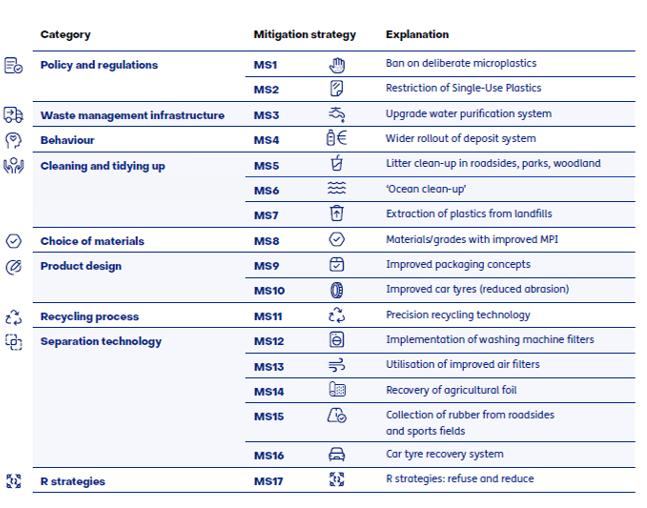
In our recent research into microplastics, we mapped their origins and potential measures to reduce them. The research shows that four sources are the main contributors to microplastic emissions:
- Car tyre wear (~35%)
- Litter: films, bags, packaging and other materials are not disposed of properly everywhere. They often end up in soil or water, where they break down into microplastics.
- The use of agricultural film
- Textiles: wear and tear on clothing releases microplastics, particularly into the air and wastewater, for example when clothes are washed.
We distinguish between primary and secondary microplastics. Primary microplastics are deliberately added by humans. Secondary microplastics are created when plastic objects break down.
Primary microplastics are manufactured intentionally. Examples include pre-production pellets, rubber granules used on artificial sports pitches and abrasive cleaning agents. In the EU, adding primary microplastics to certain products, such as exfoliating particles in cosmetics, is no longer permitted.
Secondary microplastics are not produced intentionally. They are created as plastic products wear down or break apart, for example when plastic becomes litter. Factors such as UV light, friction and heat cause increasingly smaller plastic particles to form. These particles can subsequently reach people through the air, water, food and soil.
Primary and secondary microplastics end up in water, air, food and soil. As a result, they are harmful to the environment, people and animals.
There have not yet been enough studies to determine precisely what effects microplastics have on human health. Because microplastics also vary greatly in shape, size and chemical composition, they may have a wide range of health effects.
Nevertheless, considerable progress has already been made. We know, for example, that exposing cells to microplastics can trigger stress responses. One concrete example is the occurrence of lung diseases among workers exposed to high concentrations of nylon.
To better understand how exposure to microplastics affects health, we need to know how much exposure people experience, which chemicals may be present in these plastics and how their effects can be measured accurately.
The World Health Organization (WHO) has published an overview of exposure to microplastics through food and inhalation. The WHO emphasises the need for greater awareness that plastics do not belong in the environment.
Measures are needed to limit exposure to microplastics. This is why the Netherlands applies the so-called ‘precautionary principle’. This means that the use, formation and spread of microplastics should be minimised.
Microplastics in the air
Relatively little is still known about concentrations of microplastics in the air and their effects on the environment and our health. Our knowledge of the dispersion of particulate matter is useful in our research, as microplastics are also a component of particulate matter.
This knowledge allows us to reuse existing instruments, for example in measurement campaigns investigating exposure to microplastics in indoor and outdoor air. These campaigns enable us to measure differences in concentrations at different locations.
Microplastics can now be found everywhere, from oceans and rivers to agricultural land and even polar regions. Animals can ingest these particles, potentially putting ecosystems and food chains under pressure. Although not all effects are yet fully understood, it is clear that microplastics accumulate in the environment and do not belong there.
TNO therefore investigates how microplastics are formed, how they spread and which measures are most effective in preventing pollution. For example, we have developed a Mass Flow Analysis model that shows where microplastics originate and how emissions can be drastically reduced towards 2050.
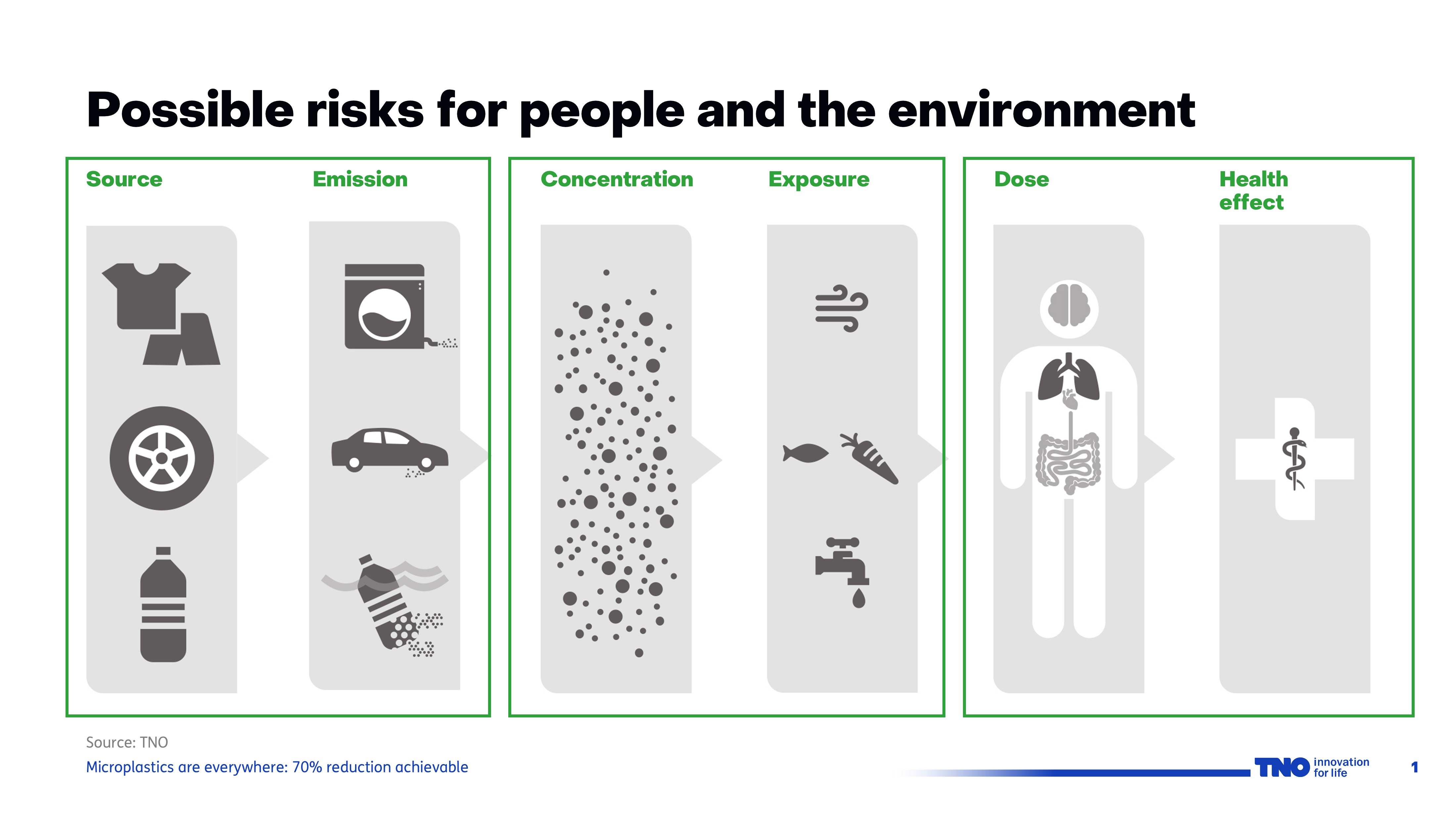
Our research shows that a reduction of up to 70% by 2050 is possible if governments and businesses make maximum use of the 17 identified measures. The greatest gains can be achieved by preventing emissions at source, for example through innovation in materials, product design and industrial processes.
Because microplastics are mainly generated through the everyday use of products such as tyres, textiles and coatings, collaboration across the entire value chain and a combination of technological and policy solutions are essential to structurally reduce emissions.
Significant improvements are also possible in recycling processes. TNO is working on technologies that reduce the formation of microplastics during the mechanical recycling of plastics. By gaining a better understanding of where and how microplastics are formed, recycling processes can be optimised. This not only reduces emissions to the environment but also increases the yield and improves the quality of recycled plastics.
Although not all the effects of microplastics are yet fully understood, there are already many opportunities to reduce pollution. By including the impact of microplastics in life cycle assessments, products, materials and recycling processes can be designed to release fewer microplastics. This creates an important opportunity to combine greater circularity with environmental benefits.
Research into microplastics
We investigate how microplastics are formed and spread, and what effects they have on people and the environment. Our research activities focus on four themes:
- Systems understanding & the environment
- Mitigation through products: reducing the release of microplastics by improving our understanding of how choices such as plastic type or production method affect the formation of microplastics.
- Mitigation through processes: certain processes release large quantities of microplastics. In some cases, processes can be adapted to reduce emissions.
- Exposure and health effects
Using this knowledge, we develop and support measures to reduce microplastics.
We conduct this research in close collaboration with partners from science and industry. We are active in networks such as MOMENTUM, TI Coast and the Circular Plastics NL National Growth Fund programme, and work with stakeholders across the entire value chain on complex research and innovation projects.
Microplastics are released from different products, materials and processes, which means different measures may be required depending on the sector, source and country. TNO maps the sources, emission pathways and spread of microplastics and investigates the impact of mitigation measures.
Using our integrated expertise, measurements and models, we can support Dutch and European policymakers in:
- identifying the most important sources and emission pathways;
- comparing policy and mitigation scenarios;
- assessing the long-term effects of measures;
- developing evidence-based policies and regulations;
- monitoring and evaluating the effectiveness of measures.
We combine systems analyses with expertise in materials, laboratory analyses, production processes, exposure and environmental impacts. This helps policymakers set priorities and determine where measures can make the greatest contribution to reducing microplastics.
Microplastics can be generated during the production, processing, use and recycling of plastic products. TNO helps businesses understand where microplastics are formed and which measures can reduce emissions and material losses.
Depending on the specific challenge, we can support businesses in:
- measuring and analysing microplastics;
- mapping emissions and material losses in production and recycling processes;
- developing and assessing measures to reduce emissions;
- selecting and optimising materials and product designs;
- investigating microplastic formation during use and ageing;
- preparing for reporting requirements and changing regulations.
We combine measurements, laboratory research, materials and process expertise, and models. In this way, we help businesses improve products and processes, reduce material losses, and develop and test solutions in practice.
As consumers, we can also help reduce the formation and spread of microplastics through small changes in our behaviour.
#1 Reduce microplastics from car tyres
Car tyres are responsible for thousands of tonnes of microplastics every year. Here is what you can do to reduce them:
- Drive less and walk, cycle or use public transport instead.
- Buy the lightest car possible.
- Driving? Check your tyre pressure.
- Drive smoothly. Avoid accelerating too quickly, take corners gently and avoid sudden braking.
- Choose environmentally friendly tyres. Check the tyre ecolabel for guidance.
#2 Reduce microplastics from litter
Microplastics are formed from litter, resulting in 1,252 tonnes entering the Dutch environment every year. Here is what you can do to reduce this:
- Separate your waste and dispose of packaging in the correct bin.
- Return deposit bottles. Since a deposit was introduced for small bottles, 70% fewer small bottles have been found in the environment. A successful measure.
- Buy products without packaging where possible, such as fruit and vegetables.
#3 Reduce microplastics from textiles and clothing
Every year, 113 tonnes of microplastic fibres are released from textiles. Here is what you can do to reduce this:
- Air your clothes more often instead of washing them. Friction in washing machines and tumble dryers can cause microplastics to be released.
- Wear and use your clothes for longer and repair them where possible.
- Buy consciously. Choose good-quality clothing made from natural materials. A garment that does not need to be produced cannot release microplastics.
- Do not rinse your tumble dryer filter under the tap. Dispose of the residue in your general waste instead.
- Need to buy something? Choose second-hand clothing.
- Take unwanted clothing to a charity shop or dispose of it through municipal textile collection points or a household waste recycling centre.
Working together to reduce microplastics
Microplastics are a growing challenge that we can only tackle together. By designing products more intelligently, limiting exposure and improving our understanding of the effects of microplastics, we can take concrete steps towards healthier living and working environments.
Would you like to work with TNO on solutions that have real impact? We would be happy to discuss how we can take the next step together.
Contact us
-
Peter Versloot
Functie:Senior Business Developer Circulaire PlasticsPeter Versloot brings technology and markets together to create sustainable solutions. As a Business Developer at TNO, he focuses on the plastics sector, with expertise in Microplastics and Circular Plastics Modelling.
-
Standplaats:Eindhoven - High Tech Campus 25
-
Email:Email Peter
-
LinkedIn:Peter on LinkedIn
-
Get inspired
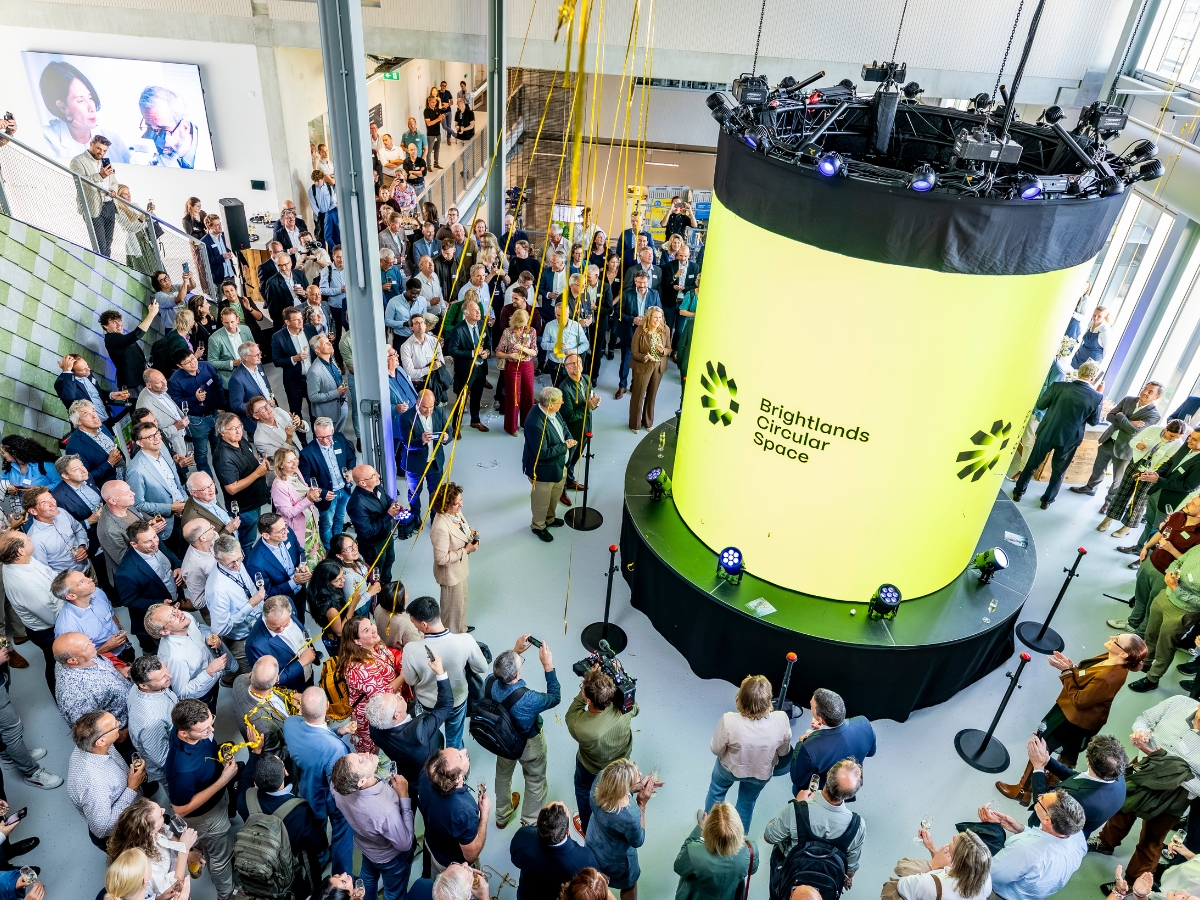
Brightlands Circular Space opens: TNO helps companies scale up plastic innovations faster
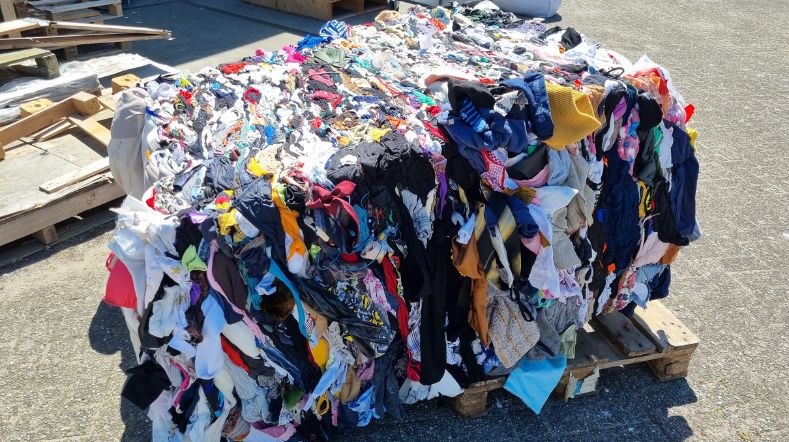
Turning textile waste into new chemical building blocks
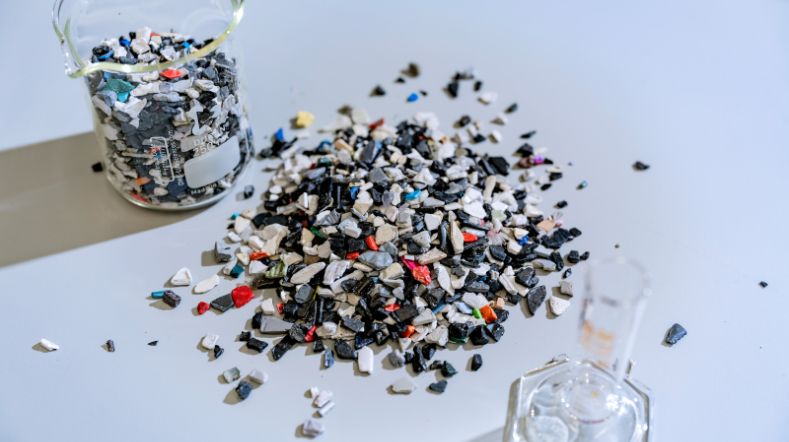
An objective standard to assess recycled plastic quality
Fewer microplastics and higher yields in plastic recycling
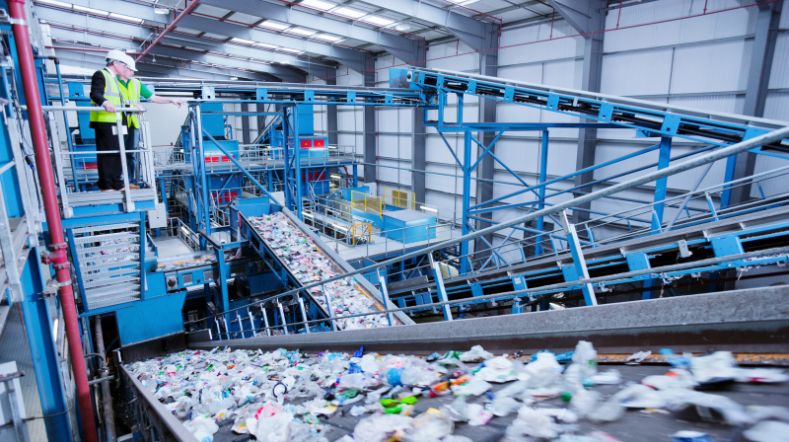
New routes for sorting and composite separation