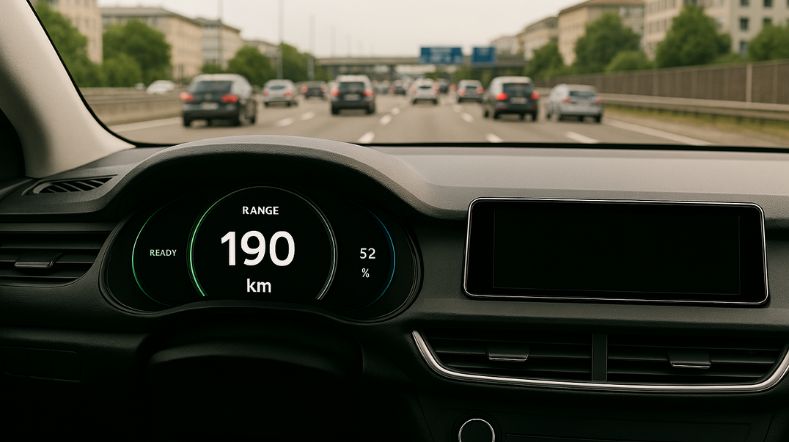
NEXTBMS: Battery remaining useful life prediction
Status
1 June 2023 – 30 September 2026
Partners
AIT, UL, VUB, BOSCH, NXP, AVL, EDF, TOFAS, Uniresearch
Reliable and safe batteries are key for a successful transition to clean energy. To enable this, each battery pack is monitored by a Battery Management System (BMS). In the NEXTBMS project, we develop the next generation BMS which can push the boundaries of battery performance.
How do we achieve this?
Currently, most BMSs are based simple algorithms operating on conservative information, mostly from datasheets. This limits the performance of the battery and can sometimes still result in unsafe situations. In the NEXTBMS project, we shift our focus to modelling the physical battery behaviour and we apply these models inside the BMS itself. Together with cloud-based data-driven methods, we aim to build a BMS which gives us grid storage and electric vehicles with better range, longer lifetime and guaranteed safety.
At TNO Powertrains, we focus on predicting remaining useful lifetime based on historical ageing data and physics-based degradation modelling. By training our models on high-fidelity ageing data measured in our lab, we can predict the remaining useful life of batteries operating in the field. This strengthens our position on battery management which is also a focus in other projects such as GTD-E.
Who do we cooperate with?
NEXTBMS consists of a strong consortium of internally recognised partners. The project is coordinated by the Austrian Institute of Technology (AIT) which like TNO is an RTO. AIT and TNO both handle testing activities and focus on ageing modelling and life time prediction. Our academic partners are the University of Ljubljana (UL), focusing on physics-based modelling, and the Vrije Universiteit Brussel (VUB), who provide expertise on BMS hardware and cell balancing.
Industrial partners familiar to the BMS supply chain are NXP Semiconductors, who design and produce BMS chips, BOSCH and AVL, both known for their battery related engineering expertise. Lastly, EDF and TOFAS provide relevant use cases and OEM experience regarding challenges in stationary energy storage and electric vehicle manufacturing.
Battery management is a challenging field overlapping multiple domains of expertise. Significant impact can only be made by combining the right players from multiple domains as done in the NEXTBMS project.
Impact
Results of the NEXTBMS project will help strengthen the European position on batteries by incorporating expertise from multiple domains into one BMS. The resulting battery performance will be better, safer and more reliable. This enables the use of batteries in applications which are currently still very challenging such as aviation.
The NEXTBMS project is made possible by the HORIZON program of the European Commission.
Contact us
-

Feye Hoekstra
Functie:Battery ScientistAt TNO I work on sustainable mobility and built environment by using batteries to replace fossil fuels. My research is aimed at using battery management to enhance battery performance and my expertise lies in battery management algorithms, and battery modelling and testing.
-
Standplaats:Helmond - Automotive Campus
-
Email:Email Feye
-
Get inspired
Forces combined: how TNO supports LionVolt to accelerate next-generation battery technology

How Arriva and TNO are shaping the next phase of electric bus transport
From lab to ice sheet: how TNO accelerates battery innovation with Team Polar
Reliable monitoring of battery condition for transparent battery passports
How far can you travel in an electric car?