International beyond Europe
TNO has over 35 years of experience in air quality monitoring in Europe. We are now bringing this knowledge to other parts of the world, starting in East Africa. Our goal is to build lasting partnerships with local governments, organisations, and institutes, and to translate our expertise in emissions, modelling, exposure, and health effects into solutions that fit local needs.
Societal challenge
Air pollution is one of the leading causes of illness and premature death in Sub-Saharan Africa. Rapid urbanisation and industrialisation are worsening ambient air quality, posing a growing threat to public health. The economic toll of increased illness and lost productivity can account for around 5% of GDP.
Vulnerable communities in low- and middle-income countries (LMICs) bear the brunt of poor air quality, with reduced access to clean energy and higher exposure to pollution sources such as industry and open fires. Children under five are disproportionately affected: household air pollution is a leading cause of death in this age group.
Monitoring is essential for effective health interventions, environmental justice, policy development, and sustainable development. Yet many countries in the region still lack robust air quality monitoring systems, making investment in this area both pressing and overdue.
Rising temperatures due to climate change are also affecting LMICs severely, despite their historically low contribution to global emissions. Those with the least adaptive capacity are hit hardest.
Our vision
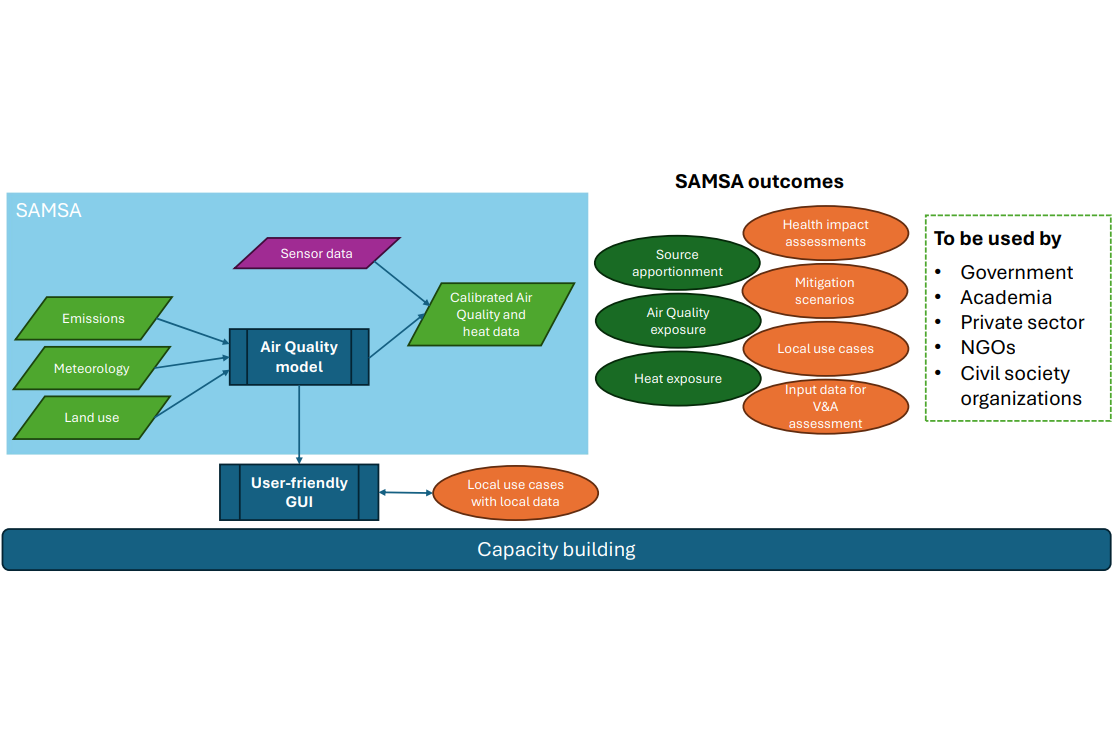
SAMSA (Sustainable Atmospheric Monitoring Service for Africa) is a proposed service to continuously track and predict air quality and heat stress across Africa. It will deliver free, high-quality data for a wide range of applications, providing regional and local insights into pollutants such as short-lived climate pollutants (SLCPs), ozone, particulate matter, and reactive gases (nitrogen and sulphur oxides). Data is delivered near real time, with forecasts up to three days ahead.
The operational service is inspired by the EU Copernicus Atmospheric Monitoring Service (CAMS). Within CAMS, an ensemble of advanced models is used to simulate atmospheric chemistry, of which TNO’s LOTOS-EUROS is one of the leading models. At the start, SAMSA will be powered by LOTOS-EUROS, but later on, the SAMSA initiative should be powered by a similar ensemble, with addition of local models and expertise.
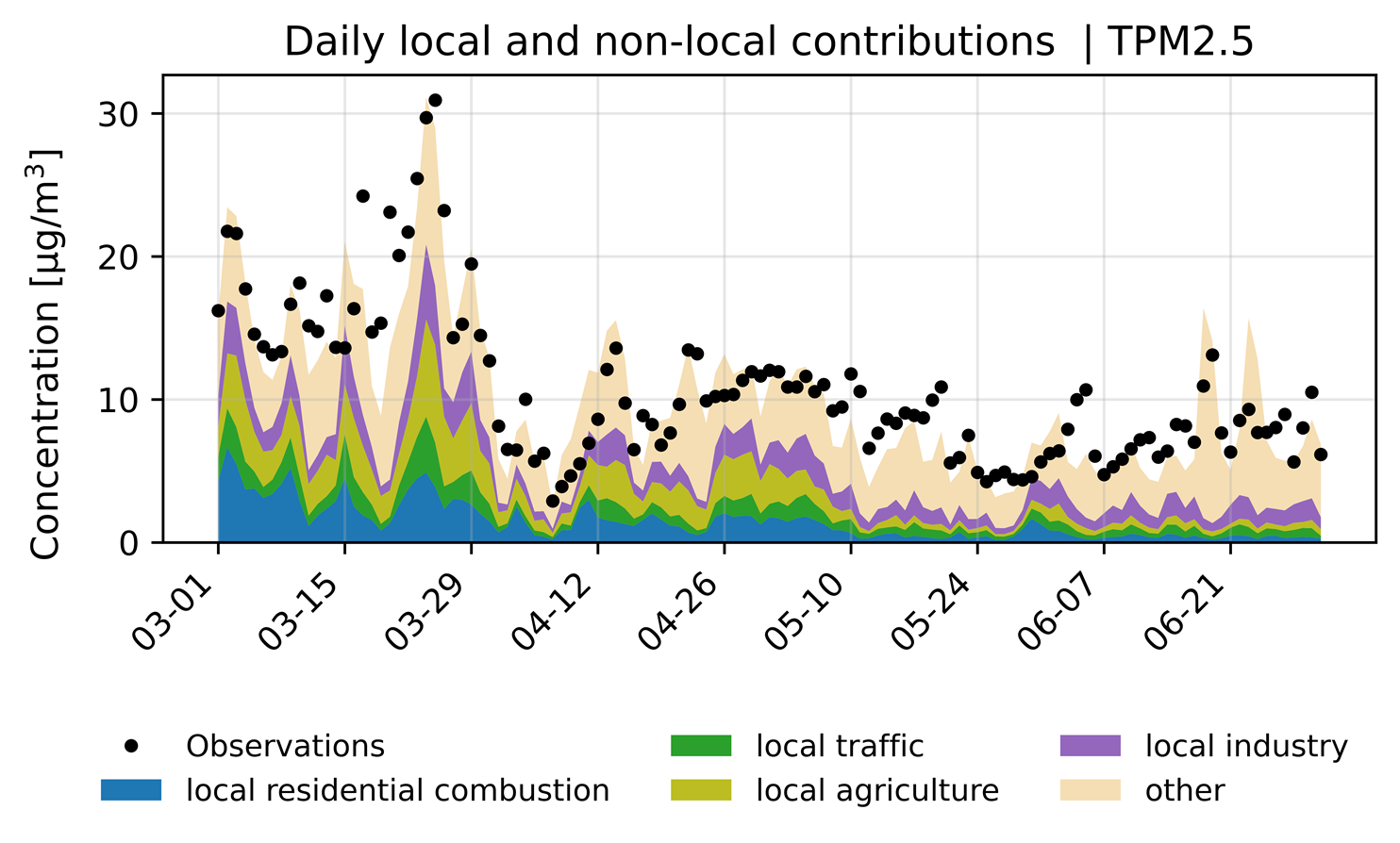
Monitoring consists of both modelling and measurements. Many initiatives already exist in Africa to measure air quality with low-cost and reference sensors. SAMSA builds on these sensor networks through data assimilation, while also providing air quality information for locations without a sensor through accurate modelling. SAMSA can also disentangle contributions from different sources and locations, offering insight into the origin of pollution (see figure for an example).
A key aspect of SAMSA is its local ownership. Capacity building is central to the implementation phase of SAMSA. Students are trained in operating the modelling tools and interpreting the system output. Implementation starts in Kenya, creating a strong foundation for South-South learning with neighbouring countries.
Utilise our existing expertise
Emission inventorying, air quality modelling and health impact studies.
LOTOS and EUROS were developed in the 1990s by the Dutch organisation for Applied Scientific Research TNO and the Environmental Assessment Agency of the Dutch National Institute for Public Health and the Environment (RIVM/MNP) and have been used as models for the study of the atmospheric distribution of photo-oxidants.
The two models were combined in 2004 to give LOTOS-EUROS version 1.0, which has been used by TNO, RIVM and the Royal Dutch Meteorological Institute KNMI. The open-source 2.0 version of the model was released in 2016 to extend the community of users.
During these years, we helped develop the EEA_EMEP emission inventory guidebook for Europe and have worked on projects outside the EU in the Sahara, China, Chile, the Middle East and Colombia. Where previously our international involvement was project-driven, we are now committed to a more structural role in sharing knowledge and insights with countries beyond the EU.
To broaden the user community of LOTOS-EUROS, TNO is developing an accessible version of the open-source model. This version is called LOTOS-Go, an application built as a user-friendly interface to the model. It is designed so that policymakers and those without a scientific background can generate clear insights into the sources of air pollution.
Reducing greenhouse gas emissions also reduces air pollutant emissions. In Kenya, TNO is working with the University of Nairobi CEMA, KEMRI and AQS to evaluate a set of climate mitigation actions, such as transport electrification or industrial emission reductions, based on their potential health and socio-economic co-benefits. The results will inform the Kenyan government and help prioritise the most impactful measures.
Partners beyond our borders
Monitoring air quality and heat stress across Africa is an ambitious goal that requires broad collaboration. TNO takes a coordinating and technical support role, working alongside partners with complementary expertise. Current collaborators include the Ministry of Health Kenya, Kenya Medical Research Institute, AQS East Africa, Nairobi City County, the Dutch Ministries of VWS & BuZa, ICPAC, University of Nairobi CEMA, APHRC and many others. We are grateful for these partnerships and see joint effort as the only effective route to addressing these challenges.
Contact us
-

Bas Henzing
Functie:Business developer air quality monitoring and climate mitigationBas is a social business developer looking for the common good. Having been a researcher for 25 years, he now mainly directs climate and air quality research as a manager. You can contact him with any questions relating to air quality monitoring and climate mitigation. He has expertise in the scientific aspects and policy development within the air pollution and climate dossiers.
We help national and international governments towards cleaner air and verifiable emission reduction strategies.
-
Standplaats:Utrecht - Princetonlaan
-
Email:Email Bas
-
Get inspired
Knowing where a signal comes from: airborne eDNA meets wind modelling

eDNA
Report: 1st Dutch National eDNA Workshop

Environmental DNA: TNO charts a new course for biodiversity monitoring

An innovative view on particulate matter