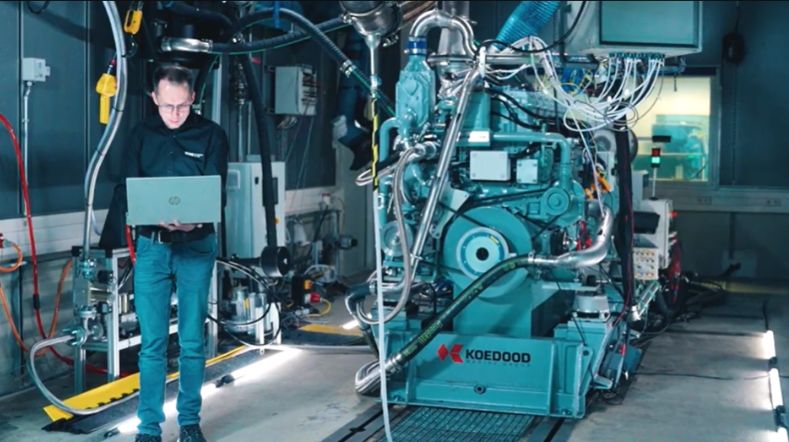
Monitoring actual emissions: report summary
Measurements show that there is a gap between the European standards for motor vehicle emissions and the actual emissions on the road. For years, we have been measuring under real conditions the emission of harmful substances such as nitrogen oxides (NOx), particulates, and CO2 from passenger cars, vans and lorries, ships, and trains.
We fed the results into our models to predict air quality. This allows us to help governments, private parties, and users to make evidence-based decisions on improving air quality.
Accurately measuring emissions in practice
The measurements under real conditions are mainly done with the Portable Emission Measurement System (PEMS) and with the smart variant SEMS developed by TNO. This enables us to monitor emissions and driving behaviour on a daily basis. This data provides us with accurate, real-time data on emissions under all conceivable situations over an extended period of time.
The data is needed to understand under what conditions harmful emissions and CO2 emissions are high or low. With this knowledge, we can advise governments on how to improve air quality through source-based policy. For example, European emissions legislation, national incentive schemes, local environmental zones, and traffic measures. NGOs and environmental organisations also use our measurement data.
Advising consumers and manufacturers
We monitor large numbers of vehicles with relatively simple measuring devices such as SEMS. Owners of fleets of vehicles, both government agencies and companies (including lease companies), and private citizens can have our measuring equipment installed in their cars. This allows us to collect large quantities of measurement data on all types of passenger cars and delivery vans under various conditions. This means a great enrichment of our database and our calculation models with which we make emission forecasts and calculate future scenarios.
In the future, we will be able to tell individual consumers exactly which cars are actually clean and economical under normal use, and what driving behaviour contributes to this. We will be able to help vehicle manufacturers optimise the adjustment of the emission reduction system.
Emission factors for motorways and non-motorway roads to calculate air quality and nitrogen deposition
TNO publishes current data that are used to calculate emissions of environmental pollutants. These emission factors are used for the Standard Calculation Methods (SCM) 1 and 2 for air quality, and for determining nitrogen deposition with the help of the AERIUS calculation tool.
The Dutch government has an obligation to monitor air quality in the Netherlands annually. In addition, government agencies and companies have to determine the consequences of planned projects for air quality. To ensure that it always has the latest input data, the government has been updating air quality models annually since 2006 and publishes these by 15 March. Emission factors for nitrogen deposition, such as ammonia emission factors, are formally outside this obligation. There is considerable overlap between the two emission factors and TNO brings together both sets here with the latest input data.
Download here the emission factors for air quality as at 15 March 2022, and the 2022/2023 AERIUS release.
View our publications and reports
- TNO 2017 R10436 - Chase car study: driving behaviour in the Netherlands, Belgium, France and Germany (pdf)
- TNO 2016 R11178 - Assessment of road vehicle emissions: methodology of the Dutch in-service testing programmes (pdf)
- TNO 2016 R10304 Emission factors Euro 6/VI LD/HD diesel (pdf)
- TNO 2016 R 10040 Composition / payload HD fleet in NL (pdf)
- TNO 2015 R10192 On-road emissions of Euro 5 diesel vans (pdf)
- TNO 2015 R11043 IUC and deterioration of vehicle emissions (pdf)
- TNO 2015 R11041 Euro-V truck PM10 and EC emission factors (pdf)
- TNO 2015 R11005 NH3 emission factors for road transport (pdf)
- TNO 2014 R11088 Update emission model mopeds (pdf)
- TNO 2014 R11309 Emission factors alt. drivelines/fuels (pdf)
- TNO 2014 R11513 CO2 emission from urea consumption HD SCR (pdf)
- TNO 2013 R10148 Emission performance CNG/LNG HD vehicles (pdf)
- TNO 2013 R11083 VERSIT+ emissiefactoren SRM 2013 update (pdf)
- TNO 2013 R11891 Emission performance Euro 6 LD vehicles (pdf)
- TNO 2012 R11316 Uncertainties in road traffic emissions (pdf)
- Dependence on technology, etc. of RW fuel consumption
- TNO 2012 R11099 NOx emission factors Euro-5 diesel cars (pdf)
- TNO-060-UT-2011-01556 Emissions of two-wheeled vehicles (pdf)
- MON-RPT-033-DTS-2009-03840 RW NOx emissions Euro-V trucks (pdf)
- Toelichting SRM1-emissiefactoren en emissiefactoren snelwegen 2009 (pdf)
- 2009 Methodology VERSIT+ emission model (pdf)
- MON-RPT-033-DTS-2008-01376 VERSIT+ EFs SRM 2008 update (pdf)
-
Dutch In-service emissions testing programme for heavy-duty vehicles 2019-2020 | TNO Publications
-
Analysis of the 2019 Flemish remote sensing campaign | TNO Publications
-
On road emissions of 38 petrol vehicles with high mileages | TNO Publications
-
Emissions of five Euro 6d-Temp Light Duty diesel vehicles | TNO Publications
- TNO, Emisia SA, LAT, Heinz Steven: Effect study of the environmental step Euro 5 for L-category vehicles (ET-04-17-619-EN-N), May - 2017 (pdf)
- TNO 2017 R11495 Tailpipe emissions of mopeds in the Dutch fleet (pdf)
- TNO 2013 R10232 Emissions standard and tampered mopeds (pdf)
- TNO 2014 R11088 Emission model for two-wheeled mopeds (pdf)
- TNO 2022 R10409 - Real-world fuel consumption and electricity consumption of passenger cars and light commercial vehicles - 2021 (pdf)
- TNO 2020 R11664 - Real-world fuel consumption of passenger cars and light commercial vehicles (pdf)
- From laboratory to road: A 2018 update of official and “Real-World” fuel consumption and co2 values for passenger cars in Europe (ICCT 2019) (pdf)
- TNO 2018 R10371 - Real-world fuel consumption of passenger cars based on monitoring of Dutch fuel pass data 2017 (pdf)
- TNO 2016 R11258 - Real-world fuel consumption of passenger cars based on monitoring of Dutch fuel-pass data (pdf)
(pdf) - From laboratory to road: A 2016 update of official and “Real-World” fuel consumption and CO2 values for passenger cars in Europe (ICCT 2016) (pdf)
- TNO 2016 R11285 - NEDC - WLTP comparative testing (pdf)
- Dutch CO2 emission factors for road vehicles, Ligterink, N.E., Zyl, P.S. van, and Heijne, V.A.M., TNO 2016 R10449 (pdf)
- From laboratory to road: A 2015 update of official and “Real-World” fuel consumption and CO2 values for passenger cars in Europe (ICCT 2015) (pdf)
- Potential CO2 reduction technologies and their costs for Dutch passenger car fleet, Ligterink, N.E., Zyl, S., Verbeek, M., Spreen, J., TNO 2015 R10730 (pdf)
- TNO 2014 R11063 - Update analysis of real-world fuel consumption of business passenger cars based on Travelcard Nederland fuelpass data (pdf)
- From laboratory to road: A 2014 update of official and “Real-World” fuel consumption and CO2 values for passenger cars in Europe (ICCT 2014) (pdf)
- From laboratory to road: A comparison of official and ‘real-world’ fuel consumption and CO2 values for cars in Europe and the United States, ICCT 2013 (pdf)
- Supporting Analysis regarding Test Procedure Flexibilities and Technology Deployment for Review of the Light Duty Vehicle CO2 Regulations, Service request #6 for Framework Contract on Vehicle Emissions (Framework Contract No ENV.C.3./FRA/2009/0043), TNO 2012 (pdf)
- TNO 2019 R10519 - Dutch In-service emissions testing programme 2015 - 2018 for heavy-duty vehicles: status quo Euro VI NOx emissions (pdf)
- TNO 2019 R10193 - Emissions testing of a Euro VI LNG-diesel dual fuel truck in the Netherlands (pdf)
- TNO 2018 R11328 - Tail-pipe NOx emissions of Euro VI buses in daily operation in the Netherlands (pdf)
- TNO 2018 R10550 - Evaluation of the EU real-world PEMS test for heavy-duty vehicles (pdf)
- TNO 2018 R10313v2 - Tail-pipe NOx emissions of refuse collection vehicles with a Euro VI engine in daily operation in the Netherlands (pdf)
- TNO 2017 R11336 - Emissions testing of two Euro VI LNG heavy-duty vehicles in the Netherlands: tank-to-wheel emissions (pdf)
- TNO-2016-R11270 - The Netherlands In-Service Emissions Testing Programme for Heavy-Duty Vehicles 2015-2016 – Annual report (pdf)
- TNO 2016 R11178 - Assessment of road vehicle emissions: methodology of the Dutch in-service testing programmes (pdf)
- TNO 2014 R10641 Final report HD emission testing 2011-13 (pdf)
- TNO 2014 R11307 NOx and PM of Euro VI Mercedes Citaro bus
- NOx emissions of Euro V and Euro VI HDV (pdf)
- TNO 2013 R10623 On-road emission measurements (pdf)
- TNO 2013 R10960 NL HDV Euro VI in-service testing (pdf)
- TNO 2013 R10753 NL HDV in-service testing report 2012 (pdf)
- TNO 2012 R10561 NL HDV in-service testing report 2011 (pdf)
- TNO 2012 R10466 Emission testing methods for ISC testing (pdf)
- MON-RPT-2010-02777 Real world NOx emissions of Euro V (pdf)
- MON-RPT-2010-02396 Emissions of N2 Distribution Trucks (pdf)
- MON-RPT-033-DTS-2009-03840 On-road NOx emissions of Euro-V (pdf)
- MON-RPT-2010-00969 HDV in-service testing 2006-2009 (pdf)
- Follow-up research into the PN limit value and the measurement method for checking particulate filters with a particle number counter (TNO 2020 R10006) (pdf)
- Investigation into a Periodic Technical Inspection (PTI) test method to check for presence and proper functioning of diesel particulate filters in light-duty diesel vehicles. Part 2 (TNO 2017 R10530) (pdf)
- Investigation into a Periodic Technical Inspection test method to check for presence and proper functioning of Diesel Particulate Filters in light-duty diesel vehicles (TNO 2016 R10735) (pdf)
- Roadworthiness Test Investigations of Diesel Particulate Filters on vehicles (TNO 2015 R10307) (pdf)
- Roadworthiness Test Investigations of Diesel Particulate Filters (TNO 2013 R10160) (pdf)
Download the 2022 report
Read more in the report 'Approaches for detecting high NOx emissions of aged petrol cars during the periodic technical inspection'.
Contact us
-

Martijn Stamm
Functie:Market DirectorI am Martijn Stamm, the Director of Mobility at Mobility & Built Environment Unit. As Director of Mobility, my goal is to define and develop national and international projects, public-private partnerships with industrial and governmental partners, in support of the Unit's propositions in Safe & efficient mobility, Sustainable mobility, and Safe & sustainable maritime & offshore.
-
Standplaats:Helmond - Automotive Campus
-
Email:Email Martijn
-
-

Ann Delahaye
Functie:Project manager Sustainable Transport and LogisticsHello, I'm Ann Delahaye, project manager at Sustainable Transport and Logistics. Projects that make an impact towards sustainable transport, on the road or on water, excite me.
-
Standplaats:Den Haag - New Babylon
-
Email:Email Ann
-
-

Bas Dorsman
Functie:Senior Business Developer - Sustainable VehiclesIn my role as Business Developer for Sustainable Vehicles, my focus is on the sustainability of propulsion technologies for heavy transport vehicles, such as trucks, buses, off-road machines, and inland shipping, as well as stationary systems. My goal is to provide suitable solutions and, where possible, collaborative forms based on market demands from both industrial (private) and government (public) partners that contribute to the sustainability of mobility. In this capacity, I support our customers and partners, both in the Netherlands and abroad, in Europe and the rest of the world.
-
Standplaats:Helmond - Automotive Campus
-
Email:Email Bas
-
-

Emiel van Eijk
Functie:Researcher Fleet Development and Emission FactorsI focus on the evolution of the mobile source fleet - such as road vehicles, construction equipment and ships - and their associated climate and environmental impacts. Based on field inputs, emission factors and policy initiatives, I provide knowledge input for the models used to make emission and deposition calculations at local and national levels.
-
Standplaats:Den Haag - New Babylon
-
Email:Email Emiel
-
-

Erik Hoedemaekers
Functie:Scientist Integrator'As a battery researcher my work mostly focusses on the optimal use of batteries in vehicles and mobility related applications, with the target of lifetime extension and TCO minimisation. This includes battery modelling, the development of estimation and control algorithms (e.g. optimal control of the battery charging process and the estimation of current and future states and performance) and the execution of validations testing of those. Part of these development and validation activities is the realisation of battery pack prototypes and the compliance with (new) regulation, like the inclusion of a battery passport.'
-
Standplaats:Helmond - Automotive Campus
-
Email:Email Erik
-
-

Federico Ribatti
Functie:Project managerIn TNO, I coordinate research projects focused on several technologies applied to sustainable mobility and sustainable storage of energy, both in civil and military domain.
-
Standplaats:Helmond - Automotive Campus
-
Email:Email Federico
-
-

Feye Hoekstra
Functie:Battery ScientistAt TNO I work on sustainable mobility and built environment by using batteries to replace fossil fuels. My research is aimed at using battery management to enhance battery performance and my expertise lies in battery management algorithms, and battery modelling and testing.
-
Standplaats:Helmond - Automotive Campus
-
Email:Email Feye
-
-

Fieke Beemster
Functie:Research ManagerWith the technology that we develop, we help policy makers to form policy in such a way that there is a safe and pleasant living environment where everyone can live, reside and work. We do this from a focus on mobility and on the basis of data and models. In the research group I find it important that everyone can develop themselves and that everyone's contribution is seen and recognised.
-
Standplaats:Den Haag - New Babylon
-
Email:Email Fieke
-
-

Frank Willems
Functie:Principal Scientist at TNO and Professor at TU EindhovenTo accelerate the transition to climate neutral mobility, the development of self-learning control systems for sustainable powertrains is crucial to guarantee minimal energy consumption and operational costs over lifetime and to minimize development time and costs.
-
Standplaats:Helmond - Automotive Campus
-
Email:Email Frank
-
-

Jack Bloem
Functie:Business DeveloperIn my role as a business developer, I work on establishing collaborations between TNO, governmental bodies, and industrial partners with the aim of developing combustion engines for renewable fuels such as hydrogen, methanol, and ammonia. These engines can be applied in the heavy-duty transport sector, as well as in inland shipping, coastal shipping, agriculture, and construction.
-
Standplaats:Helmond - Automotive Campus
-
Email:Email Jack
-
-

Jannette de Bes-van Staalduinen
Function not known-
Standplaats:Den Haag - New Babylon
-
Email:Email Jannette
-
Get inspired
Five tips for driving plug-in hybrid more efficiently
Forces combined: how TNO supports LionVolt to accelerate next-generation battery technology

How Arriva and TNO are shaping the next phase of electric bus transport
From lab to ice sheet: how TNO accelerates battery innovation with Team Polar
Sailing with an engine that emits only water? Mitsubishi and TNO prove it’s possible